Support you barely notice, in a shoe that has quietly put on weight
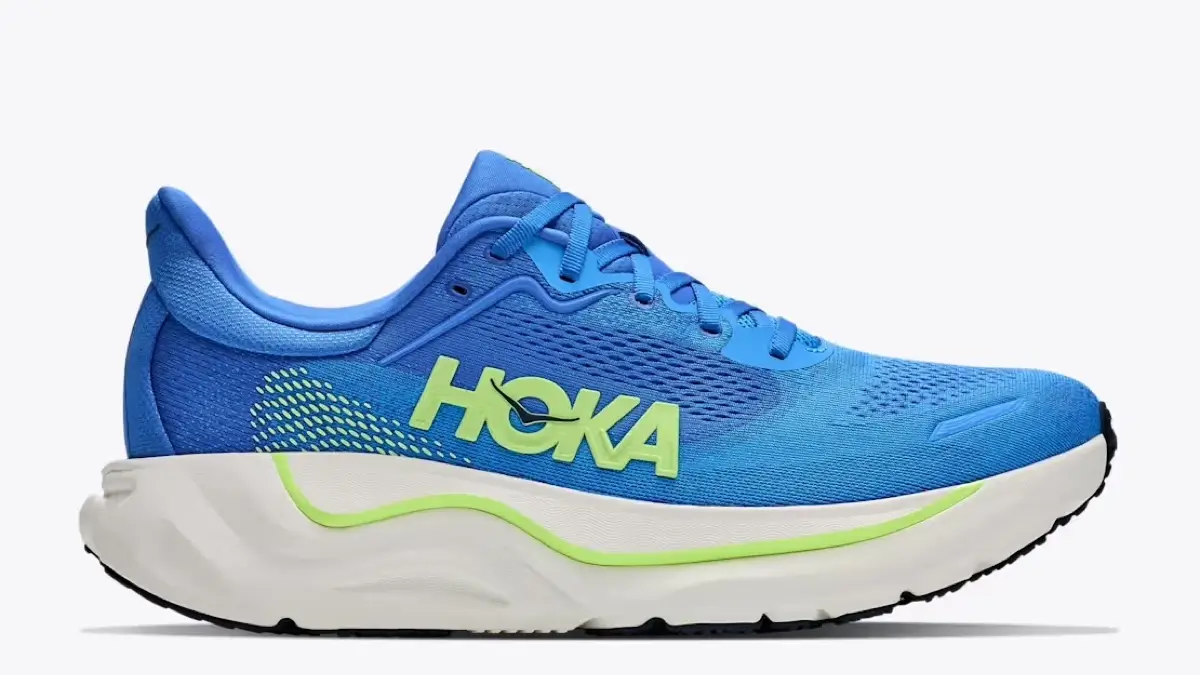
Quick Answer: Hoka Arahi 9 Review: The Arahi 9 is Hoka’s everyday stability shoe, and it is the pick for walkers and easy-paced runners whose feet roll inward but who dislike being pushed around by a support shoe. Hoka builds a firmer H-shaped frame into the foam instead of a wedge under the arch, so it holds you upright without pressing on anything. The midsole is softer and the upper cooler than before. It has also gained weight, which shows on longer outings. Check latest price.
Gender-specific buy links: Men’s version | Women’s version
The Hoka Arahi 9 is the quiet achiever of the Hoka range. It is the brand’s lightest support shoe, it has been around long enough to have a following, and it does not get the attention the Clifton and the Bondi do. It sits below the heavily built Gaviota and alongside the neutral Clifton in the everyday part of the lineup.
What makes it worth knowing about is how the support works. The midsole, meaning the layer of foam under your foot, has a firmer piece molded into it in the shape of an H. That firmer material runs up both sides of the shoe, so it stops the foot tilting either way without a hard wedge digging into your arch. Hoka calls this the H-Frame, and version nine gets an updated one.
Rolling inward, or overpronation, is normal to a degree, and only worth addressing when the arch drops far enough that it starts to tire you out. A shoe like this makes that motion feel controlled rather than corrected. What follows covers the fit, the ride, how it handles a full day of walking and the one place where the Arahi 9 has gone backward.
Specs
Here are the specifications for the Hoka Arahi 9:
| Type | Stability road running and walking shoe |
| Gait type | Overpronation, or anyone who wants a steadier platform |
| Midsole | Dual-density compression-molded EVA, softer than the Arahi 8 |
| Support system | Enhanced H-Frame: a firmer foam molded in an H shape that braces both sides of the foot |
| Stack height | Not published by Hoka. Independent measurement of the Arahi 8 put the heel near 40 mm, and the 9 is comparable. Treat as approximate |
| Heel-to-toe drop | Disputed: Hoka lists 8 mm, while one independent lab measured 10.3 mm on its sample |
| Weight | Approximate: Hoka lists 284 g (about 10 oz) for the men’s shoe; independent weighings range from about 9.7 oz to 9.8 oz. Roughly 8 g heavier than the Arahi 8 |
| Upper | Engineered mesh reinforced on the inner side, with haptic print, 3D silicone touchpoints and reflective detailing |
| Outsole | Super-abrasion rubber, chosen for durability |
| Widths | Standard and wide |
| Best use | Daily easy runs, walking, standing and time on your feet |
| Price | $155 at launch in August 2026. Check latest price |
Pros
These are the Arahi 9’s real strengths:
- The support is genuinely unobtrusive. Because the firmer foam sits in the walls of the midsole rather than under your arch, there is no pressure point and no sense of being pushed sideways.
- The midsole is softer than the Arahi 8, which makes it kinder on concrete without giving up the steady feel.
- The upper runs cooler than the previous version, which matters on a shoe people wear all day.
- The super-abrasion rubber outsole is among the more hard-wearing on any road shoe, so the sole outlasts most of the competition.
- Standard and wide fittings are both offered, which is important in a support shoe.
Cons
These are the drawbacks worth weighing:
- It has gained weight. Around 10 oz is not light for a shoe that used to be sold on being the nimble support option.
- The compression-molded EVA is a dependable foam rather than an exciting one, so there is little bounce and little help with forward motion.
- Published figures do not agree on the drop, which makes it harder to know exactly what you are standing on.
- Hoka does not publish stack heights for this shoe, so you are relying on independent measurement.
- At $155 it is priced against livelier shoes that do more for the money if speed matters to you.
What is new versus the Hoka Arahi 8
The H-Frame has been updated. Hoka describes it as enhanced, and the practical effect is a slightly broader, more confident brace on both sides of the foot. This is the part of the shoe doing the support work, and improving it without adding a wedge under the arch is the right way to make a support shoe more effective.
The midsole foam is softer. Hoka has kept the dual-density compression-molded EVA construction, meaning two firmnesses of the same basic foam molded together, but tuned the softer part to give more. Anyone who found the Arahi 8 a bit unyielding on hard ground should notice the difference, particularly at the heel.
The upper is reworked and runs noticeably cooler, with reinforcement concentrated on the inner side where a rolling foot pushes hardest. Hoka has added haptic print, silicone touchpoints and reflective details, the kind of changes that read as cosmetic but do help the shoe hold the foot. The cost of all this is about 8 g of extra weight, which on a shoe already near 10 oz is the wrong direction.
Who should buy the Hoka Arahi 9
This is the shoe for someone who needs support and hates feeling it. If a traditional support shoe has ever given you a sore arch or made you feel like your foot was being levered outward, the Arahi’s approach will be a relief. You get the same steadying effect from the shape of the foam, with nothing pressing into you.
Walkers and people on their feet for hours are the natural audience. The combination of a soft midsole, a broad frame and a sole that resists wear is exactly what a long day on concrete asks for, and the fact that the weight matters less at walking pace removes the shoe’s main drawback.
It also suits runners doing steady, unhurried miles, especially those who have been told to look at stability shoes and have found the usual options stiff. The wide fitting broadens the appeal again, because flattening arches and broad feet often come as a pair and a lot of support shoes are only sold in one width.
Not sure this is the right shoe? Use our free Shoe Finder to narrow your choices by fit, cushioning, support and how you plan to use the shoe.
Who should probably skip it
If you want to run fast, this is not it. The foam is a sensible everyday compound with very little spring, and near 10 oz of shoe makes quick turnover hard work. There is nothing wrong with that in a shoe designed for easy miles, but it means the Arahi will never be the pair you reach for on a tempo day.
It is also more shoe than a mildly pronating runner needs, and it is not enough shoe for someone who needs serious control. Those are opposite problems with opposite answers. And if you are shopping mainly on price, there are support shoes at half the money that will do a perfectly good job for walking.
Better starting points in those cases:
- Brooks Adrenaline GTS 25: the best-known support shoe going, with guidance along both sides of the foot and a broad run of widths (check price | read review).
- Asics GT-1000 15: mild support for a lot less money, and a sensible pick if your arches only drop a little (check price | read review).
- Asics Gel-Cumulus 26: the shoe to buy if it turns out you do not need support at all and just want a comfortable neutral trainer (check price | read review).
How does the Hoka Arahi 9 fit?
The Arahi 9 fits like a Hoka: secure through the midfoot, a touch snug at the front and with a heel that holds well. The new upper is cooler and a little more accommodating than the Arahi 8’s. Here is what to expect when you try a pair.
Fit and sizing
Take your usual size. Hoka’s shoes have a reputation for a slightly narrow toe box, and while the Arahi is not the worst offender in the range, anyone with a broad forefoot should plan on the wide fitting rather than hoping the standard version will stretch.
The wide is a real width increase rather than a longer shoe, which is the right way to do it. It is worth trying if your feet swell through the day, because the reinforced inner side of the upper is firmer than the rest and can feel tight against a swollen foot by the evening.
Upper and step-in comfort
The upper is engineered mesh with extra structure on the inner side, where a foot rolling inward pushes hardest. Hoka has added haptic print, which is a raised pattern printed onto the mesh, and small silicone touchpoints inside, both of which stop the foot sliding without needing stitched overlays that can rub.
Step-in comfort is good and noticeably cooler than the previous version, which is a genuine improvement on a shoe many people wear for eight hours at a time. The heel collar is well padded and the tongue sits flat. There is also reflective detailing, which is a practical touch for early-morning and evening walks.
How does the Hoka Arahi 9 perform?
The Arahi 9 is a comfortable, dependable shoe that does its best work at easy paces and on foot. It is not quick and does not pretend to be. The sections below cover how the cushioning feels, what the ride is like and how the support actually works.
Cushioning and ride
Hoka does not publish stack heights for the Arahi, but independent measurement of the previous version put the heel close to 40 mm, and this one sits in the same territory. That is a tall shoe by ordinary standards, though modest for Hoka, and it means there is plenty of foam between you and a concrete sidewalk.
The softer foam is the main improvement this time. Compression-molded EVA is the everyday workhorse of midsole materials: durable, predictable and not especially lively. Here it is tuned softer than before, so landings feel more forgiving while the firmer H-shaped sections keep the shoe from feeling vague.
Ride and running performance
Hoka shapes its soles with a rocker, meaning a curve that tips you from landing to push-off, and the Arahi uses a moderate one. It makes the stride feel smooth and rolling rather than flat, which is genuinely useful on tired legs and at the end of a long day.
What you will not get is any sense of return. The foam absorbs far more than it gives back, and combined with the weight that makes faster running feel like effort for its own sake. Treat it as an easy-day shoe, pair it with something lighter for quick work, and it is a pleasant thing to run in.
Stability and support
This is a stability shoe and the mechanism is worth understanding, because it is unusual. The H-Frame is a firmer foam molded into an H shape within the midsole, with the two uprights of the H running along the inside and outside walls of the shoe. When your foot starts to tilt, it runs into that firmer wall and stops. Nothing has to press up into the arch to make it happen.
The result is support that a lot of people cannot feel at all, which is the highest compliment a stability shoe can get. Be clear about what it does, though: it can make a foot that rolls inward feel steadier and less tired, and it can reduce how far the arch travels. It does not correct anyone’s gait, and no shoe should be sold as doing so. Persistent or worsening pain is a reason to see a podiatrist or physical therapist rather than to buy a different shoe.
Outsole, grip and durability
Hoka uses super-abrasion rubber here, a hard, dense compound chosen specifically to resist wear, and it is one of the shoe’s standout qualities. On a support shoe that many people will walk hundreds of miles in, an outsole that refuses to wear smooth is worth more than a few grams saved.
Grip on dry pavement and indoor floors is dependable, and acceptable in the wet, though hard rubber is never as tacky as a soft compound. Durability is a strong point: the usual 300 to 500 mile figure is only a broad guideline and varies with your weight, stride and surfaces, and no shoe has a guaranteed lifespan, but this outsole routinely outlasts the upper.
Is the Hoka Arahi 9 good for walking?
Yes, and walking may be where it makes the most sense of all. The weight that holds it back on a run is almost irrelevant at walking pace, so what is left is a soft, tall, steady shoe with a rocker that rolls you along and an outsole that will not wear out. For a few miles a day or a long day of sightseeing, that is a very good combination.
It also works for standing on hard floors, where the depth of foam and the firmer side walls both earn their keep: your foot is cushioned but it is not sinking and tilting after six hours. The wide fitting matters here, because feet swell through a shift and the reinforced inner panel can feel snug by the end of it. A thin orthotic fits once the insole comes out, though a bulky one is better suited to the wide version.
Hoka Arahi 9 vs. Hoka Arahi 8
Here is how the two generations compare:
Feature | Arahi 9 | Arahi 8 |
Support | Enhanced H-Frame | H-Frame |
Midsole | Dual-density compression-molded EVA, softer tuning | Dual-density compression-molded EVA, firmer |
Weight | About 284 g as listed, roughly 8 g heavier | About 276 g as listed |
Upper | Cooler engineered mesh with haptic print and silicone touchpoints | Engineered mesh, warmer in use |
Widths | Standard and wide | Standard and wide |
Buy the Arahi 9 when you want the softer ride and the cooler upper, both of which make it the better shoe for long days on your feet.
Buy the Arahi 8 when you find it discounted, you prefer a firmer feel, or the extra few grams matter to you. The support system is fundamentally the same.
Hoka Arahi 9 Alternatives
The weight is the Arahi’s weak spot, so if that is what bothers you the Mizuno Wave Inspire 22 is the direct counter. It creates its steadiness with a plate buried in the arch rather than with foam walls, which makes for a lighter and noticeably more responsive shoe, and it comes in wide fittings as well.
At the other end, anyone who finds the Arahi’s support too gentle should look at the Brooks Beast GTS 26. It is a far more structured shoe, built for heavier walkers and orthotic users who want real control, and it offers a generous run of widths. It is heavier still, which is the honest cost of that much structure.
And the previous generation remains a strong buy. The Arahi 8 uses the same H-Frame idea with firmer foam and a few grams less weight, so anyone who prefers a more connected feel underfoot loses very little by taking the discount.
- Mizuno Wave Inspire 22: lighter, livelier support built around a plate rather than foam walls, in standard and wide (check price | read review).
- Brooks Beast GTS 26: much more structure for heavier walkers and orthotic users, with a wide range of fittings (check price | read review).
- Hoka Arahi 8: the same support approach with firmer foam and slightly less weight, usually at a discount (check price).
Price and value
At $155 at its August 2026 launch, the Arahi 9 is priced in line with the mainstream support shoes it competes against. What the money buys is a genuinely comfortable way to get stability, a softer midsole than before, two width options and an outsole that will still be there long after the upper has given up. What it does not buy is lightness or any sense of speed. For a walker or an easy-paced runner that is a fair deal. For anyone wanting one shoe that also handles faster running, it is not.
Final verdict
Best for: walkers, people on their feet all day and easy-paced runners whose feet roll inward and who want support they cannot feel.
Avoid if: you want a light or responsive shoe, you need serious motion control, or your pronation is mild enough that a neutral trainer would be simpler.
Fit: true to size, secure and slightly snug at the front, with standard and wide fittings available.
Verdict: softer, cooler and still one of the least intrusive support shoes you can buy, held back only by a weight figure that keeps creeping upward. Check the latest price.
Frequently Asked Questions for Hoka Arahi 9
The H-Frame is a firmer piece of foam molded into the midsole in the shape of an H, with its two uprights running along the inside and outside walls of the shoe. It braces the foot from both sides so it cannot tilt far, without a wedge pressing into the arch.
Yes. Hoka offers the Arahi 9 in standard and wide fittings. The wide is worth considering if your feet swell through the day, because the reinforced inner side of the upper is firmer than the rest of the mesh.
Hoka lists the shoe at an 8 mm drop, while one independent lab measured 10.3 mm on its own sample. Measured figures often differ from listed ones because of how the insole and outsole are counted, so treat the number as approximate.
Both are Hoka support shoes. The Arahi is the lighter, more everyday option with a moderate platform. The Gaviota is heavier, taller and more heavily built, aimed at runners and walkers who want maximum cushioning and more structure.
Yes. Because the firmer foam sits in the side walls rather than under the arch, most neutral runners find it simply feels like a steady, cushioned trainer rather than a corrective one. It is a common choice for people who want a planted platform without needing support.
It is one of the better options for it. There is a lot of foam underfoot, the firmer side walls stop the foot tilting after hours of standing, and the hard-wearing outsole copes with constant use. Try the wide fitting if your feet swell through a shift.