Layers of real cushioning under a statement sneaker that’s weighty
Quick Answer: New Balance 9060 Review: The New Balance 9060 is a lifestyle sneaker that walks far better than its styling suggests. Under the wavy, Y2K-inspired sole sit three cushioning systems taken from New Balance’s running shoes, and the result is a genuinely comfortable shoe for walking, standing and travel. What holds it back is weight and shape. It is a heavy, bulky shoe that runs snug through the toes, so it suits fashion-first buyers more than distance walkers. Check latest price.
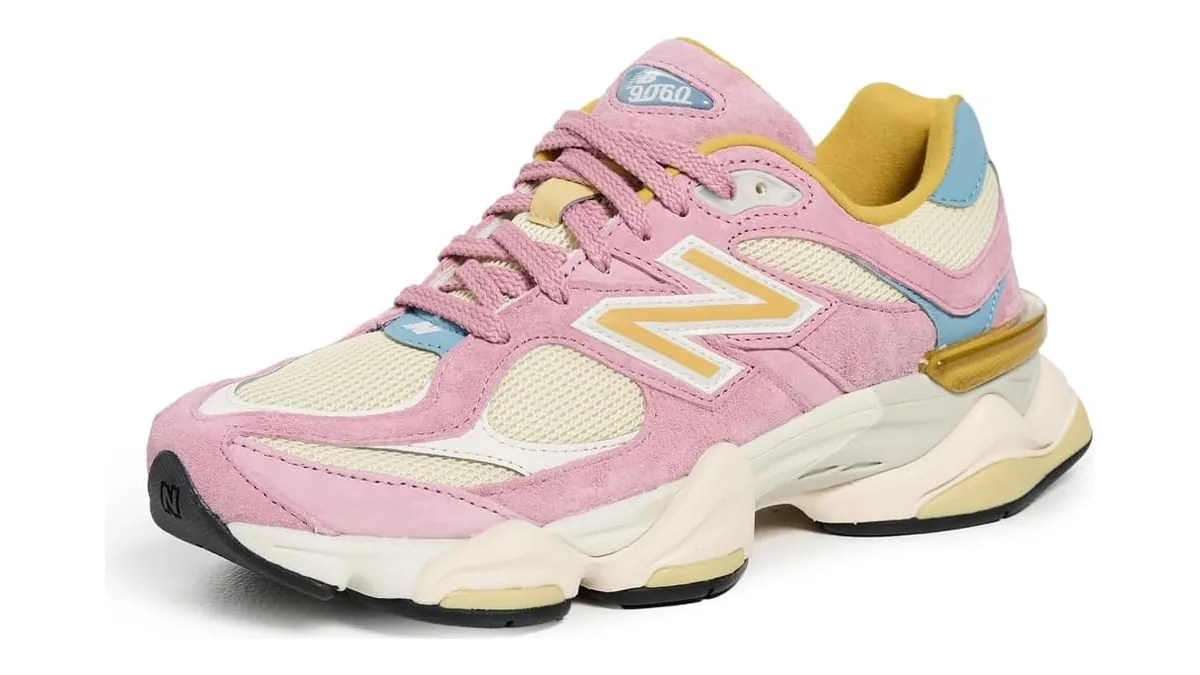
The New Balance 9060 is a lifestyle shoe, not a running shoe, and it is important to start there. New Balance introduced it in 2022 as a deliberately exaggerated take on its 99X running models from the 1990s and early 2000s, with the classic shapes stretched and warped into something that belongs to the Y2K revival rather than a track.
What makes it worth reviewing on a site about feet rather than fashion is what New Balance put underneath. The 9060 uses ABZORB, SBS and ENCAP, three cushioning technologies developed for running shoes, arranged in a sculpted pod midsole. Most fashion sneakers put a slab of flat foam under a nice-looking upper. This one does not.
So the honest framing is this: the 9060 is a shoe people buy because they like how it looks, and then keep wearing because it turns out to be comfortable. If you are choosing purely on comfort you would buy something else. If you want a shoe you can wear all day that also looks like a sneaker rather than orthopaedic footwear, it earns its place.
Specs
Here are the specifications for the New Balance 9060:
| Type | Lifestyle sneaker, neutral |
| Best for | Everyday wear, city walking, standing, travel |
| Upper | Mesh with pigskin suede overlays |
| Midsole | Sculpted dual-density pod midsole using ABZORB and SBS cushioning |
| Heel unit | ENCAP, a firm outer shell around a softer foam core |
| Outsole | Rubber |
| Design lineage | Built from 99X running shoe components, reshaped in a Y2K style |
| Widths | Standard fitting on most colourways |
| Weight, stack and drop | Weight of approximately 15.3 oz (432g), a heel stack height of 37.3 mm, a forefoot stack height of 26.0 mm |
| Price | New Balance introduced the 9060 in 2022, and standard colourways have typically listed at about $150 to $160. Limited editions and collaborations have cost more, so treat this as approximate rather than a single launch figure. Check latest price |
Pros
Here is what the 9060 gets right:
- Serious cushioning for a fashion sneaker. Three separate systems under your foot, all borrowed from running shoes, is not something you find in this category.
- Shock absorption where it counts. ABZORB sits under the heel, so the impact of walking on concrete gets softened instead of travelling up your leg.
- Stable underfoot despite the height. The sole is wide and the pods spread the base out, so it does not feel tippy.
- The upper is well made. Mesh keeps the weight down and the suede overlays hold their shape rather than creasing into a mess.
- Cushioning that lasts. ABZORB does not flatten as quickly as ordinary EVA foam, so the shoe stays comfortable for longer than a cheap sneaker.
- It looks like a sneaker. That sounds obvious, but for anyone who wants comfort without wearing something that reads as medical, it is the whole point.
Cons
And here is where it falls down:
- Heavy. All that sole material adds up, and by the end of a long day you feel it in your legs.
- Snug through the toes. The tapered shape looks great and gives narrow-footed people a perfect fit, and it is unforgiving on wide feet.
- Standard width only on most colourways, so there is no easy fix for the above.
- Bulky. The sole is tall and wide, and it looks out of place with anything remotely formal.
- Expensive for a shoe with no technical performance claims. You are paying a design premium.
- The mesh and suede upper is not weatherproof, and light suede marks easily.
What is new: the 99X lineage and the 9060R
The 9060 does not have a version one and a version two the way a running shoe does, so the useful comparison is with the shoes it borrows from. New Balance built it out of parts from its 99X family, the 990 and its relatives, which are the shoes that gave New Balance its reputation for comfort. The sway bars along the side, the sculpted midsole and the ENCAP heel are all recognisable from those models, stretched and exaggerated.
ENCAP is worth explaining because it is the oldest idea in the shoe. It is a firm polyurethane rim wrapped around a softer foam core, so the soft part cushions and the firm part stops it squashing out sideways. It is why the 9060 feels supportive at the heel despite having no support features in the technical sense.
New Balance has since introduced a 9060R, described as a next-generation take on the shape. The standard 9060 remains widely available and is the model this review covers. If you see both and cannot tell them apart online, the safest approach is to buy the one whose product page lists the cushioning you have just read about, since the R is a different construction rather than a colour update.
Who should buy the New Balance 9060
Buy it if you want an everyday shoe that is genuinely comfortable and does not look like a comfort shoe. That combination is rarer than it should be. Plenty of people reach an age where their feet want cushioning and their taste has not changed, and the 9060 solves exactly that tension.
Buy it if your feet are average or narrow. The tapered shape that frustrates wide-footed buyers is a beautifully secure fit if your foot suits it, and the shoe holds the midfoot well without needing the laces cranked tight.
And buy it if your day involves a lot of standing and walking on hard surfaces in ordinary clothes. Commuting, city days, teaching, retail, conferences, travel. The cushioning is real and it holds up over hours, which is more than most fashion sneakers manage.
Who should probably skip it
Skip it if you have wide feet. This is the clearest dividing line with the 9060. The toe box tapers, most colourways come in one width, and a shoe that pinches across the toes for eight hours a day is not a shoe you should buy however good it looks.
Skip it too if weight matters to you, or if you want a shoe for walking real distances. The 9060 is a heavy shoe and it has no rocker shape to help roll you through each step, so a long walk in it is more work than it needs to be. Those readers are better off with:
- Brooks Ghost Max 3: a genuinely wide, deeply cushioned shoe with a rocker that does the rolling for you, for anyone whose priority is distance rather than looks (check price | read review)
- Hoka Clifton Pro: much lighter, much softer and built for actual miles, if the 9060’s weight is what puts you off (check price | read review)
- Skechers GO WALK 8: featherlight and cheap, the opposite end of the scale for readers who simply want easy comfort with no styling agenda (check price | read review)
How does the New Balance 9060 fit?
The 9060 fits snugly, and that is the most important thing to know before ordering. It is true to length for most people but tapered at the front, so the shape of your foot matters more here than your usual size does. Narrow and average feet get a clean, secure fit. Wide feet get a shoe that presses.
Fit and sizing
Take your normal New Balance size unless you have a broad forefoot, in which case going up half a size is the usual workaround. It is a compromise rather than a fix, because you gain width by gaining length, and a shoe that is too long slides at the heel.
Most colourways come in a standard width only. If you have been buying 2E shoes for years, this is not the model to break that habit with, and New Balance has plenty of walking and running models that do offer the width you need.
Upper and step-in comfort
The upper is a mesh base with pigskin suede overlays laid over the top. The mesh keeps the shoe from feeling stifling and the suede panels give it structure, which is why the 9060 holds its shape instead of collapsing into folds after a month.
Step-in comfort is good. There is generous padding around the collar and tongue, and no hard seams in the usual trouble spots. The interior feels plush the moment you put the shoe on, which is a fair reflection of how it feels an hour later. The one caution is the suede, which marks in rain and needs a brush rather than a wipe.
How does the New Balance 9060 perform?
The 9060 was not designed for athletic performance and we are not going to judge it as though it were. What it is designed for is being worn all day, and on that measure it does considerably better than its category usually manages.
Cushioning and feel underfoot
Three things work together here. ABZORB is a rubbery compound that absorbs impact, and it sits where your heel lands. SBS is a softer foam layered alongside it. ENCAP wraps the heel in a firm shell so the soft parts cannot squash out sideways. The word New Balance uses is dual-density, which simply means two firmnesses of material in one midsole.
Underfoot that reads as cushioned but controlled. It is softer than a plain foam sneaker and firmer than a modern max-cushion running shoe, and it does not feel mushy or unstable. The practical benefit is that it stays comfortable across a long day rather than feeling great for an hour and then flattening out.
Ride and everyday performance
Walking in the 9060 is smooth but effortful. The sole is flat rather than rockered, so nothing helps you roll from heel to toe, and the shoe’s weight means each step costs a little more than it would in a lighter walker. Over a mile or two around a city, that is invisible. Over five miles it is not.
Running is not what this shoe is for, and the weight alone rules it out for anything beyond catching a bus. Treat it as a walking and standing shoe with sneaker styling and you will be happy with it.
Stability and support
This is a neutral shoe. There is no medial post, the firmer wedge that stability shoes use to slow the inward roll of the foot, and no guidance system. What it does have is a broad, sculpted base and the ENCAP heel, which together give it a planted feel that a lot of chunky sneakers lack.
Read that as passive stability rather than support. The shoe is hard to tip over. It will not resist a foot that rolls inward and it will not change your gait, because no shoe does. If your arches ache regularly or you have been told you need support, a properly supportive shoe or a conversation with a podiatrist is the right route, and a lifestyle sneaker is not.
Outsole, grip and durability
The outsole is rubber with a shallow, mostly flat pattern. On pavement, indoor floors and shop tiles it grips fine. On wet grass, gravel or anything loose it does not, because there is no meaningful tread depth. This is a pavement shoe.
Durability is a strength. Rubber outsoles outlast exposed foam, ABZORB holds its cushioning better than plain EVA, and the structured upper keeps its shape. The part that ages first is the light-coloured foam on the midsole sidewall, which scuffs and yellows, and the suede, which marks. Neither affects how the shoe feels, only how it looks.
Is the New Balance 9060 good for walking?
For everyday walking, yes, and better than you would expect from the styling. The cushioning is real, the base is stable and the shoe holds up over the kind of walking most people do: a couple of miles broken up across a day, on pavement, in ordinary clothes. Plenty of people wear these to work and stand in them for hours without complaint.
For deliberate walking, meaning several miles at a steady pace, it is a poor choice. The weight is the main problem and the flat sole is the second, because without a rocker shape your calves and ankles do more work over each step. Our line would be around three miles: below that the 9060 is a perfectly good walking shoe, above it you would be happier in something built for the job.
Standing all day in the 9060
Standing is arguably the 9060’s best use case, because weight matters much less when you are not lifting your feet repeatedly. What matters instead is how well the shoe spreads pressure, and the layered midsole does that well. The heel in particular gets more protection than almost any other fashion sneaker offers.
Two practical notes. The insole lifts out, so you can drop in your own if you want more arch shape than the standard one gives, and the shoe has enough interior volume to accept a modest orthotic. But the snug forefoot means a bulky custom device will make an already tapered toe box tighter, so try before you rely on it.
If you are on a hard concrete floor for a full shift and comfort is the only criterion, a purpose-built work or walking shoe will serve you better. If you need to look presentable and stay comfortable, this is a strong compromise.
9060 vs the New Balance 990 family
Most people cross-shopping the 9060 are also looking at a 990, so here is the difference in practical terms.
New Balance 9060 | New Balance 990 family | |
Styling | Exaggerated Y2K shape, chunky | Classic, restrained |
Cushioning | ABZORB, SBS and ENCAP in a sculpted pod midsole | ABZORB and ENCAP in a conventional midsole |
Fit | Snug, tapered toe, standard width | Roomier, with multiple widths on most models |
Best for | Buyers who want the look | Buyers who want the fit |
Buy the 9060 if the styling is what drew you and your foot is not wide. Buy a 990 if you want the same cushioning heritage in a shoe you can order in a wide fitting and wear for longer walks.
New Balance 9060 Alternatives
The 9060 offers cushioning inside a shoe you would choose on looks. Each alternative below drops part of that in exchange for something more practical.
Hoka Transport 2 is the closest thing to a like-for-like swap for someone who liked the chunky look but wants a shoe that works outdoors. It has a deeper, softer midsole, a Vibram outsole that grips wet ground, and a rocker that makes distance easier. It is plainer, and it is a shoe you wear rather than a shoe you show (check price | read review).
Where the 9060 keeps its cushioning controlled, the On Cloudmonster 3 goes the other way with a tall, bouncy stack and a striking silhouette of its own. It suits readers who wanted the statement look but also want a shoe they can run in, and it is considerably lighter (check price | read review).
The value pick is the Skechers Arch Fit 2.0, which costs a fraction as much and gives you something the 9060 does not: a properly contoured insole under the arch. It is a plain shoe with none of the design appeal, so this is a straight trade of style for support and money (check price | read review).
Price and value
Standard 9060 colourways have typically listed at about $150 to $160 since the shoe arrived in 2022, with collaborations and limited runs asking more. That is a lot for a sneaker with no performance claims, and it is roughly what a good daily running shoe costs.
The value argument rests on two things: the shoe is genuinely comfortable rather than just fashionable, and it is built to last, with a rubber outsole and cushioning that holds up rather than packing down in a season. Judged against other lifestyle sneakers at the same price, it gives you far more shoe. Judged against a purpose-built walking shoe, you are paying a premium for the styling, which is a perfectly reasonable thing to do as long as you know you are doing it.
Final verdict
Best for: people with average or narrow feet who want a comfortable, cushioned everyday shoe that still looks like a proper sneaker.
Avoid if: you have wide feet, you dislike heavy shoes, or you want a shoe for walking several miles at a time.
Fit: true to length, snug and tapered through the toes, standard width on most colourways. Half a size up is the usual workaround for a broad forefoot.
Verdict: the 9060 is a fashion sneaker with a running shoe’s cushioning underneath, and that is an unusually good combination for anyone who spends their day on their feet in normal clothes. It is heavy, it is bulky and it will not suit a wide foot, but the comfort is real and it holds up over years rather than months. Buy it for the look, and enjoy the fact that it also happens to be a good shoe. Check the latest price.
Frequently Asked Questions for New Balance 9060
Yes. The layered midsole uses ABZORB, SBS and an ENCAP heel unit, all borrowed from New Balance’s running shoes, which gives it far more cushioning than a typical fashion sneaker. The main limitation over a full day is weight rather than comfort.
They run true to length but narrow through the toes. If you have a broad forefoot, going up half a size is the common workaround, though it leaves you with a shoe that is slightly long.
You can, but you should not make a habit of it. It is a lifestyle shoe with no performance claims, it is heavy and it has no rocker to help you roll through each step. New Balance makes plenty of proper running shoes for that.
ABZORB is New Balance’s impact-absorbing compound. It sits under the heel and softens the jolt of each step on hard ground, and it holds its cushioning longer than ordinary EVA foam does.
Most colourways are standard width only. If you regularly buy wide fittings, look at New Balance’s walking and running lines instead, where multiple widths are standard.
The 9060 is a reworked, exaggerated version of the 99X shape with an extra cushioning layer and a snugger, tapered fit. The 990 is the classic original: more restrained to look at, roomier, and available in more widths.
Brush the suede overlays with a soft suede brush rather than wiping them, and clean the mesh with mild soap and a damp cloth. Keep them out of the washing machine, and let them dry away from direct heat so the adhesives are not affected.