Exceptional ground feel and toe room, in an upper that may not last
Quick Answer: Vivobarefoot Primus Lite IV Review: The Vivobarefoot Primus Lite IV is a proper barefoot shoe: a sole about 2 mm thick, no heel lift, a toe box wide enough for your toes to spread and almost nothing else. It is light, it breathes, and the ground feel is among the best available, which makes it excellent for the gym and for city wear. What you give up is protection and lifespan, since the thin vegan upper is not built for rough ground or years of daily use. Check latest price.
Vivobarefoot is one of the original barefoot shoe companies, and the Primus Lite is its everyday training model. The Primus Lite IV is the current version, which arrived in the US in early 2024, and it sits at the centre of the range: less rugged than the trail models, less dressy than the leather ones, and the one most people buy first.
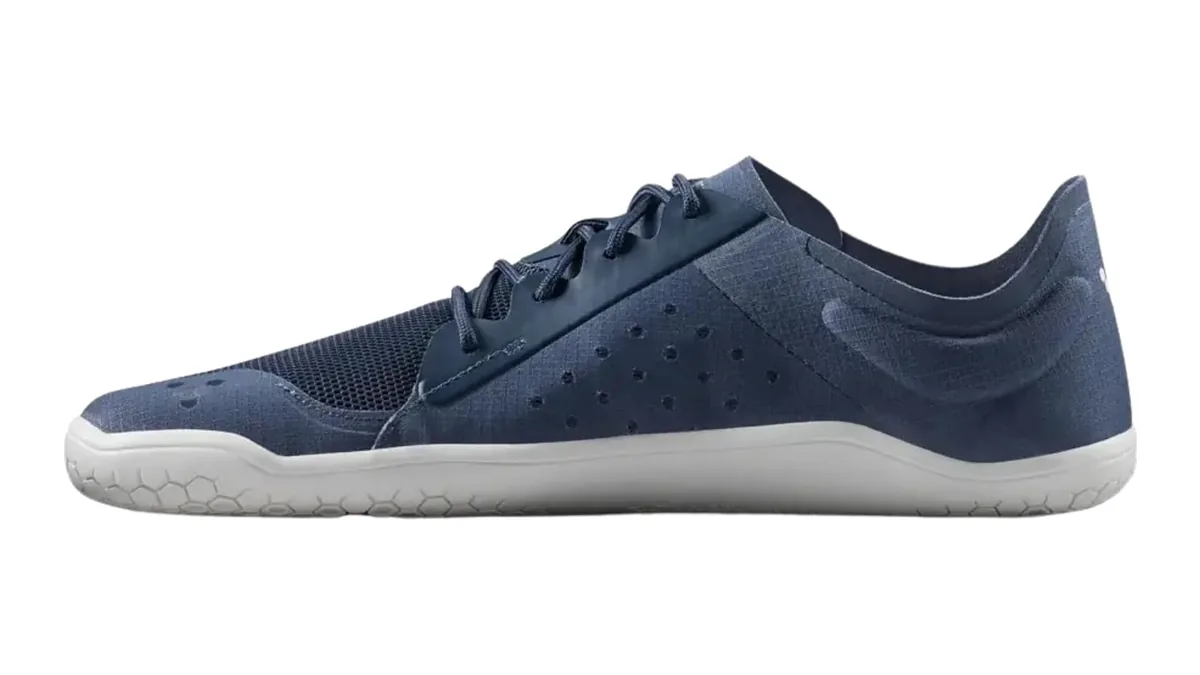
A word on what barefoot means here, because Vivobarefoot takes it further than most. The sole is roughly 2 mm thick. That is a couple of sheets of card between your foot and the pavement. There is no cushioning, no arch shaping, no heel lift and no structure of any kind. The shoe exists to protect the skin on your feet and to be legal indoors, and that is genuinely all it is trying to do.
That makes it a specialist rather than a general-purpose shoe. If you already wear minimal footwear and want the real thing, it is close to the top of the category. If you are coming from a cushioned trainer, please read our guide to zero-drop shoes first, because switching straight into something this thin is how people end up with sore calves and Achilles tendons.
Specs
Here are the specifications for the Vivobarefoot Primus Lite IV:
| Type | Barefoot training shoe, neutral |
| Best for | Gym and functional training, city wear, foot strengthening |
| Sole thickness | About 2 mm, an independently measured figure. Thin enough to feel the texture of what you are standing on |
| Heel-to-toe drop | Zero, so your heel and toes sit at the same height |
| Toe box | Wide and foot-shaped |
| Weight | About 235 g per shoe in a men’s EU 44, independently measured rather than a manufacturer figure |
| Upper | Breathable mesh, vegan, made partly from recycled materials |
| Outsole | Thin flexible rubber with a low-profile hexagonal pattern |
| Widths | One width, on a foot-shaped last that is wider than a standard shoe |
| US availability | The women’s version became available in the US on 4 March 2024 |
| Price | Vivobarefoot does not publish a single US launch price we could verify, and retailer pricing varies, so we are not quoting a figure. Check latest price |
Pros
These are the reasons barefoot enthusiasts keep coming back to this shoe:
- Outstanding ground feel. At about 2 mm the sole lets you sense texture and slope through your feet, which is the entire point of the category and few shoes do it this well.
- Genuinely wide toe box. Your toes can splay rather than being funnelled into a point, which for wide feet and bunions is transformative.
- Very light. At around 235 g per shoe it is noticeably lighter than most minimal trainers, so it feels like almost nothing on the foot.
- Extremely flexible. You can roll the shoe up, which means your foot bends naturally instead of fighting a stiff sole.
- Quick to get on and off, which matters more than you would think in a gym.
- Vegan and made partly from recycled materials, if that is part of your decision.
Cons
And these are the reasons to think twice:
- Durability is the weak point. The lightweight mesh is not hard-wearing, and about a year of regular use is a realistic expectation before the upper starts to give up.
- No protection. A sharp stone, a dropped dumbbell or a kerb edge goes almost straight through to your foot.
- No cushioning at all. On concrete this is a demanding shoe, and it stays demanding.
- Expensive relative to how long the upper lasts.
- The adjustment period is longer than with a moderately minimal shoe, because there is even less between you and the ground.
- Poor on abrasive trails. The mesh abrades and the thin sole offers no defence against rocks.
What is new compared with the Primus Lite III
The Primus Lite line has been iterating for years and the fourth version is a refinement rather than a rethink. The defining features carry straight over: the ultra-thin flexible sole, the zero drop, the foot-shaped last and the vegan construction that Vivobarefoot has built its identity on.
Where the IV moves the shoe forward is in materials. Vivobarefoot describes it as delivering the same barefoot feel using recycled, vegan materials, and the emphasis on breathability in the mesh is more pronounced than in earlier versions. In practice the shoe feels cooler and slightly more forgiving over the top of the foot.
What has not improved is longevity, which remains the criticism most often levelled at the model. Building a shoe this light from thin recycled mesh means accepting that it will wear out sooner than a conventional trainer. If you owned a Primus Lite III and found it wore through, the IV is unlikely to change your mind on that point.
Who should buy the Vivobarefoot Primus Lite IV
Buy it if you already wear barefoot shoes and want one of the best in the category. This is not a beginner’s shoe and it does not pretend to be. For someone whose feet are already conditioned, the combination of ground feel, flexibility and low weight is very hard to beat.
Buy it if the gym is your main use. Functional training, weights, rope work, box jumps and anything that involves being connected to the floor all benefit from a shoe that does not squash underneath you. The flexibility also helps in movements where your foot needs to bend, which a stiff trainer resists.
And buy it if you want a city shoe that keeps your feet working. Plenty of people wear these for commuting and walking around town precisely because it turns an ordinary day into gentle foot exercise. It looks unremarkable enough for that, which is part of the appeal.
Who should probably skip it
Skip it if you are new to minimal footwear. Starting at 2 mm of sole is like starting a running programme with a half marathon. Your calves, Achilles tendons and the small muscles of your feet need months to adapt, and a shoe this thin gives you no margin for getting the pace wrong. A slightly thicker minimal shoe is a much safer first purchase.
Skip it too if you have any current foot pain, or if your day involves hours on concrete. Persistent heel or arch pain should be assessed by a podiatrist or physiotherapist before you change footwear this drastically. Those readers will be better served by:
- Brooks Ghost Max 3: the opposite philosophy, with a tall cushioned stack and a rocker that protects your feet rather than exercising them (check price | read review)
- Hoka Transport 2: for anyone who liked the idea of an everyday city shoe but wants cushioning and a grippy outsole for wet pavements (check price | read review)
- Skechers Arch Fit 2.0: a light, affordable shoe with a contoured insole, for readers who need arch support rather than less of it (check price | read review)
How does the Vivobarefoot Primus Lite IV fit?
The Primus Lite IV fits like a thin sock stretched over a foot-shaped sole. It is wide at the front, close at the heel and has almost no internal structure, so it takes on the shape of whatever is inside it. People used to conventional shoes usually find it looks strange and feels immediately better.
Fit and sizing
Vivobarefoot uses European sizing, and its own size guide is worth following rather than converting from your usual US size by habit. The brand publishes a printable foot-measuring guide, and with a shoe that has no cushioning to disguise a poor fit, using it is time well spent.
There is one width, and it does not need more than one. The foot-shaped last already gives more room across the toes than a standard wide fitting from a mainstream brand. The heel is where fit problems show up, since a shoe this unstructured relies on the lacing to hold you.
Upper and step-in comfort
The upper is a light, breathable mesh with no padding to speak of and no stiff overlays. Step-in comfort is excellent in the sense that nothing rubs, presses or pinches, and unremarkable in the sense that there is nothing soft about it either. It feels closer to putting on a slipper than a shoe.
Breathability is a genuine strength, which makes this a good hot-weather shoe. The trade-off is straightforward: thin, open mesh lets air in and lets water in just as easily, and it abrades against rocks and rough surfaces. Vivobarefoot sells an all-weather version for people who need protection from the elements.
How does the Vivobarefoot Primus Lite IV perform?
This shoe is measured by how little it interferes. On that basis it performs superbly: it is one of the most transparent shoes on the market, letting your foot do essentially what it would do unshod. The consequence is that everything protection-related is a weakness.
Ground feel and cushioning
There is no cushioning, and describing the shoe any other way would be misleading. What you get instead is sensitivity. With about 2 mm of rubber underfoot you can feel a pebble, a paving joint or the edge of a gym mat, and your foot adjusts to each of them automatically. That constant small adjustment is what strengthens the foot over time.
Whether you enjoy that depends on where you walk. On grass, wood, gym flooring and dry earth it is a pleasure. On gravel and cold concrete it is work, and even experienced barefoot wearers need time to adjust to how sensitive this particular shoe is. Do not expect that to fade entirely, because it is the shoe doing exactly what it was designed to do.
Ride and training performance
In the gym it is close to ideal. Being flat on the floor with nothing compressing underneath you makes lifting feel steadier, and the flexibility lets your foot spread and grip on lunges, jumps and lateral movement. It is light enough that fast footwork feels natural rather than clumsy.
For running, treat it as a specialist tool. Short, easy runs on forgiving surfaces are what it is for, and they are genuinely useful for working on your form. Longer road running in a 2 mm shoe loads the calf and Achilles heavily, and that is the injury most commonly associated with rushing into minimal footwear. Build up over months.
Stability and support
There is none, deliberately and completely. No medial post, which is the firmer wedge a stability shoe uses to slow the inward roll of the foot. No arch shaping. No heel counter. Vivobarefoot’s argument is that a foot allowed to move and work becomes strong enough to support itself, and that a shoe doing the job weakens it.
The stability you do get comes from being flat on the ground, which is why it feels so secure under a barbell. That is a real advantage. But it will not resist a foot that rolls inward, and no shoe corrects gait. If you have been prescribed orthotics, this shoe asks you to move in the opposite direction, and that is a decision to make with a clinician rather than on your own.
Outsole, grip and durability
The outsole is thin rubber with a low hexagonal pattern. On gym floors, pavement and dry indoor surfaces it grips well and the flat profile means full contact with the ground. On wet grass and mud it does not, because there are no lugs to bite with.
Durability is the honest weakness of this shoe. The light, breathable materials that make it so pleasant to wear are not hard-wearing, and about a year of regular use is a realistic expectation before the mesh starts to fail, with abrasive trail use shortening that considerably. Judge the shoe as an excellent one-year purchase rather than a long-term one.
Is the Vivobarefoot Primus Lite IV good for walking?
For everyday city walking, yes, and it has become a favourite for exactly that. It is light, it breathes, the toe room makes ordinary strolling more comfortable than a tapered shoe, and every step gives your feet a small amount of work to do. For short walks on pavement, park paths and around a house, it is excellent.
For long walks, or for anyone whose feet are not already conditioned to minimal shoes, no. Two miles on concrete in a 2 mm sole is a lot of work, and there is nothing to fall back on when your feet tire. The practical approach is to use it for the walking you do anyway, keep a cushioned shoe for deliberate distance, and let your feet adapt on their own timetable.
Transitioning safely and who should be cautious
This matters more with the Primus Lite IV than with most minimal shoes, because there is so little sole. Going from a cushioned trainer to 2 mm changes how your ankle sits and asks your calf and Achilles to work through a longer range, and those tissues adapt over months rather than weeks.
A reasonable approach is to wear the shoes indoors and on short easy walks for several weeks first, then add gym sessions, and only then consider running. Calf tightness or a nagging ache at the back of the heel is a signal to reduce, not to push through. Alternating with your usual shoes rather than switching entirely is the single most useful habit.
If you have diabetes, reduced sensation in your feet, or any diagnosed foot condition, this is not a shoe to experiment with unsupervised. A shoe that lets you feel everything is the wrong choice when you cannot feel much, and professional advice should come first.
Primus Lite IV vs the Primus Lite IV All-Weather
Vivobarefoot sells both, and the choice is about climate rather than performance.
Primus Lite IV | Primus Lite IV All-Weather | |
Upper | Open breathable mesh | Weather-resistant construction |
Breathability | Excellent | Reduced |
Best season | Warm and dry | Cold and wet |
Sole and fit | Thin, flexible, wide toe box | Thin, flexible, wide toe box |
Buy the standard Primus Lite IV if it is mainly a gym and warm-weather shoe. Buy the All-Weather if you want to wear a barefoot shoe through winter and would rather not have wet feet every time it rains.
Vivobarefoot Primus Lite IV Alternatives
The Primus Lite IV wins on ground feel, weight and toe room. Where it loses is durability, protection and price, so the alternatives sort themselves accordingly.
Xero Shoes Prio Neo is the sensible substitute for anyone who wants the same shape and philosophy with a longer-lasting sole and a lower price. It is heavier and less sensitive underfoot, which makes it more forgiving and a much better first barefoot shoe (check price).
If ground feel is what you are here for and you want even less shoe, the Merrell Vapor Glove 6 goes thinner and lighter still, with a Vibram outsole that grips better on rough ground than the Vivobarefoot’s flat pattern. Its outsole wears quickly, so it is a trade of grip and weight for lifespan (check price).
There is also a middle road worth naming. The Altra Torin 9 keeps the zero drop and the wide foot-shaped toe box but puts a full cushioned midsole underneath, which makes it practical for the distances the Primus Lite IV cannot cover. Choose it if you love the shape but your feet want protecting (check price | read review).
Price and value
Vivobarefoot pricing varies between its own site and retailers, and we could not verify a single US launch figure, so we are not quoting one. What we can say is that the Primus Lite IV sits at the premium end of the barefoot market and costs meaningfully more than comparable shoes from Xero or Merrell.
Against that you have to weigh the lifespan. A shoe that lasts about a year of regular wear at a premium price is a harder value argument than the specification alone suggests. What you are paying for is the quality of the ground feel and the shape of the last, both of which are genuinely class-leading. If those are the reasons you want a barefoot shoe, it is worth it. If you want the most miles per dollar, it is not.
Final verdict
Best for: experienced barefoot wearers, gym and functional training, and anyone who wants a city shoe that keeps their feet working.
Avoid if: you are new to minimal footwear, you have current foot pain or reduced sensation in your feet, or you need a shoe that will last several years.
Fit: wide at the toes, close at the heel, one width on a foot-shaped last. Use Vivobarefoot’s own measuring guide rather than converting from your usual size.
Verdict: the Primus Lite IV is one of the best barefoot shoes you can buy, and it is not for everyone. The ground feel is exceptional, the toe box is a relief for wide feet, and it is light enough to forget you are wearing it. The price is high and the light mesh upper will not see out several years, so treat it as a specialist purchase for feet that are already ready for it. Meet it on its own terms and there is very little to complain about. Check the latest price.
Frequently Asked Questions for Vivobarefoot Primus Lite IV
Independent measurement puts it at about 2 mm, which is among the thinnest of any mainstream barefoot shoe. You can feel the texture and shape of the ground through it.
Use Vivobarefoot’s own printable measuring guide rather than converting from your usual US size. Sizing is European, and with no cushioning to disguise a poor fit it is worth measuring properly.
Expect around a year of regular use before the light mesh upper starts to fail, and considerably less if they are used on abrasive trails. The thin sole outlasts the upper.
They are one of the better options for it. A flat, thin, flexible sole gives you full contact with the floor, which makes lifting feel more stable, and the shoe is light enough for jumps and lateral work.
Not really. At about 2 mm they are among the most extreme minimal shoes available, and starting here gives your calves and Achilles no margin for error. A slightly thicker minimal shoe is a safer first pair.
Yes, in short doses and only once your feet are conditioned. The absence of cushioning loads the calf and Achilles heavily, which is the injury most commonly associated with switching to minimal shoes too quickly.
The standard Primus Lite IV is not. Its open mesh upper is built for breathability and lets water straight through. Vivobarefoot offers an all-weather version of the same shoe for wet and cold conditions.