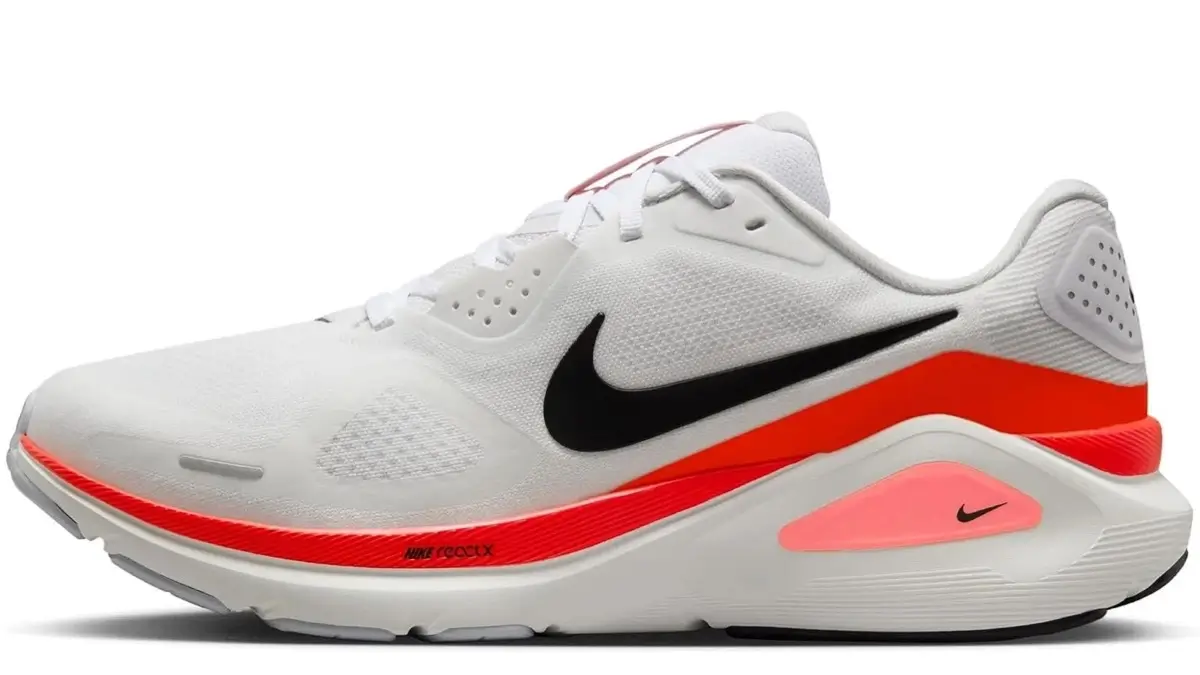
Softer, smoother ride at a hefty weight
Quick Answer: Nike Structure 26 Review: The Structure 26 is a moderate stability daily trainer for runners and walkers who want steady support without a corrective feel. Nike swapped the old firm setup for a full-length ReactX midsole and dropped the forefoot Zoom Air unit, which makes the ride noticeably softer and smoother than the Structure 25. A wide base and a firm heel counter supply the guidance. The main drawback is weight, since this is a heavy shoe that does not want to run fast. Check latest price.
The Nike Structure 26 is the twenty-sixth version of Nike’s oldest support shoe, and it is the version that finally brings the line in line with how stability shoes are built now. For years the Structure meant firm foam, a dense medial wedge under the arch and a ride that told you it was working. The 26 replaces that with a full-length ReactX midsole, Nike’s current everyday foam, and lets the shape of the platform do the supporting.
Stability, in a running shoe, means design features that limit how far the foot rolls inward after it lands. The Structure 26 does that with a wide midsole footprint, raised sidewalls that cradle the foot and a stiff heel counter, the internal cup at the back that holds the rearfoot in place. Nothing pushes back against the arch, so the shoe feels guided rather than corrected, which is a very different experience from the Structure of five years ago.
In Nike’s range it sits below the pricier Structure Plus, which uses a dual-foam setup with ZoomX on top, and it competes directly with the Brooks Adrenaline GTS and the Asics GT-2000. It is best understood as an easy-mileage shoe with support built in, not as a do-everything trainer.
Specs
Here are the specifications for the Nike Structure 26:
| Type | Road stability daily trainer |
| Best for | Easy daily miles, long runs, walking, mild to moderate overpronation |
| Midsole | Full-length ReactX foam, no forefoot Zoom Air unit |
| Stability system | Wide base, midsole sidewalls, firm heel counter |
| Stack height | 38 mm heel / 28 mm forefoot, approximate |
| Heel-to-toe drop | 10 mm |
| Weight | About 11.3 oz (320 g) men’s US 10, about 9.2 oz (261 g) women’s US 8 |
| Upper | Engineered mesh with a padded collar and a structured heel |
| Outsole | Rubber across heel and forefoot with a segmented crash pad |
| Widths | Standard, wide and extra wide on selected colorways |
| Price | Launched at $145 in July 2025. Check latest price |
Pros
These are the reasons runners keep coming back to this version:
- Much softer than the Structure 25, so long runs on pavement feel less harsh
- Support comes from the shape of the platform, so nothing presses into the arch
- Smoother forefoot now that the Zoom Air unit is gone, which removes an awkward transition point
- Secure, well-padded upper that locks the heel without rubbing
- Wide and extra wide fittings on some colorways, which the Structure has not always offered
- Generous rubber coverage that holds up to sidewalk mileage
Cons
These are the compromises to weigh up:
- Heavy for a daily trainer, which blunts anything faster than an easy pace
- ReactX cushions well but returns little energy, so the ride feels flat rather than lively
- The 10 mm drop is high by current standards and suits heel strikers more than midfoot strikers
- Support is mild, so strong overpronators will want something firmer
- At $145 it is priced against lighter, more versatile stability shoes
What is new in the 26 versus the Nike Structure 25
The Structure 25 was a firm shoe. It paired Cushlon foam with a Zoom Air unit in the forefoot, and the combination gave a ride that felt hard underfoot with a pocket of springiness at the front. Plenty of runners found the transition between those two sensations abrupt.
The Structure 26 removes both halves of that setup. ReactX runs the full length of the midsole, so the feel is consistent from heel to toe, and the forefoot air unit is gone entirely. What replaces it is simple foam and a moderately flexible forefoot, which is why the 26 rolls through the step more naturally than its predecessor. Nike also reshaped the platform, widening it and lifting the sidewalls so the foot sits down into the midsole instead of on top of it.
The upper was streamlined too, with less overlay material and a cleaner heel. Compared with the Structure 25 (read review), this is a softer, smoother and more forgiving shoe, and it is the reason the line is worth revisiting if the old Structure put you off. What has not improved is weight, and the 26 remains near the top of the scale for a road trainer.
Who should buy the Nike Structure 26
The Structure 26 suits runners who log steady road miles at an easy effort and want a little help staying aligned as they tire. Mild to moderate overpronation, the inward roll of the ankle that flattens the arch after landing, is what this platform is built around, and the support arrives without the pressure under the arch that older posted shoes created.
Heel strikers get more from it than anyone else. The 10 mm drop and the segmented crash pad at the back mean the shoe catches a rearfoot landing early and passes it forward, which keeps the stride smooth even when form gets sloppy late in a run. Runners coming from the Pegasus who want the same familiar Nike fit with more structure underneath will find this an easy switch.
It is also a reasonable buy for walkers and for anyone who wants a single shoe for jogging and for the rest of the day. The cushioning depth handles concrete well, the outsole rubber wears sensibly and the wide and extra wide fittings widen the range of feet it works for.
Who should avoid the Nike Structure 26
Runners who want one shoe to cover everything should look elsewhere. The Structure 26 is heavy, and heavy shoes make strides, intervals and tempo runs feel like more effort than they are. ReactX is a durable comfort foam rather than a springy one, so there is nothing here that helps you turn over quickly.
Anyone who needs firm control should also pass. The Structure 26 offers mild guidance, not motion control, and a foot that collapses hard will move through the platform more than a firmer shoe would allow. If a clinician has recommended strong support, treat this as too soft for the job, and seek a professional assessment if pain persists.
Finally, the 10 mm drop is not for everyone. Runners who prefer a low-drop shoe, or who load the forefoot heavily, will feel the heel sitting high and may find their calves working differently than they expect. Midfoot strikers in particular get less benefit from the rocker at the back.
How does the Nike Structure 26 fit?
Here is how this shoe fits.
Fit and sizing
The Structure 26 fits close to true to size for most feet, with the standard Nike shape: a snug midfoot, a secure heel and a toe box that is adequate rather than roomy. Buyers who have historically found Nike narrow will find this one no different in standard width, which is why the wide and extra wide fittings matter.
Lacing is straightforward and the midfoot wraps evenly, so there is no need to work around a hot spot over the instep. If you plan to use a custom orthotic, the sockliner lifts out and the platform is deep enough to take one, though the fit will tighten and sizing up a half is worth considering.
Upper and step-in comfort
Step in and the shoe feels plush at the ankle and firm at the back. The engineered mesh is soft, the collar is well padded and the tongue spreads lace pressure without bulk. Breathability is moderate, which is a fair trade for the security the upper gives.
The heel counter is stiff and that is deliberate. Because the midsole is softer than it used to be, the counter is what stops the rearfoot from tipping as the foam compresses. It is a large part of why the shoe still feels planted despite losing the old firm foam.
How does the Nike Structure 26 perform?
Here is how this shoe performs.
Midsole and cushioning
ReactX is Nike’s durable everyday foam, and its character is protective rather than bouncy. Underfoot the Structure 26 reads as medium-soft: enough give that pavement stops feeling sharp, not so much that the foot sinks. The 38 mm heel gives plenty of material to absorb a landing, and the softness is even from front to back now that the air unit is gone.
Energy return, the share of impact energy a foam hands back at toe-off, is modest. That is the fundamental limit on this shoe: it will keep your legs fresh over a long, slow run, but it will not help you go faster.
Ride and running performance
The ride is smooth and predictable at easy paces. The crash pad at the heel breaks up the landing, the platform carries the foot forward and the moderately flexible forefoot lets the toes bend at the end of the step. Compared with the previous version there is no longer a firm patch to run over in the middle of the stride, and that alone makes the shoe feel more finished.
Push the pace and the weight asserts itself. At faster efforts the shoe feels like what it is, a heavy trainer, and there is no plate or resilient foam to offset that. Runners who want stability and speed in one shoe should be looking at a lighter model, while runners who simply want their easy days to be comfortable are well served here.
Stability and support
We would classify the Structure 26 as a moderate stability shoe. There is no medial post, no firmer wedge of foam under the arch and no guidance rail. Instead the midsole is wide, especially at the heel, the sidewalls rise around the foot to keep it centered and the heel counter locks the rearfoot down. Support of this kind may suit walkers and runners with mild to moderate overpronation, though it does not correct gait and no shoe should be described as doing so.
The trade-off is that the softer midsole reduces the amount of inherent stability the foam itself provides. Runners who need a firm platform to feel controlled will find the 26 more permissive than the 25 was, which is exactly what most buyers wanted but is worth knowing if you are one of the exceptions.
Outsole, grip and durability
Nike covered the high-wear areas broadly with rubber and left the outsole segmented so the shoe still bends. Traction on dry and damp pavement is dependable, and the compound is durable enough that the outsole is unlikely to be the first thing to fail. Wet painted lines and metal covers deserve the usual caution that any road shoe does.
ReactX was developed with midsole longevity in mind, so the foam should hold its feel over a normal training block. The familiar 300 to 500 mile figure is a broad guideline rather than a guarantee, and it moves with body weight, surface and stride.
Is the Nike Structure 26 good for walking?
Yes, and for a lot of walkers it is a better shoe than it is a running shoe. The features that hold the Structure 26 back on a fast run barely register at walking speed. Weight matters less when your feet leave the ground gently, and what you notice instead is a broad, steady platform, a heel counter that keeps the ankle from wobbling and enough foam to take the edge off concrete for a couple of hours.
The forefoot flexes reasonably, which matters because walking bends the shoe at the toes more than running does, and the outsole rubber grips well on wet sidewalks and smooth indoor floors. The 10 mm drop suits walkers who land heel first, which most do. If you are on your feet all day, or you walk for fitness on hard surfaces, the wide and extra wide fittings make this one of the easier stability shoes to fit properly.
Nike Structure 26 vs. Structure 25
Here is how the two generations differ where it counts:
Structure 26 | Structure 25 | |
Midsole | Full-length ReactX | Cushlon foam with forefoot Zoom Air |
Feel | Medium-soft and consistent | Firm with a springy forefoot pocket |
Forefoot | Moderately flexible | Stiffer, with an abrupt transition |
Support method | Wide base and sidewalls | Firmer foam and more structure |
Drop | 10 mm | 10 mm |
Buy the 26 if you want a softer, smoother shoe and you never liked the firmness of the older Structure. Buy the 25 while it is discounted if you prefer a firm, controlled platform, if you like the pop of a forefoot air unit or if you simply want the same shoe you have run in for years at a lower price.
Nike Structure 26 Alternatives
If the softness appeals but the flat ride does not, the Nike Structure Plus is the natural step up within the same family. It layers a livelier foam over a firmer base, which gives back more at toe-off while keeping the wide, guided platform the Structure line is built on, and it costs more for that reason (check price | read review).
Weight is the Structure 26’s biggest handicap, and the Brooks Adrenaline GTS 25 is the obvious answer. It is lighter, it flexes more readily and its GuideRails sit at the sides of the heel rather than under the arch, so runners who want support and still want to run a workout in the same shoe get a far more versatile package (check price | read review).
Stronger overpronators are better served by the Asics Gel-Kayano 33, which firms up the medial side as the foot loads instead of relying on shape alone. It gives a much more definite sense of being held than the Structure 26 manages, at the cost of a more noticeable support feel (check price | read review).
Walkers and all-day wearers who want more cushioning than the Structure 26 provides should consider the Hoka Gaviota 6. It carries a taller stack and a stronger rocker shape, which does more of the work of rolling you through each step and pays off most at slow speeds on hard floors (check price | read review).
Price and value
The Structure 26 launched at $145 in July 2025, which places it just under most premium stability trainers. For that you get a full-length ReactX midsole, broad outsole rubber, a genuinely well-built upper and, on some colorways, wide and extra wide fittings. Measured against the Structure 25 it is a clear improvement in comfort for the same kind of money, and as the previous generation clears out this version is often the better buy of the two. What holds the value back is versatility, because at this price several rivals do the same job while weighing less.
Final verdict
Best for: easy daily road miles, long runs, walking and standing, heel strikers and runners with mild to moderate overpronation.
Avoid if: you want a trainer that can also run fast, you need firm motion control or you prefer a low heel-to-toe drop.
Fit: close to true to size, snug midfoot, secure heel, with wide and extra wide fittings on selected colorways.
Verdict: The Structure 26 is the most comfortable version of this shoe in a long time, and losing the forefoot air unit was the right call. It is still heavy and still slow, so buy it as an easy-day and all-day shoe rather than as your only pair. You can check online prices before deciding.
Frequently Asked Questions for Nike Structure 26
It fits close to true to size for most feet, with the usual snug Nike midfoot. If you have found Nike shoes narrow in the past, look for the wide or extra wide fitting rather than sizing up in length.
Yes, a moderate one. It supports the foot with a wide base, raised midsole sidewalls and a firm heel counter rather than with a hard wedge under the arch, so it guides rather than corrects. Runners who need strong motion control should look at a firmer shoe.
Removing it let Nike run ReactX foam the full length of the midsole. The practical effect is a consistent feel from heel to toe and a smoother forefoot, since runners no longer roll over a firmer, springier patch mid-stride.
The Pegasus is the neutral daily trainer in the range and is lighter and more flexible. The Structure 26 adds a wider platform, more sidewall and a firmer heel counter for runners who want guidance, and it pays for that with extra weight.
The sockliner is removable and the platform is deep enough to take most devices. Expect the fit to tighten once an orthotic is in, so a half size up or a wider fitting is often the better choice.
It is built for it. ReactX is a durable foam, the outsole carries plenty of rubber and the upper is substantial, so the shoe suits runners who accumulate steady weekly mileage at easy paces rather than those chasing fast sessions.