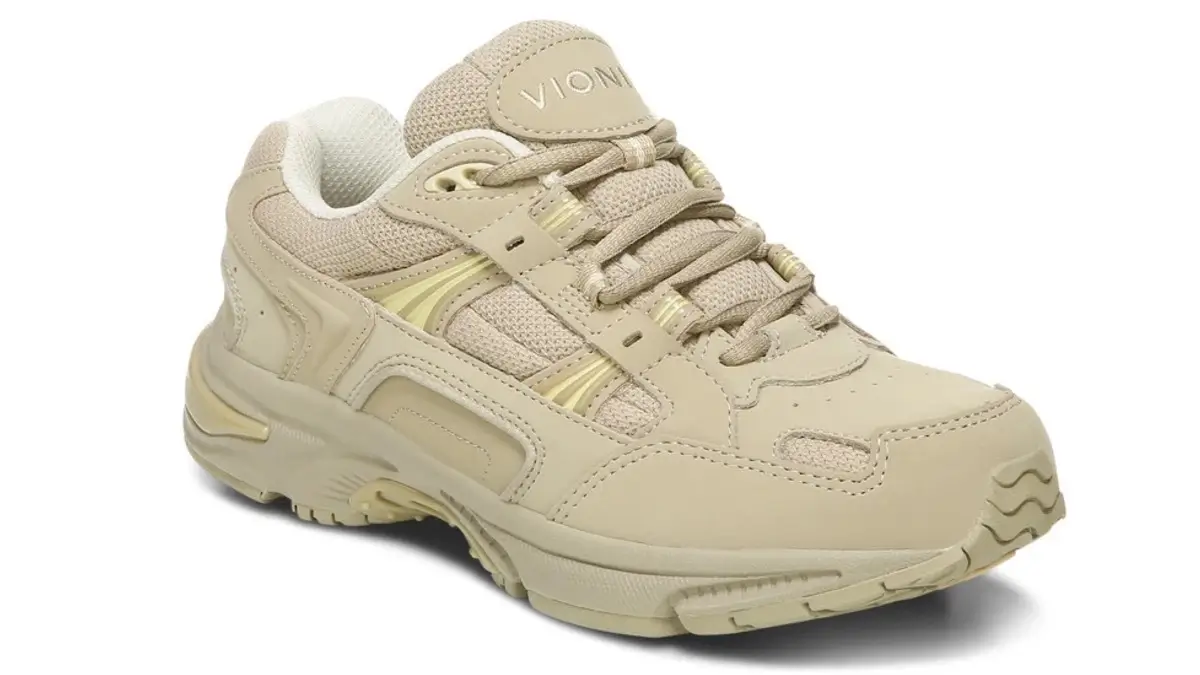
Quick Answer: The Vionic Walker Classic is still worth considering if you want firm arch support, a removable contoured footbed and a sturdy leather walking shoe. It is less appealing if you prefer soft cushioning, a light mesh upper or a flatter insole. Availability now appears limited: Vionic’s U.S. site no longer surfaces it in search, while Vionic Canada lists remaining Classic Walker styles as final sale. That makes fit and price especially important before buying. Jump to the specs.
The Vionic Walker Classic has been around for years because it does something many modern walking shoes do not: it puts a firm, shaped support system inside a traditional leather sneaker. Vionic uses its podiatrist-developed footbed, a deep heel cup, a removable molded EVA component and a firm heel counter to create a more structured feel than you get from a soft neutral walking shoe.
That support can be helpful for walkers who like a noticeable arch underfoot, but it is not automatically better for every foot. Some people find the arch too prominent. Others simply prefer the softer ride of newer shoes such as the Vionic Walk Max. If you are shopping because of heel or arch pain, also see our guide to the best shoes for plantar fasciitis. Shoes can improve comfort, but they do not treat plantar fasciitis by themselves.
Vionic Walker Classic specs
The Walker Classic is built more like a traditional supportive walking shoe than a modern running-inspired trainer. The leather upper adds structure and weather resistance, while the removable footbed gives the shoe a clearly shaped arch and heel cup. Vionic also uses a firm thermoplastic heel counter to hold the rear of the foot more securely. The company recommends easing into the shoe for a few hours at a time during the first several days because the support can feel different from a flat or soft insole.
| Type | Supportive leather walking shoe |
| Best for | Everyday walking, errands and people who prefer firm arch support |
| Upper | Full-grain water-resistant leather |
| Lining | Moisture-wicking polyester mesh over PU foam |
| Footbed | Removable podiatrist-developed contoured footbed |
| Midsole | Molded EVA with about 0.5 inch of built-in elevation |
| Heel | Firm thermoplastic heel counter |
| Outsole | Durable rubber |
| Widths | Regular and wide versions have been offered |
| APMA | Vionic states that the Walker Classic received the APMA Seal of Acceptance |
| Current availability | Limited and inconsistent by market and size |
Do not read the APMA seal as a guarantee that the shoe will solve a foot problem. The American Podiatric Medical Association says its Seal of Acceptance recognizes footwear found to promote good foot health after review, but it is not an endorsement and APMA does not compare the product with competing shoes. We explain the distinction in our guide to the APMA Seal of Acceptance.
Gender-specific shopping links: women’s Walker Classic | men’s Walker Classic.
Is the Vionic Walker Classic still worth buying?
Yes, for the right buyer. The Walker Classic still makes sense if you specifically want a leather walking shoe with a firm, shaped footbed rather than a soft athletic sneaker. The combination of the contoured footbed, deep heel cup and structured heel counter gives the shoe a planted feel. That can be reassuring if you dislike shoes that feel soft or unstable underfoot.
The catch in 2026 is availability. Vionic’s current U.S. site search does not surface the Walker Classic as an active product result, while Vionic Canada lists the women’s Classic Walker as final sale and the men’s wide version as sold out/final sale. That does not prove the shoe has been discontinued everywhere, but it does mean we would not treat it as a fully current, easy-to-replace model. Remaining stock may vary sharply by size, width and color.
Because of that, price matters more than it used to. If you find the Walker Classic at a sensible clearance price and already know that Vionic’s firm arch shape works for you, it can be a good buy. If you are paying full price or trying Vionic for the first time, compare it with the newer Walk Max and other current walking shoes before committing.

Fit and arch support
The defining feature of the Walker Classic is not cushioning. It is the shape under the foot. The removable footbed has a noticeable arch and heel cup, and the firm heel counter helps keep the rear of the foot from moving around excessively. If you already wear Vionic shoes and like that shape, the Walker Classic will feel familiar. If you are coming from a flat insole or a soft neutral trainer, the support may feel unusually strong at first.
Vionic itself recommends wearing new Vionic footwear for only a few hours at a time during the first several days so your feet can adjust. That is useful advice here. A strong arch should feel supportive, not painful. If the arch feels as though it is pressing into the wrong part of your foot, more break-in time is not always the answer.
The brand has offered the Walker Classic in regular and wide versions. Wide sizing can help if the sides of your forefoot feel compressed, but it is better to choose the correct width than to add extra length. Our Vionic sizing guide and guide to how to tell if you have wide feet can help before ordering.
The footbed is removable, so a custom orthotic may fit once the factory insert is removed. Do not stack a custom orthotic on top of the existing contoured insert unless your clinician specifically tells you to. That can reduce room and change where the arch sits.
How it feels for walking
The Walker Classic feels firmer and more structured than most modern walking sneakers. The leather upper does not disappear around the foot the way a knit or engineered mesh upper does, and the underfoot feel is more supportive than plush. That makes it better suited to steady everyday walking, errands and long periods of mixed standing and walking than to fast fitness walks where low weight and flexibility matter more.
The molded EVA component includes about a half-inch of elevation that Vionic says is intended to smooth the transition from heel to toe. In practice, the shoe feels more controlled than springy. There is no thick slab of soft foam and no dramatic rocker. People who like to feel firmly supported often prefer that. People who want the softer ride of a Hoka, Brooks or modern Vionic Walk Max may find it dated.
The rubber outsole is appropriate for normal sidewalks, stores and everyday paved surfaces, but Vionic does not market it as a specialized slip-resistant work outsole. That distinction matters. If you work in a restaurant, hospital kitchen or other environment where certified or tested slip resistance is important, choose a work shoe built for that job instead.
The water-resistant leather also makes the Walker Classic more practical than a mesh shoe in light rain, but it is not a waterproof hiking shoe. Think everyday weather protection, not puddle or storm protection.
Who should buy it and who should skip it?
The Walker Classic is most convincing for people who already know they like firm arch support. It can also be worth trying if you want a leather walking shoe with a removable footbed and a more structured heel than a typical soft sneaker. Some people with plantar fasciitis prefer this kind of firm support, but footwear needs vary and a shoe is not a treatment for the condition.
Skip it if you have a very sensitive arch, strongly prefer a flat footbed or want a soft, lightweight shoe. The Walker Classic is also a questionable choice if you need a very broad toe box or extra-wide sizing because remaining inventory is limited. If fit is your main problem, our free shoe finder can narrow the choices by width, cushioning and support.
We would also avoid describing the Walker Classic as a “diabetic shoe.” The manufacturer describes supportive and wide versions, but that is different from being prescribed or fitted as therapeutic footwear for diabetes. Anyone with diabetes, neuropathy, a history of ulcers or reduced sensation should be especially careful about fit and pressure points and should follow the advice of their clinician.
If your priority is simply everyday comfort rather than pronounced arch structure, start with our broader best walking shoes guide.
Vionic Walker Classic vs. Vionic Walk Max
The Walker Classic and Walk Max are both walking shoes, but they feel very different. The Walker Classic is the traditional option: leather upper, firm heel structure and a clearly shaped support system. The Walk Max is the newer, more athletic option, with a mesh upper, deeper cushioning and a more modern rolling feel underfoot.
Feature | Walker Classic | Walk Max |
|---|---|---|
Upper | Water-resistant leather | Breathable athletic mesh |
Underfoot feel | Firm and structured | Softer and more cushioned |
Best use | Steady everyday walking and support | Longer or more athletic walking |
Availability | Limited remaining stock | Current model |
Full review | This page |
Choose the Walker Classic if you already know you prefer a firmer Vionic footbed, want a leather upper and find a good price in your size. Choose the Walk Max if you want more cushioning, lighter materials and a model that is easier to replace later. For a first-time Vionic buyer in 2026, the Walk Max is usually the easier model to start with because availability is better and its ride feels more familiar to people coming from modern athletic shoes.
Vionic Walker Classic alternatives
If the Walker Classic is unavailable in your size, there are several sensible alternatives. The best replacement depends on what you liked about it: the Vionic arch shape, the firm stability, the leather construction or simply the fact that it came in wide sizing.
- Vionic Walk Max: the easiest same-brand alternative. It keeps Vionic’s supportive approach but adds a lighter mesh upper and substantially more cushioning. Check price.
- New Balance 847v4: a better match if width selection and a stable platform matter more than having Vionic’s exact arch shape. Check price.
- Skechers Arch Fit 2.0: lighter and usually less expensive, with a contoured support system and a more athletic look. Check price.
- Orthopedic shoe options: worth considering if you need more depth, more width choices or room for a custom orthotic rather than simply a stronger built-in arch.
The main decision is whether you are replacing the Walker Classic because you loved its specific support shape or because you simply need a comfortable walking shoe. If it is the support shape, stay close to Vionic. If it is comfort, width or cushioning, there are now many more current options than there were when the Walker Classic first became popular.
Frequently asked questions
We cannot confirm a worldwide discontinuation. However, Vionic’s current U.S. site search no longer surfaces it as an active product result, while Vionic Canada lists remaining Classic Walker styles as final sale and some versions as sold out. Availability now appears limited.
Some people with plantar fasciitis prefer the shoe’s firm arch support, deep heel cup and structured heel. That does not make it a treatment, and the best shoe depends on your fit, symptoms and comfort.
Yes. Vionic has offered regular and wide versions of the Walker Classic, although remaining stock now varies by size, width and market.
Yes. Vionic describes the Walker Classic footbed as removable. That can create room for a custom orthotic, but do not stack orthotics unless your clinician recommends it.
We would not describe it as a diabetic shoe. Supportive construction and wide sizing are not the same as therapeutic footwear prescribed or fitted for diabetes. People with diabetes or reduced foot sensation should pay particular attention to fit and pressure points.
The APMA says the Seal of Acceptance recognizes footwear found to promote good foot health after review. It is not an endorsement, APMA is not a testing laboratory, and the seal does not mean a shoe will work for every foot.
The Vionic Walk Max is the most obvious current same-brand alternative if you want Vionic support with more cushioning. The New Balance 847v4 and Skechers Arch Fit 2.0 are also worth comparing for stability, width or arch support.