Last Updated on September 23, 2026
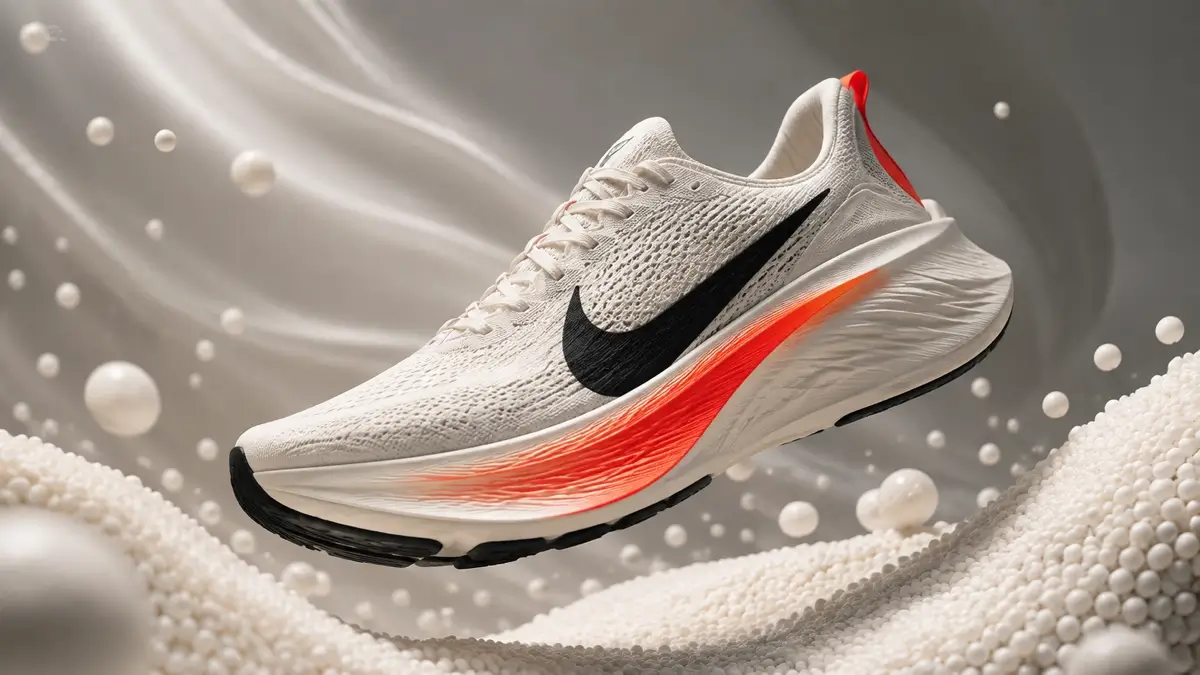
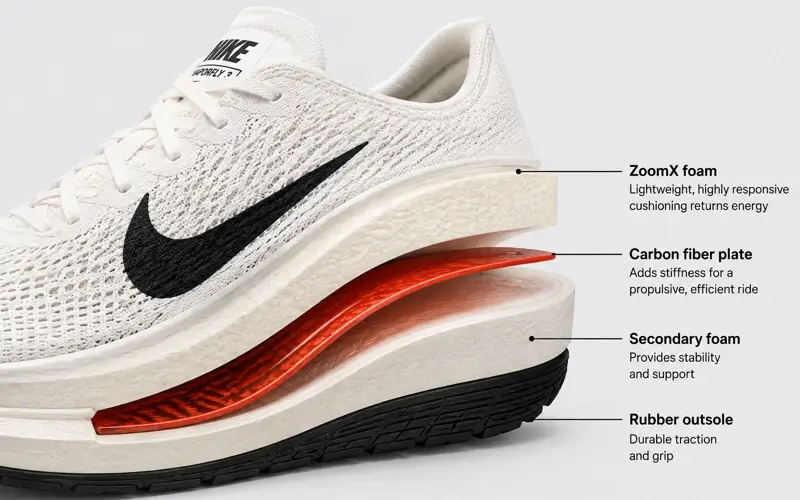
Nike ZoomX is a lightweight, highly responsive cushioning foam used in many of Nike’s premium running shoes. It was originally developed for elite racing shoes but has since spread into daily trainers, maximum-cushioning shoes and some trail models. For the broader technology picture, see our Running Shoe Technology guide.
What makes ZoomX different from conventional shoe foam is the amount of energy it returns when compressed. Instead of simply absorbing the force created when your foot hits the ground, ZoomX compresses and rebounds quickly, producing the soft, springy sensation Nike describes as a propulsive ride.
Nike says ZoomX is its lightest, softest and most responsive foam and claims a ZoomX midsole can return about 85% of the energy applied to it.
For runners, that can translate into a shoe that feels fast without requiring an unusually firm midsole. For walkers, ZoomX can provide considerable cushioning and a lively feel underfoot, although not every ZoomX shoe is necessarily a good walking shoe.
See also: Running shoe foam guide
Quick answer: What is Nike ZoomX?
Nike ZoomX is Nike’s premium lightweight cushioning foam. It compresses when your foot lands and rebounds quickly as you move forward, giving shoes a soft, bouncy and responsive feel.
Nike originally developed ZoomX for performance running and introduced it in the Nike Zoom Vaporfly Elite and Vaporfly 4%. The company now uses the material in racing shoes, everyday running shoes, maximum-cushioning shoes and trail shoes.
The important thing to remember is that ZoomX is a midsole foam, not a type of Nike shoe.
How does Nike ZoomX work?
The midsole is the thick cushioning layer between the upper portion of a shoe and its rubber outsole. It has a major influence on how soft, firm, stable or responsive a shoe feels.
When your foot lands, a ZoomX midsole compresses. As your weight moves forward and pressure comes off the foam, it rapidly returns toward its original shape. That rebound creates the characteristic ZoomX sensation.
Nike describes ZoomX as providing its highest level of energy return and says the material was derived from foam technology traditionally associated with aerospace applications.
In practical terms, ZoomX generally gives you three things:
- Low weight: Nike says ZoomX is its lightest foam.
- Soft cushioning: The foam compresses considerably beneath the foot.
- High responsiveness: It rebounds quickly instead of simply absorbing impact.
That combination is one reason ZoomX became important in the development of modern performance running shoes.
What does ZoomX feel like?
ZoomX usually feels noticeably soft and springy. Step into a conventional foam shoe and the midsole may compress slightly before becoming relatively firm. ZoomX tends to have a more pronounced compression-and-rebound sensation.
Depending on the shoe, you may describe the feeling as:
- Bouncy
- Soft
- Springy
- Lightweight
- Energetic
The exact sensation varies considerably because ZoomX is only one part of a shoe.
Midsole thickness, geometry, outsole construction, heel width, rocker design and the addition of plates or other foams can dramatically change how a ZoomX shoe behaves.
A thick ZoomX training shoe, for example, may feel plush and comfortable. A ZoomX racing shoe combined with a carbon-fiber plate may feel considerably more aggressive and propulsive.
Where did ZoomX come from?
ZoomX has its roots in Nike’s attempt to help an athlete run a marathon in less than two hours.
Nike combined athlete feedback with biomechanical analysis while developing footwear for its Breaking2 project. ZoomX first appeared in the Nike Zoom Vaporfly 4% worn by Eliud Kipchoge when he ran 2:00:25 during the 2017 Breaking2 attempt.
That project helped establish the blueprint for what eventually became known as the modern “super shoe”: an extremely lightweight shoe combining highly responsive foam with specialized geometry and, frequently, a rigid plate.
ZoomX didn’t remain confined to racing shoes. Nike subsequently introduced it into the Pegasus Turbo as a training technology and has continued expanding ZoomX into additional running categories.
Today, ZoomX appears in shoes designed for everything from road racing and everyday training to maximum cushioning and ultradistance trail running.
Is ZoomX the same as Nike Zoom?
No. This is one of the more confusing parts of Nike’s shoe terminology. ZoomX is a foam.
Nike Zoom or Air Zoom generally refers to Nike’s pressurized Air cushioning technology.
A Nike shoe can actually contain both technologies.
For example, Nike’s Pegasus Premium combines ZoomX foam, ReactX foam and Air Zoom cushioning to create its underfoot cushioning system.
So don’t assume that a shoe with “Zoom” in its name necessarily contains ZoomX. Check the specifications for the individual shoe.
Is ZoomX good for walking?
ZoomX can be excellent for walking, particularly if you like substantial cushioning and a softer, springier ride.
There is an important qualification, however. ZoomX was developed primarily as a performance technology rather than specifically as a walking-shoe technology. Some ZoomX shoes are therefore much better suited to walking than others.
A highly cushioned daily trainer containing ZoomX can make considerable sense for walking because you get the cushioning without an excessively heavy shoe.
A lightweight carbon-plated racing shoe is a different matter. It may contain plenty of ZoomX, but its geometry and stiffness were designed to improve running performance. That doesn’t automatically make it comfortable or practical for several hours of everyday walking.
If walking is your primary activity, look at the entire shoe rather than choosing it simply because it contains ZoomX.
Who may like ZoomX for walking?
ZoomX may particularly appeal to walkers who prefer cushioning rather than a firm connection with the ground.
You may like it if you:
- Walk long distances.
- Prefer a soft midsole.
- Like noticeable rebound beneath your feet.
- Want substantial cushioning without an extremely heavy shoe.
- Alternate between walking and running.
People who spend long periods standing may also enjoy the cushioning, although stability becomes increasingly important in that situation. See also best shoes for standing all day.
Who might not like ZoomX?
More cushioning isn’t automatically better for every foot. Some people prefer firmer midsoles because they feel more stable or predictable. Extremely soft foam can also allow greater movement beneath the foot than a firmer material.
You may prefer another cushioning system if you:
- Like firm shoes.
- Want considerable ground feel.
- Feel unstable in very soft midsoles.
- Prefer low-stack shoes.
- Need a particularly structured walking platform.
This is another reason to evaluate individual shoes rather than treating ZoomX as a guarantee that a shoe will work for you.
Is ZoomX good for standing all day?
Potentially, but shoe design matters more than the ZoomX label.
Soft cushioning can make prolonged standing comfortable because the foam reduces the hard sensation you may experience from standing on concrete, tile or other unforgiving surfaces. But standing also places a premium on stability.
A tall stack of soft foam sitting on a narrow platform may feel less secure than a moderately cushioned shoe with a wide base. Nike now uses ZoomX in different configurations, including shoes that combine it with firmer foams or more supportive structures.
For example, Nike introduced the Structure Plus with a ZoomX midsole surrounded by a ReactX foam carrier, combining responsive cushioning with a more supportive design.
That illustrates why the question shouldn’t simply be, “Does this shoe have ZoomX?” A better question is, “How is ZoomX being used in this particular shoe?”
See also: Best shoes for standing all day.
Is ZoomX good for running?
Running is where ZoomX made its reputation.
Nike designed the foam around a combination of low weight and high energy return, attributes that are particularly valuable when athletes are repeatedly loading and unloading the midsole over thousands of strides.
ZoomX can now be found in shoes intended for several types of running, including:
- Racing
- Speed training
- Everyday road running
- Long-distance training
- Maximum-cushioning running
- Trail running
Nike describes ZoomX as its highest-energy-return foam, and the technology continues to appear across the company’s performance running lineup.
See also: Nike 2026 lineup
Does ZoomX make you run faster?
ZoomX itself shouldn’t be treated as a magic speed booster. Running-shoe performance results from the entire shoe system, including foam properties, weight, geometry, stiffness and, in some models, a carbon-fiber plate.
Responsive foam can reduce some of the energy lost each time the midsole compresses. In a performance shoe engineered around that material, it can contribute to improved running efficiency.
That’s substantially different from saying that simply wearing ZoomX automatically makes someone faster. Nike’s top racing shoes use ZoomX as one component of a larger performance system.
Does ZoomX contain a carbon plate?
Not necessarily. ZoomX and carbon-fiber plates are separate technologies.
Some performance shoes combine the two because the soft, responsive foam and stiff plate can work together to create a highly propulsive platform. Nike specifically notes that some ZoomX shoes incorporate its carbon-fiber Flyplate technology. But many ZoomX shoes do not have a carbon plate.
If you’re buying a shoe for walking, don’t assume a carbon plate is desirable simply because it appears in Nike’s fastest racing shoes. A stiff racing plate may be unnecessary for normal walking.
See also Carbon plate shoes
Is ZoomX better than Nike ReactX?
Neither foam is automatically better. They serve somewhat different purposes.
ZoomX sits at the high-performance end of Nike’s cushioning lineup, emphasizing low weight, softness and responsiveness. ReactX can be used where designers want different levels of durability, cushioning, support or structural control. Nike sometimes combines the two.
The Vomero 18, for example, uses ZoomX along with ReactX in its cushioning system.
The Pegasus Premium also combines ZoomX and ReactX while adding Air Zoom cushioning.
Rather than thinking of one technology replacing another, it is often more useful to think of them as materials Nike can combine to tune how a particular shoe feels.
Does more ZoomX mean more cushioning?
Not necessarily. The amount of foam matters, but cushioning is also affected by the shape and construction of the shoe. A thick ZoomX midsole will generally provide substantial material beneath your feet, but engineers can change the riding characteristics through shoe geometry, plate placement, foam combinations and other design elements. This explains how the same basic foam technology can appear in both aggressively fast racing shoes and comfortable everyday trainers.
What are the advantages of Nike ZoomX?
ZoomX has become one of Nike’s flagship cushioning technologies because it provides characteristics that are difficult to combine in a single material.
Its biggest potential advantages include:
- High energy return
- Very low weight
- Soft cushioning
- A springy, responsive feel
- The ability to provide substantial cushioning without excessive bulk-related weight
Nike says ZoomX delivers about 85% energy return, although consumers should understand that this is a Nike performance claim rather than a promise that 85% of the energy generated by a runner is somehow returned to the runner. The percentage refers to properties of the cushioning material under testing conditions.
What are the disadvantages of ZoomX?
The characteristics that make ZoomX appealing won’t suit every walker or runner. Potential drawbacks can include a ride that feels too soft for people who prefer firm cushioning, less inherent stability in some high-stack designs and higher shoe prices when ZoomX is used in Nike’s premium models.
The most important drawback is probably simpler: seeing ZoomX on a specification sheet tells you very little about whether the complete shoe is right for your feet.
A broad, cushioned ZoomX trainer and a narrow racing shoe can have fundamentally different purposes despite using the same foam family.
How do you know if a Nike shoe has ZoomX?
Check the shoe’s technical specifications rather than relying on its name. Nike normally identifies ZoomX in the description of models that use it. The company also maintains a dedicated ZoomX shoe category. This is particularly useful because names such as Zoom, Air Zoom and ZoomX can otherwise be easy to confuse.
Is Nike ZoomX worth it?
ZoomX is worth considering if you enjoy lightweight cushioning with a pronounced soft and responsive feel.
For runners, it has become an important performance foam that can work across racing, training and long-distance applications.
For walkers, the answer depends more heavily on the shoe surrounding the foam.
Don’t buy a shoe simply because it says ZoomX.
Look for a ZoomX model that also provides the fit, width, heel security, outsole, stability and overall geometry appropriate for the kind of walking you do.
That combination matters far more than the foam’s name.
Common questions about Nike ZoomX
No. ZoomX is a foam cushioning material. It should not be confused with gel cushioning systems used by some other footwear manufacturers.
No. Memory foam is designed primarily to conform slowly around the foot. ZoomX is engineered to compress and rebound rapidly, producing a considerably more responsive sensation.
Nike describes ZoomX as its lightest, softest and most responsive foam. The actual softness you feel will still depend on how the foam is configured within a particular shoe.
It can be, but don’t choose solely on cushioning. Heavier walkers may also benefit from a wide platform, adequate heel support and a stable midsole design. A very tall, soft shoe may feel comfortable to one person and unstable to another. See shoes for heavy walkers.
Yes, if the particular shoe is designed for everyday use. Nike now uses ZoomX in daily trainers as well as performance footwear. Dedicated racing shoes containing ZoomX may be less practical as everyday walking shoes.
No. Although ZoomX originated in Nike’s performance racing program, it now appears in training, maximum-cushioning and trail shoes as well.
ZoomX itself is foam. Some Nike shoes combine ZoomX with Air Zoom units, but these are separate cushioning technologies.
Sometimes. Certain performance shoes combine ZoomX with a carbon-fiber Flyplate, while many other ZoomX shoes do not.
ZoomX provides cushioning, but the presence of ZoomX alone does not make a shoe appropriate for plantar fasciitis. Fit, heel cushioning, support, stability and individual biomechanics all matter. People with persistent heel or foot pain should seek advice from an appropriate health professional rather than selecting footwear solely on the basis of its foam technology. See also best shoes for plantar fasciitis.
It can be. Its substantial cushioning may make hard surfaces feel more comfortable, particularly during long walks. For prolonged walking or standing on concrete, however, also look for a stable platform, comfortable fit and appropriate outsole. See also best shoes for walking on concrete.
Its combination of very low weight, softness and high rebound distinguishes it from more conventional cushioning foams. Nike calls ZoomX its highest-energy-return foam and says a ZoomX midsole can deliver approximately 85% energy return.
ZoomX is worth considering, especially for walkers who enjoy a soft, lively and highly cushioned shoe. But choose by model rather than cushioning technology alone. The best ZoomX running shoe isn’t necessarily the best ZoomX walking shoe.