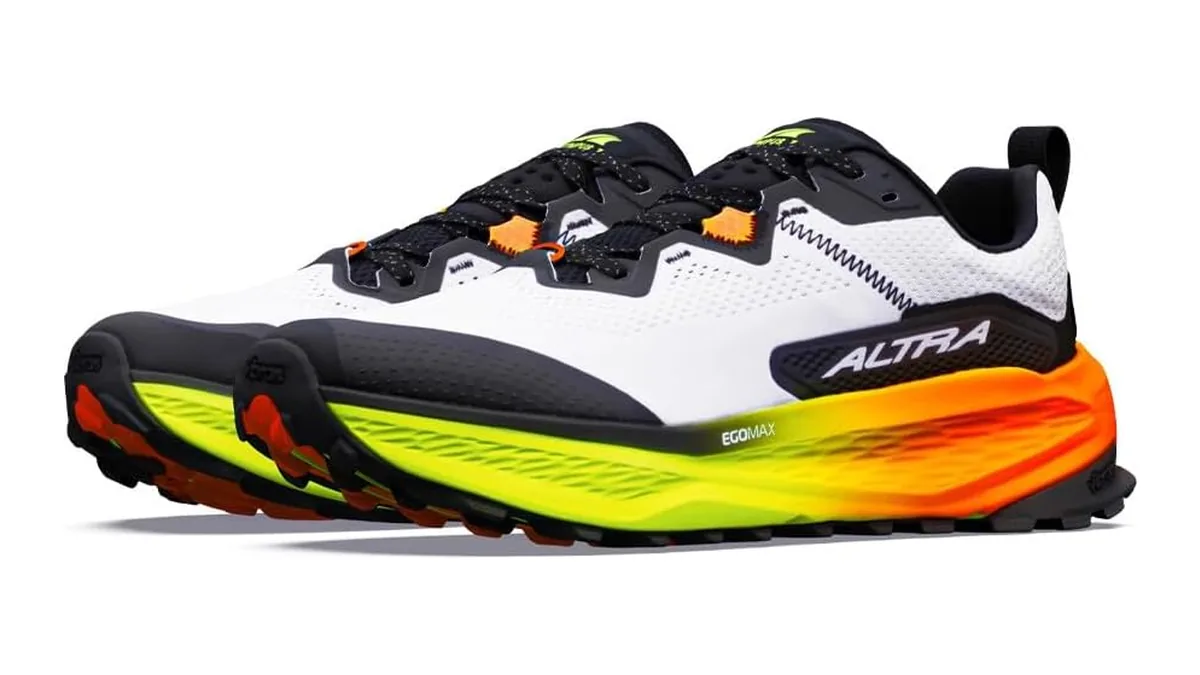
Room for your toes and deep trail cushioning, in a shoe that is still heavy
Quick Answer: Altra Olympus 7 Review: The Altra Olympus 7 is a maximum-cushion trail shoe with a zero-drop platform and Altra’s famously wide, foot-shaped toe box. It is built for long days off road, and a Vibram Megagrip outsole gives it dependable grip on wet rock and loose dirt. New EGO MAX foam makes it lighter and softer than the Olympus 6, though it is still a substantial shoe. Zero drop asks something of your calves, so ease into it. Check latest price.
The Altra Olympus 7 is the most cushioned trail shoe Altra makes, sitting above the Lone Peak and the Timp in the range. Altra builds every shoe on two ideas that set the brand apart. The first is zero drop, which means the heel and the forefoot sit at exactly the same height off the ground rather than the heel being raised by 8 or 10 millimeters as in most shoes. The second is what the brand calls FootShape, a toe box shaped like an actual foot, wide at the front and tapering behind.
Put those two ideas together with a thick slab of foam and a Vibram sole, and you get a shoe with a very specific audience: people who walk and run long distances off road, who have wide feet or toes that hate being squeezed, and who either already run flat or are willing to adapt to it. It went on sale in August 2026 at $195.
Specs
Here are the specifications for the Altra Olympus 7:
| Type | Maximum-cushion trail running shoe |
| Gait type | Neutral |
| Midsole | Altra EGO MAX, which Altra states is 15 percent lighter and 10 percent softer than the previous foam |
| Stack height | 33 mm, front and back |
| Heel-to-toe drop | 0 mm |
| Weight | 11.5 oz (325 g) men’s; 9.7 oz (274 g) women’s |
| Upper | Engineered mesh with a reinforced toe cap |
| Outsole | Vibram Megagrip with TractionLug |
| Fit | Original FootShape, Altra’s widest toe box |
| Price | $195 at launch, August 2026. Check latest price |
Pros
Here is where the Olympus 7 is hard to beat:
- The roomiest toe box of any serious trail shoe, which stops the hot spots and black toenails that ruin long days
- Deep, forgiving cushioning that keeps working late in an ultra or a long hike
- Vibram Megagrip, the most dependable trail rubber on wet rock
- Lighter and softer than the Olympus 6 thanks to the new EGO MAX foam
- A flat platform that spreads your weight evenly rather than concentrating it under the heel
Cons
And where it will not suit you:
- Still heavy at 11.5 oz, and that is a lot to carry for hours
- Zero drop takes weeks of adjustment if you are used to a raised heel, and it loads the calf and Achilles more
- The tall, flat platform feels vague on genuinely technical ground
- $195 is premium money for a shoe with no plate and no exotic foam
- Narrow feet will swim in it
What is new compared with the Olympus 6
The headline change is the midsole. Altra has moved the Olympus to EGO MAX foam, which the brand says is 15 percent lighter and 10 percent softer than what came before. Both of those are things the Olympus needed. The previous version was widely liked for its comfort and widely criticized for its bulk, so shaving weight while adding softness is the update people were asking for.
The outsole has also been reworked, with Vibram Megagrip now paired with the TractionLug pattern for a better bite on loose and mixed ground. The upper is cleaner and the toe cap is more substantial, which is a sensible fix for a shoe that spends its life around rocks. What has not changed is the shape: same zero drop, same Original FootShape toe box, same broad, stable platform. Altra knows who buys this shoe and has not tried to convert anyone new.
Who should buy the Altra Olympus 7
Buy it if your toes need space. This is the single strongest argument for the shoe. Feet swell over a long day and downhill running pushes your toes forward, so a shoe that is comfortable at mile 5 can be agony at mile 25. The Original FootShape toe box is genuinely wide at the front, and for people who have spent years fighting blisters, bunion pressure and lost toenails, that alone justifies the purchase.
Buy it if you go long. Thirty-three millimeters of foam under the whole foot is a lot of protection, and because the platform is flat that protection is spread evenly rather than piled under the heel. That suits hikers and fast-packers as much as runners, and it suits anyone who finishes long efforts with sore feet rather than sore legs.
Buy it too if you already run in zero-drop shoes and want the most cushioned one available. Within that category the Olympus has no real rival. Just be honest about the adjustment if you are coming from a raised heel, because moving to a flat platform puts noticeably more work through the calf and Achilles tendon. Build up over several weeks rather than switching in one go, and see a professional if you get pain that does not settle.
Who should probably skip it
Skip it if you have never run in a zero-drop shoe and you do not particularly want to. It is a real change to how your leg is loaded, and buying an expensive trail shoe is a poor way to experiment with it. Skip it if your trails are steep, rocky and slow, because a tall flat platform is harder to place accurately than a lower one. And skip it if weight matters to you, because 11.5 ounces is heavy even by max-cushion standards.
These are better places to start:
- Saucony Peregrine 16: lower, lighter and far more precise underfoot, which is what you want on technical trails, and it has a normal heel height (check price | read review)
- Hoka Challenger 8: a lighter door-to-trail shoe for routes that mix pavement and dirt, with shallow lugs that do not clatter on the road (check price | read review)
- Altra Torin 9: the same brand’s roomy zero-drop shoe for roads, and a gentler, cheaper way to find out whether a flat platform agrees with you (check price | read review)
How does the Altra Olympus 7 fit?
The Olympus 7 fits unlike almost anything else on sale, and that is its main selling point. The front of the shoe is wide and squared off rather than tapering to a point, so your toes sit where they naturally would when you stand barefoot. The rest of the shoe is more conventional, with a normal heel and a midfoot you can tighten down.
Fit and sizing
Take your usual size. Altra’s length is accurate, and the extra room is all width at the front rather than extra inches. This is the Original FootShape last, which is the widest of Altra’s three fits, so if you have tried a Lone Peak or a Torin and found even those roomy, expect more here. Narrow feet are the problem. There is a lot of space to take up, and while the laces help through the midfoot they cannot do much about the toe box. Try before you buy if your feet are slim.
Upper and step-in comfort
The upper is a sturdy engineered mesh with a reinforced toe cap, which is the right priority for a shoe that will be kicked into rocks all day. Step-in comfort is immediately soft, with plenty of padding at the collar and a generous tongue. It is not the most breathable trail upper on sale, partly because there is simply more material wrapping a wider foot, and it holds water a little longer than a thin racing mesh. For its intended use, which is hours rather than minutes, the durability is the better trade.
How does the Altra Olympus 7 perform?
The Olympus 7 is built for endurance rather than speed, and it behaves accordingly. It is comfortable and unhurried, it grips well and it protects your feet from everything underneath. What it will not do is feel lively.
Cushioning and ride
Stack height is the amount of foam between your foot and the ground, and 33 mm of it is a lot for a trail shoe, especially when it is the same front and back. The new EGO MAX foam is softer than the outgoing version, so the shoe absorbs sharp rocks and hard-packed ruts without transmitting them to your foot. The ride is cushioned and slightly plodding rather than springy: it dampens impact well and gives very little back. On a long day that is exactly right, because what tires you out over ten hours is accumulated impact, not a lack of bounce.
Ride and running performance
Running in the Olympus 7 feels steady and deliberate. Because there is no heel lift, you tend to land flatter, and the shoe rolls through the stride evenly instead of tipping you forward. There is no plate and no rocker doing the work for you, so pace comes from your legs. At an easy trail pace that is comfortable and natural. Push harder and the weight becomes the limiting factor. This is a shoe for covering ground for a long time, not for chasing a personal best.
Stability and support
The Olympus 7 is a neutral shoe with no pronation control. Its steadiness comes from the shape of the platform: it is wide, and because the foam sits level from heel to toe your weight is spread rather than perched. Altra argues that a flat, wide base encourages a more balanced stance, and on smooth or rolling trail that holds up well. On genuinely technical ground the height works against it. A tall shoe is harder to place precisely, and you feel less of what is under you, which is the main reason this is not a scrambler’s shoe.
Outsole, grip and durability
Vibram Megagrip is the best-known trail compound for wet rock, and the TractionLug pattern adds bite on soft, loose surfaces. The combination copes with mud, gravel, wet roots and slabby rock, and there is no obvious weak condition. Durability is a strength as well, because this is full-thickness rubber rather than a weight-saving version, and the upper is built to take abuse. The usual 300 to 500 mile figure for running shoes is a rough guideline rather than a promise, and a heavy, well-protected shoe like this one tends to sit at the top of that range rather than the bottom.
Is the Altra Olympus 7 good for walking?
Yes, and hiking is arguably its second career. Long-distance walkers and thru-hikers have been buying Altras for years, and the Olympus is the most cushioned option in the line. The deep foam takes the sting out of a full day under a pack, the Vibram sole handles the same ground a boot would and the wide toe box matters even more when you are walking than running, because you spend longer on each foot and swelling has more time to build.
The weight is the catch, and so is the lack of ankle support if you are used to boots. For town walking, standing on hard floors or travel it is the wrong shoe entirely: too heavy, too warm and far too aggressive underfoot. Think of it as a hiking shoe that happens to run, and it makes complete sense.
Altra Olympus 7 vs Olympus 6
Here is how the update compares with the shoe it replaces:
Feature | Olympus 7 | Olympus 6 |
Midsole | EGO MAX, lighter and softer | Previous EGO MAX formulation |
Stack height | 33 mm, zero drop | 33 mm, zero drop |
Outsole | Vibram Megagrip with TractionLug | Vibram Megagrip |
Toe box | Original FootShape | Original FootShape |
Weight, men’s | 11.5 oz (325 g) | Heavier than the Olympus 7 |
Price at launch | $195, August 2026 | Not confirmed |
Buy the Olympus 7 for the softer, lighter foam and the improved lug pattern, which together make the biggest practical difference on a long day. Buy the Olympus 6 if you find it discounted and the extra ounces do not worry you, because the fit and the geometry are unchanged and the older version was already a good hiking and ultra shoe.
Altra Olympus 7 Alternatives
Three shoes answer the most common reasons for hesitating.
Hoka Speedgoat 7 is the obvious comparison, and the one to take if the zero drop is the sticking point. It offers a similar amount of cushioning and the same Vibram Megagrip grip, but with a conventional raised heel and a lighter build, so the transition from a normal shoe is effortless (check price | read review). Its toe box is narrower, which is the trade.
For long, slow days on your feet where comfort beats everything, Brooks Caldera 8 is the closer match in character. It is another deeply cushioned, stable trail shoe that hikes as happily as it runs, with a quick-draining upper, and it costs less (check price | read review).
When the ground turns soft and wet, cushioning stops being the deciding factor. Salomon Thundercross has deeper, more aggressive lugs than anything here and holds a line in mud that the Olympus slides around in, which makes it the sensible winter alternative (check price | read review). It fits much more narrowly, so it is only an option if width is not why you came.
Price and value
At $195 on launch in August 2026, the Olympus 7 costs more than most trail shoes without a plate. The money goes on the Vibram outsole, the volume of foam and the specialized last, none of which are cheap to make. If you need the toe box, there is no direct substitute at any price, so the value question does not really arise. If you are buying purely for cushioning, several rivals give you as much for less.
Final verdict
Best for: ultra runners, thru-hikers and anyone with wide feet or sensitive toes who covers long distances off road.
Avoid if: you have narrow feet, you run technical terrain, or you have no interest in adapting to a zero-drop platform.
Fit: true to size, Original FootShape toe box, roomy throughout. Standard width only, because the shape does the work.
Verdict: The Olympus 7 is a specialist that knows exactly what it is. The new foam has finally made it lighter without costing it comfort, and the combination of a genuinely wide toe box with this much cushioning and this much grip does not exist anywhere else. If the shape suits you, nothing else will do. If it does not, there is no reason to be here.
Frequently Asked Questions for Altra Olympus 7
Most people need several weeks. Start with short, easy runs or walks and keep your old shoes in rotation, because a flat platform puts more work through the calf and Achilles tendon than a raised heel does. If you get pain that does not settle within a few days, back off and get it looked at.
Altra now builds its shoes on three widths of toe box. Original is the widest and is what the Olympus 7 uses, Standard is moderately roomy and Slim is closer to a conventional running shoe. If you found an older Altra too wide, the Slim models are where to look.
It is one of the most popular choices for it. The deep cushioning, the Vibram Megagrip outsole and the wide toe box all matter more on a multi-day hike than on a short run, and plenty of long-distance hikers use Altras for exactly this reason. It offers no ankle support, so it is a trail shoe rather than a boot.
No. It relies on the sheer depth of foam for protection rather than a stiff insert. In practice 33 mm of midsole handles most sharp rocks well, though you get less of the pinpoint protection a thin, plated shoe provides.
Yes. Order your normal size. The extra room is width at the front rather than length, so sizing up only leaves you with a shoe that slips at the heel.
For a short stretch of pavement between trails, yes. For regular road running it is a poor choice: the lugs wear down fast on asphalt and the weight is hard to justify when lighter road shoes with the same roomy shape exist.