An unusually steady giant of a shoe, with a painful jump in price
Quick Answer: Asics Sonicblast 2 Review: The Sonicblast 2 is a tall, plated super trainer that does two jobs well: it cushions easy miles and it holds a fast pace when you ask it to. What makes it stand out is how planted it feels for a shoe with this much foam under it, which is rare and useful. Asics has also made it lighter and added a springy pod under the forefoot. The problem is the price, which climbed steeply over the first version. Check latest price.
Gender-specific buy links: Men’s version | Women’s version
The Asics Sonicblast 2 belongs to a category that barely existed five years ago: the super trainer. These are shoes built with race-day foams and stack heights, but softened and strengthened enough to be worn for regular training. The Sonicblast is the plated one in the Asics lineup, sitting alongside the plateless Superblast and the everyday Novablast.
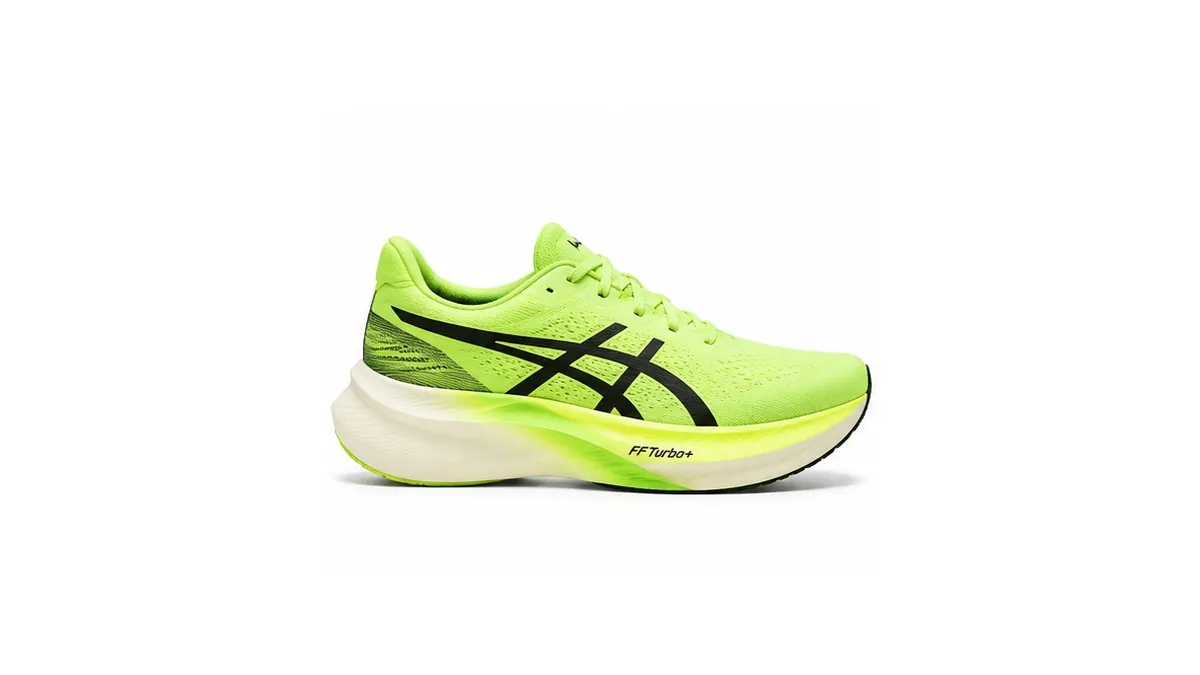
The midsole, meaning the layer of foam between your foot and the road, is FF Turbo2. That is Asics’ lightweight performance foam, and it sits on the firmer end of the modern super foams, which turns out to be the key to the whole shoe. Inside it sits a forked plate, a stiffening piece split at the front so it can flex where you need it to and resist where you do not.
The second version is a real step forward rather than a colorway change. It is lighter, the plate has been redesigned to let more foam through the middle of the shoe, and the forefoot now has a springy pod that changes how the push-off feels. Whether that is worth the extra $30 is the question everything below is trying to answer.
Specs
Here are the specifications for the Asics Sonicblast 2:
| Type | Neutral road running shoe, plated super trainer |
| Gait type | Neutral, though unusually stable for a tall shoe |
| Midsole | FF Turbo2, a lightweight performance foam on the firmer side of super foams |
| Plate | Redesigned forked plate, allowing more foam through the middle of the shoe, plus a forefoot pod |
| Stack height | 46 mm heel and 38 mm forefoot men’s; 45 mm and 37 mm women’s |
| Heel-to-toe drop | 8 mm |
| Weight | About 8.5 oz (242 g) men’s US 9 and 7.5 oz (212 g) women’s US 8; roughly 14 g lighter than the first version |
| Upper | New engineered mesh, with a more rounded heel than the first version |
| Outsole | Rubber across the high-wear areas |
| Best use | Long runs, tempo work, faster daily miles, race day up to the marathon |
| Price | Launched at $190 in September 2026, up $30 from the first version. Check latest price |
Pros
These are the things the Sonicblast 2 does better than its rivals:
- For a shoe with 46 mm of foam under the heel, it is remarkably stable. Tall shoes usually wobble, and this one does not, which makes it far easier to trust when you are tired.
- It is light for the size. At about 8.5 oz in a men’s 9, you are carrying very little for the amount of cushioning you get.
- The new forefoot pod gives a distinct trampoline-like kick at the point you push off, which the first version lacked.
- The firmer character of FF Turbo2 means the shoe does not sink and collapse the way softer super foams do under a heavier runner.
- Asics has cut 14 g from the first version while adding features, which is the right direction.
Cons
These are the reasons to hesitate:
- $190 is a steep ask, and a $30 jump over the first version is hard to swallow when that shoe already worked.
- The firmer foam is a trade-off. If you want the marshmallow softness of the plushest super trainers, this is not it.
- A 46 mm platform is a lot of shoe, and it feels unwieldy at genuinely slow paces.
- There is no wide fitting, which rules it out for a lot of people.
- It is a poor choice for walking, and a worse one for standing all day, so it will only ever be a running shoe.
What is new versus the Asics Sonicblast
The plate has been redesigned. It is still forked, meaning it splits toward the front so the shoe can bend where your foot does, but the new shape allows more FF Turbo2 to extend through the midsole rather than being sandwiched around the plate. More foam in the load path means more cushioning and more bounce, without adding height.
The bigger change you actually feel is the forefoot pod. Asics has built a springy section into the front of the sole that compresses and rebounds as you roll onto your toes, and the effect is a noticeably livelier push-off. The first Sonicblast was praised for comfort and criticized for being a bit flat at the front. That complaint is largely answered.
Elsewhere, the heel is more rounded, which smooths the moment of landing for anyone who comes down heel first, and the upper is new. Stack height and drop are unchanged at 46 mm and 38 mm with an 8 mm difference, and the shoe is about 14 g lighter. The price rose by $30 to pay for all of it.
Who should buy the Asics Sonicblast 2
This is the shoe for a runner who wants one pair that covers both ends of the week. It has enough cushioning for a two-hour long run and enough snap for a tempo session, which is exactly what a super trainer is supposed to do and what few of them actually manage.
It is a particularly good pick for anyone who has tried tall super trainers and found them tippy. Most shoes in this category pair a huge stack with very soft foam, which is a recipe for feeling unsteady as your form falls apart late in a run. The firmer FF Turbo2 and the plate here hold the platform together, and that stability is the Sonicblast 2’s real selling point.
Heavier runners should read that same point as a recommendation. Soft foams bottom out faster the more you weigh, meaning you compress through the cushioning and land on what is effectively a thin shoe. A firmer super foam resists that, so the protection you paid for is still there at mile 15.
Not sure this is the right shoe? Use our free Shoe Finder to narrow your choices by fit, cushioning, support and how you plan to use the shoe.
Who should probably skip it
If your running is mostly slow and steady, this is too much shoe and too much money. A 46 mm platform with a plate in it is designed to reward a reasonably quick turnover, and at an easy jog you are hauling around a lot of engineering that never gets used. A straightforward daily trainer will feel better and cost half as much.
It is also wrong for anyone who needs support or a wide fitting. There is no guidance built into it and no extra widths offered. And if you were hoping for one shoe to run and walk in, look elsewhere entirely: a tall, plated racing-adjacent shoe is uncomfortable and impractical for walking or standing.
Better places to start in those cases:
- Nike Pegasus 42: a firm, dependable daily trainer for steady miles, at a fraction of the price (check price | read review).
- Asics Gel-Cumulus 26: the sensible Asics for everyday running and walking alike, with none of the complexity (check price | read review).
- Brooks Adrenaline GTS 25: the pick if your feet roll inward and you need guidance, with wide and extra-wide fittings available (check price | read review).
How does the Asics Sonicblast 2 fit?
The Sonicblast 2 fits like a performance shoe that has been asked to be comfortable for two hours: snug through the midfoot, secure at the heel and with a little more room at the toes than a pure racer. The new upper is a meaningful improvement. Here is what to expect.
Fit and sizing
Most people should take their usual size. The shoe is built on a performance shape rather than a roomy one, so if you have a broad forefoot or you like plenty of space ahead of your toes on long runs, going up half a size is worth considering.
Asics does not offer a wide fitting in this model. That is standard for shoes in this category and it is still a limitation. Women’s sizing uses a slightly lower stack, 45 mm and 37 mm rather than 46 mm and 38 mm, which keeps the drop the same while trimming a little height.
Upper and step-in comfort
The upper is new engineered mesh, and the most useful change is at the back: a more rounded heel shape that sits more kindly against the Achilles than the first version. Anyone who found the original Sonicblast’s heel collar sharp should find this one easier to live with.
Step-in feel is soft and high. You are standing on a lot of foam, so the first impression is of height rather than plushness, and the firmness of FF Turbo2 becomes apparent as soon as you start moving. Lockdown is secure once laced, which matters on a platform this tall.
How does the Asics Sonicblast 2 perform?
The Sonicblast 2 is a shoe that gets better the longer and the faster you go. It is cushioned enough to protect you over distance and snappy enough at the front to make a tempo run enjoyable, and unusually for the category, it stays steady while doing both. The sections below cover each part.
Cushioning and ride
Stack height is the amount of foam between your foot and the ground, and 46 mm under the heel is close to the legal maximum for road racing. The practical effect is that the road stops existing: long runs on concrete leave your legs far fresher than they would in a conventional trainer.
FF Turbo2 is firmer than most super foams, and that shapes the whole character of the shoe. Instead of sinking into softness you get a bouncy, controlled feel with a clear sense of the platform underneath. If you have found other super trainers mushy and vague, this will make more sense to you. If you specifically want plush, it will not.
Ride and running performance
The forked plate does two jobs. It stiffens the shoe lengthwise so the foam cannot simply squash flat, and its split front lets the shoe bend naturally under the toes. That combination gives a smooth, rolling stride rather than the abrupt lever action of a full carbon racing plate.
The new forefoot pod is what you notice. It behaves like a small trampoline under the ball of the foot, compressing as you load it and springing back as you leave the ground, and it turns a competent push-off into a genuinely satisfying one. At faster paces the shoe feels eager. At a slow jog it feels like a lot of shoe doing very little, which is the usual super-trainer compromise.
Stability and support
This is a neutral shoe with no support features, and yet it is one of the steadier shoes in its class. The reason is the combination of a firmer foam and the plate: neither lets the platform deform much under an uneven landing, so there is far less of the lateral wobble that tall, soft shoes are notorious for.
That is incidental steadiness rather than support. It will not hold up a foot that collapses inward, and if you have been advised to use a stability shoe, a 46 mm neutral platform is not the answer regardless of how planted it feels. For a neutral runner who simply finds tall shoes unnerving, though, this is the one in the category to try.
Outsole, grip and durability
Rubber covers the high-wear zones with foam exposed elsewhere, which is standard practice for a shoe trying to keep weight down. Grip on dry roads is confident and adequate in the wet, though like most shoes in this class it is happier on clean asphalt than on wet paint or metal.
Durability should be better than most super trainers, because a firmer foam holds its structure longer than a very soft one and the plate spreads the load. The usual 300 to 500 mile figure is a broad guideline only, and no shoe carries a guaranteed lifespan, but this is a shoe you can reasonably train in rather than save for race day, which is the point of the whole category.
Is the Asics Sonicblast 2 good for walking?
No, and it is worth saying plainly. Everything the Sonicblast 2 does well depends on running: the plate needs a running stride to flex correctly, the forefoot pod only compresses under a hard push-off, and 46 mm of foam is more height than anyone needs to stand on. At walking pace the shoe feels tall, clumsy and vague.
For standing all day it is worse. A tall platform is less steady than a low one, the stiffness through the middle of the shoe works against the natural bend of a walking step, and there is no wide fitting for feet that swell through a shift. If you want Asics comfort for walking and time on your feet, the Gel-Cumulus or the Gel-Nimbus will serve you far better and cost considerably less.
Asics Sonicblast 2 vs. Asics Sonicblast
Here is how the two generations compare:
Feature | Sonicblast 2 | Sonicblast |
Plate | Redesigned fork, letting more foam through the midsole | Forked plate, original design |
Forefoot | New springy pod for a livelier push-off | No pod, flatter feel at toe-off |
Stack and drop | 46 mm / 38 mm, 8 mm drop | 46 mm / 38 mm, 8 mm drop |
Weight | About 8.5 oz men’s, roughly 14 g lighter | About 14 g heavier |
Price at launch | $190 | $160 |
Buy the Sonicblast 2 when you want the livelier forefoot and the lighter build, which together make it a noticeably more enjoyable shoe to run quickly in.
Buy the original Sonicblast when you find it discounted. The cushioning and the stability that define the shoe are both present in the first version, and at $30 less it is the better buy for anyone whose running is mostly steady.
Asics Sonicblast 2 Alternatives
If the plate is what puts you off, the Saucony Endorphin Azura is the shoe to compare it against. It is a plateless super trainer built on a soft PEBA-based foam, so it delivers similar cushioning and bounce with a far more natural flex through the foot, and it is the better pick for anyone who finds stiff shoes uncomfortable.
Within Asics itself, the Superblast 3 is the obvious rival to its own sibling. It skips the plate entirely and leans on foam geometry instead, which makes it the softer and more forgiving of the two while keeping the tall platform. Choose between them on whether you want the Sonicblast’s snap or the Superblast’s ease.
And if what you actually want is deep cushioning without any of the performance machinery, the Saucony Triumph 24 does that for a good deal less money, in a shoe that also works away from running. You give up the speed entirely.
- Saucony Endorphin Azura: a plateless super trainer with a softer, more natural flex for runners who dislike stiff shoes (check price | read review).
- Asics Superblast 3: the plateless Asics super trainer, softer and more forgiving on easy days (check price).
- Saucony Triumph 24: deep everyday cushioning at a much lower price, for runners who do not need the speed (check price | read review).
Price and value
At its $190 launch price in September 2026, the Sonicblast 2 is expensive even by super-trainer standards, and the $30 increase over the first version is the hardest part to defend. What the money buys is a light, deeply cushioned shoe that can genuinely do both easy and fast days, and that stays steady while doing it. If it replaces two shoes in your rotation, the math works. If you already own a good daily trainer, the first-generation Sonicblast at a discount is the smarter spend.
Final verdict
Best for: runners who want one shoe for long runs and tempo days, heavier runners who bottom out soft foams, and anyone who has found other tall super trainers too tippy to trust.
Avoid if: your running is mostly slow, you need support or a wide fitting, you want a plush ride, or you were hoping to walk in it.
Fit: true to size on a performance shape, with no wide fitting available.
Verdict: the most stable shoe of its size on sale, now with the lively forefoot it was missing. The $190 price is the only real objection, and it is a fair one. Check the latest price.
Frequently Asked Questions for Asics Sonicblast 2
The Sonicblast has a plate in the midsole and the Superblast does not. That makes the Sonicblast stiffer, snappier and better suited to faster running, while the Superblast is softer and more forgiving on easy days. Both use tall stacks of Asics performance foam.
A super trainer is a shoe built with race-day materials, meaning a tall stack of lightweight performance foam and often a plate, but tuned to be durable and comfortable enough for everyday training rather than saved for race day.
Yes. At 46 mm it sits within the usual stack limit for road racing, it is light and it is well cushioned, so it is a realistic race shoe for most runners. A dedicated carbon racer will be lighter and more aggressive for those chasing a specific time.
FF Turbo2 is Asics’ lightweight performance midsole foam. It is springy and light, but firmer than most rival super foams, which is why this shoe feels more planted and less wobbly than other tall trainers.
No. Asics lists it in a standard width only, which is typical for shoes in this category. Anyone needing a wide fitting should look at a conventional daily trainer instead, where extra widths are far more common.
It depends on your running. The lighter build and the new forefoot pod make it a better shoe for faster work, which justifies the jump if you run tempo sessions. If your miles are mostly steady, the discounted first version delivers most of the same cushioning and stability.