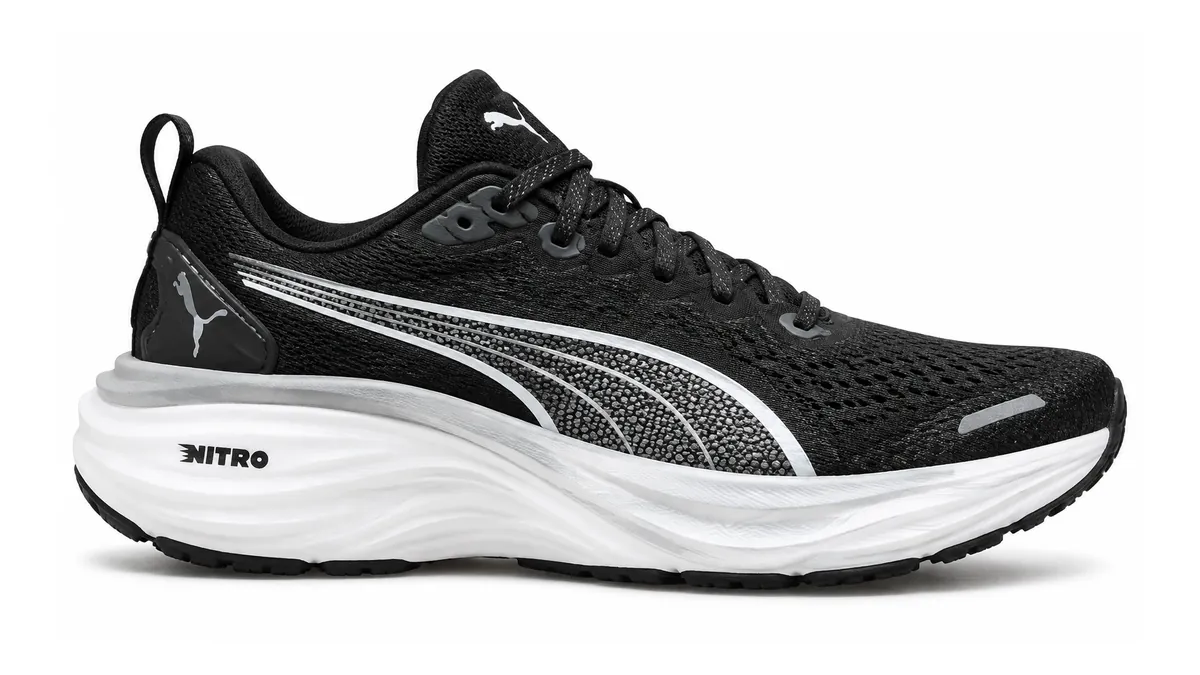
Support that never feels like being corrected, on a heavy and muted platform
Quick Answer: Puma ForeverRun Nitro 3 Review: The ForeverRun Nitro 3 is Puma’s stability trainer, and it is the pick for runners and walkers whose feet roll inward but who dislike the rigid, corrected feeling older support shoes give. Puma builds the steadiness into the shape of the foam instead, using a softer core with a firmer rim around it, which feels natural underfoot and still keeps you upright. The drawback is heft: it is a heavy shoe and it feels dull when you try to pick up the pace. Check latest price.
Gender-specific buy links: Men’s version | Women’s version
The Puma ForeverRun Nitro 3 is the third version of the shoe Puma built to answer a simple question: what does a modern support shoe look like when you stop bolting hard plastic to the inside of it? It sits alongside the Velocity Nitro as one of Puma’s everyday trainers, and it is the only shoe in the range aimed specifically at feet that roll inward.
Rolling inward, or overpronation, is normal to a degree. It becomes worth addressing when the arch collapses far enough or fast enough that it starts to feel like hard work, which many people notice as tired arches or aching shins late in a walk or a run. The traditional fix was a firm wedge under the arch. Puma’s approach here is different: the midsole, meaning the foam between your foot and the road, has a soft center and firmer walls, so it resists collapsing sideways without pushing anything into your arch.
The result is one of the more comfortable ways to buy support, and a shoe that plenty of neutral runners could happily wear too. It is also one of the heavier road shoes you can buy, and that is the compromise running through everything below.
Specs
Here are the specifications for the Puma ForeverRun Nitro 3:
| Type | Stability road running and walking shoe |
| Gait type | Overpronation, per Puma’s own listing |
| Midsole | Full-length dual-density NITROFOAM, a nitrogen-injected foam with a cushioned core and a firmer outer rim |
| Support system | RUNGUIDE: the dual-density foam, a firmer midsole rim and a supportive heel structure working together |
| Stack height | 38 mm heel and 30 mm forefoot, per Puma |
| Heel-to-toe drop | 8 mm |
| Weight | 290 g (about 10.2 oz) as listed by Puma; heavy for a road trainer |
| Upper | Engineered mesh with PWRTAPE reinforcement for lockdown |
| Outsole | PumaGRIP rubber, designed for traction across surfaces |
| Widths | Regular, as listed by Puma |
| Best use | Daily easy runs, long steady runs, walking and time on your feet |
| Price | Launched at $150 in August 2026. Check latest price |
Pros
These are the things the ForeverRun Nitro 3 gets right:
- The support never announces itself. There is no hard ridge under your arch, just a platform that quietly refuses to tip, which is far more comfortable for long periods on your feet.
- 38 mm of foam under the heel is a lot, so landings feel deep and protected rather than jarring.
- The wider midsole shape gives you a broad base to stand on, which helps walkers as much as runners.
- PumaGRIP is one of the better rubber compounds on any road shoe, and it holds confidently on wet pavement.
- Puma quotes a useful working life for the shoe, and the dense foam and full rubber coverage back that up.
Cons
These are the reasons it will not suit everyone:
- At about 10.2 oz it is heavy, and you feel that most in the second half of anything long.
- The ride is muted. The foam soaks up impact well but gives little back, so the shoe feels flat when you try to run faster.
- Puma lists a regular width only, which rules it out for anyone who needs a genuine wide fitting.
- At $150 it sits at full daily-trainer money without the liveliness that other shoes at that price offer.
- The tall stack takes a little getting used to if you are coming from a low, firm shoe.
What is new versus the Puma ForeverRun Nitro 2
Puma has widened the midsole. That sounds minor and is not: a broader platform is the single most effective way to make a shoe feel steady, because it gives your foot less room to roll before something stops it. It is also the least intrusive, since nothing has to press against you to do the job. This is the change you feel first.
The foam has been upgraded too. Puma describes the NITROFOAM here as a dual-density construction using a PEBA blend, PEBA being a lighter and more resilient plastic than the EVA used in cheaper shoes. In practice the core of the midsole is softer than before and the rim around it is firmer, so the shoe cushions more and guides more at the same time. A supportive structure at the heel completes what Puma calls its RUNGUIDE system.
Stack height and drop stay at 38 mm and 30 mm with an 8 mm difference between them, and the PumaGRIP outsole carries over. The upper gains PWRTAPE, thin reinforcing strips bonded into the mesh that hold the midfoot without adding stitched layers. If you liked the ForeverRun Nitro 2, this is a clear step forward rather than a sideways move.
Who should buy the Puma ForeverRun Nitro 3
This is the shoe for someone who has been told they need support and has hated every support shoe they have tried. If a firm wedge under the arch has ever given you a sore spot or made your foot feel shoved sideways, the ForeverRun’s approach will be a relief. You get the same end result, a foot that stays upright, without anything digging in.
It also suits anyone who spends a long time on their feet. The combination of a deep heel, a wide base and grippy rubber is a good recipe for a shoe you stand and walk in as well as run in. Runners doing steady, unhurried miles will get on with it, particularly on longer efforts where the depth of cushioning earns its keep.
Heavier runners are worth a specific mention. A tall, firm-rimmed platform of this kind holds up better under load than a soft, narrow one, and the extra weight of the shoe matters proportionally less to a larger runner. If you have found soft trainers collapsing under you, this is a sensible thing to try.
Not sure this is the right shoe? Use our free Shoe Finder to narrow your choices by fit, cushioning, support and how you plan to use the shoe.
Who should probably skip it
If you need a wide fitting, you cannot have this shoe. Puma lists it in regular width only, and no amount of good design makes up for a shoe that does not come in your size. That is a hard stop for a lot of people who need support, because broad feet and flattening arches often go together.
It is also the wrong shoe if you want to run fast in it. The foam absorbs far more than it returns, so faster efforts feel like wading rather than flying, and the weight compounds that. And if you only pronate mildly, you may find this more shoe than you need: a lighter, simpler trainer will do the job with less bulk.
In those cases, consider these instead:
- Brooks Adrenaline GTS 25: the best-known support shoe going, lighter than the Puma and available in wide and extra-wide (check price | read review).
- Asics GT-1000 15: mild support at a much lower price, for anyone whose arches only flatten a little (check price | read review).
- Brooks Beast GTS 26: the most structured option of the three, built for heavier walkers and orthotic users who want maximum control and generous widths (check price | read review).
How does the Puma ForeverRun Nitro 3 fit?
The ForeverRun Nitro 3 fits like a secure, moderately snug daily trainer. Puma’s running shoes tend to run a touch narrow through the midfoot and this is no exception, though the taped reinforcement holds the foot without squeezing. The notes below cover sizing and what the upper feels like.
Fit and sizing
Most people will be fine in their usual size. The length is conventional, and there is enough room ahead of the toes without the shoe feeling loose. If you have a high-volume foot, meaning a thick foot from top to bottom rather than a wide one, try before you buy, because the taped midfoot pulls down fairly firmly when laced.
Width is the real constraint. Puma lists this as a regular-width shoe, so anyone who needs 2E or 4E should look at Brooks or New Balance instead. Within the regular fitting the forefoot is not tight, and the wider midsole under the shoe gives the foot a broad platform to sit on even though the upper itself is not roomy.
Upper and step-in comfort
The upper is engineered mesh with PWRTAPE, which is Puma’s name for thin strips of reinforcement bonded into the material rather than sewn on top. The practical effect is a midfoot that feels held rather than wrapped, with no stitched edges to rub. Puma states the upper uses at least 30 percent recycled material.
Step-in comfort is good. The heel is well padded and holds firmly, the tongue is thin but sits flat, and the foam feels immediately deep underfoot. Breathability is reasonable, though the mesh is on the substantial side, which is the usual trade for a shoe that has to hold a foot steady.
How does the Puma ForeverRun Nitro 3 perform?
This is a shoe built to keep you comfortable and upright for a long time, and it does that well. Where it struggles is anything requiring quickness, because the foam and the weight both work against you. The sections below go through cushioning, ride, support and grip in turn.
Cushioning and ride
Stack height is the amount of foam between your foot and the ground, and at 38 mm under the heel this is a tall shoe by any measure. The initial impression is of deep, soft protection: landings sink in and the road disappears. For long steady runs and for walking on concrete, that is exactly what you want.
The character is cushioned rather than bouncy. Puma classifies the cushioning as medium, which is a fair description: it is not the plush, marshmallow feel of a max-cushion shoe, nor the firm and connected feel of a racer. It sits comfortably in between, with a slightly damp quality that becomes more noticeable the longer you are out.
Ride and running performance
At easy and steady paces the ForeverRun Nitro 3 is a pleasant, unfussy shoe. The 8 mm drop suits most people, the transition from heel to toe is smooth, and there is no point in the stride where the shoe does something unexpected. That predictability is worth a great deal in a support shoe.
Push the pace and the picture changes. The foam takes more energy than it gives back, the shoe is heavy, and there is no plate or aggressive curve at the front of the sole to flick you forward. Holding a quicker pace becomes noticeably harder work as the distance builds. Treat this as an easy-day and long-run shoe and pair it with something lighter for faster sessions.
Stability and support
This is a stability shoe, and a good one. The mechanism is entirely geometric: the midsole is wider than a neutral shoe’s, the outer rim of the foam is firmer than the core, and a supportive structure at the heel keeps the rear of the foot from tilting as it lands. Nothing pushes up into your arch, so there is no pressure point to get used to.
It is worth being clear about what that does and does not do. A shoe like this can make a foot that rolls inward feel better supported and less fatigued, and it can reduce how far the arch travels. It does not correct anyone’s gait, and no shoe should be presented as doing so. If you have persistent or worsening pain, see a podiatrist or physical therapist rather than shopping for a different shoe.
Outsole, grip and durability
PumaGRIP is the best-regarded part of Puma’s running shoes and the reason many people buy them. It is a soft, tacky rubber that holds well on wet pavement, painted road markings and smooth indoor floors, all the places a hard budget outsole lets go. For anyone walking through a wet winter, that is a genuine safety benefit.
Durability looks strong. Puma quotes a working life of around 800 km, which is about 500 miles and sits at the top of the usual 300 to 500 mile guideline. That range is a broad guide only and depends heavily on your weight, stride and surfaces, and no shoe carries a guaranteed lifespan, but the dense foam and generous rubber coverage here are the sort of construction that ages slowly.
Is the Puma ForeverRun Nitro 3 good for walking?
Yes, and it is one of the better stability shoes for it. Walking is where the shoe’s weaknesses stop mattering: you are not asking it to return energy or to turn over quickly, so the heavy, muted ride is simply a deep and comfortable one. What you do get is the wide base and the firm outer rim, which keep the foot from rolling through a long day of steps.
For standing on hard floors it is also a strong option, because 38 mm of foam under the heel is far more than most work or walking shoes offer. The grip on wet tile and pavement is a practical bonus. The one thing to check is width: with only a regular fitting available, anyone whose feet swell through a shift may find it tight by the evening, and that is worth testing before committing.
Puma ForeverRun Nitro 3 vs. Puma ForeverRun Nitro 2
Here is how the two generations compare:
Feature | ForeverRun Nitro 3 | ForeverRun Nitro 2 |
Midsole | Dual-density NITROFOAM using a PEBA blend | Dual-density NITROFOAM, earlier formulation |
Platform | Wider midsole geometry | Narrower midsole |
Stack and drop | 38 mm / 30 mm, 8 mm drop | Comparable stack, 8 mm drop |
Upper | Engineered mesh with PWRTAPE | Engineered mesh |
Widths | Regular | Regular and wide |
Buy the ForeverRun Nitro 3 when you want the wider, steadier platform and the softer core underfoot, which together make it the more comfortable shoe for long days and long runs.
Buy the ForeverRun Nitro 2 when you need a wide fitting, since Puma offered one on the older model and does not list one on the new shoe, or when you find the 2 discounted and the regular width suits you anyway.
Puma ForeverRun Nitro 3 Alternatives
Support shoes differ far more from each other than neutral trainers do, so the right alternative depends on what you dislike about this one. If the weight is the problem, the Mizuno Wave Inspire 22 is the obvious counter-proposal: it gets its steadiness from a plate buried in the arch rather than from a wide, heavy platform, comes in wide fittings and feels noticeably quicker underfoot.
Runners who want support without any of the bulk should look at the Saucony Tempus 2 instead. It uses a firm frame around a soft core, which is a similar idea to Puma’s executed in a lighter shoe, and it is the one to choose if you also want to run tempo work in the same pair.
And if the ForeverRun’s ride suits you but the price does not, the previous generation is still on sale at a discount, with the additional advantage of a wide fitting that Puma has dropped from the new model. You lose the widened platform, which is the main reason to buy the 3 in the first place.
- Mizuno Wave Inspire 22: lighter, more responsive support with wide fittings, for anyone who finds the Puma sluggish (check price | read review).
- Saucony Tempus 2: a light stability trainer that can double as a faster shoe, using a firm frame around soft foam (check price | read review).
- Puma ForeverRun Nitro 2: the discounted previous version, and the only way to get this shoe’s approach in a wide fitting (check price).
Price and value
At its $150 August 2026 launch price, the ForeverRun Nitro 3 is priced like a mainstream daily trainer rather than a premium one, which is fair. What the money buys is a genuinely well-executed support system, a deep and protective platform, an outsole compound that is better than almost anything at the price and a shoe built to last. What it does not buy is lightness or liveliness. If you value comfort and steadiness over speed, that is a reasonable exchange.
Final verdict
Best for: runners and walkers whose feet roll inward and who want support they cannot feel, heavier runners, and anyone spending long stretches on hard ground.
Avoid if: you need a wide fitting, you want a light and responsive shoe, or your pronation is mild enough that a neutral trainer would do.
Fit: true to size, secure through the midfoot, regular width only.
Verdict: the best version of Puma’s support shoe so far, and one of the most comfortable ways to buy stability, provided you accept that it is heavy and that a wide fitting is not on the menu. Check the latest price.
Frequently Asked Questions for Puma ForeverRun Nitro 3
Puma lists the ForeverRun Nitro 3 in regular width only. The previous ForeverRun Nitro 2 was offered in a wide fitting, so that is the one to look for if you need extra room.
RUNGUIDE is Puma’s name for how this shoe creates steadiness. It combines a dual-density midsole with a soft core and firmer rim, a wider platform and a supportive heel structure, so the foot is held upright by the shape of the shoe rather than by a wedge under the arch.
It is related but tuned differently. Puma injects nitrogen into the foam to make it lighter and springier, and describes the ForeverRun Nitro 3 version as a dual-density PEBA blend built for support and durability rather than for the maximum bounce found in its race-day shoes.
Yes. Because the support comes from the shape of the platform rather than from a firm wedge, neutral runners generally find it comfortable rather than intrusive. It simply feels like a tall, steady, slightly heavy daily trainer.
Puma quotes an average working life of around 800 km, which is roughly 500 miles. No shoe carries a guaranteed lifespan, and the common 300 to 500 mile range is only a rough guide, but the dense foam and full PumaGRIP coverage tend to wear slowly.
The outsole is a strong point in wet conditions. PumaGRIP is a soft, tacky rubber that holds better than most on wet pavement, road markings and smooth floors. The mesh upper is not waterproof, so your feet will still get wet in a downpour.
Compare this model with the rest of the current lineup in our Puma shoes hub and Puma running shoes comparison.