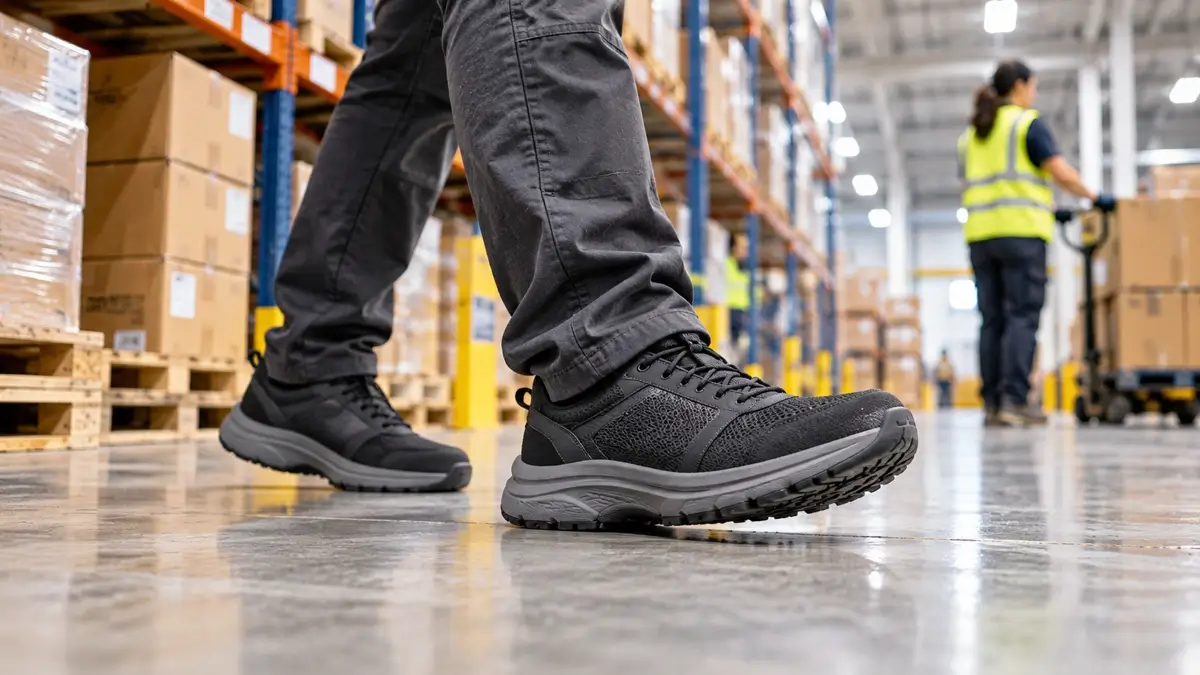
Warehouse work is hard on shoes because it combines two different problems: hours on unforgiving concrete and workplace hazards that ordinary walking shoes are not designed to handle. Pickers and packers may walk several miles in a shift. Shipping, receiving and manufacturing jobs can add slick floors, carts, pallets, dropped objects and employer rules about safety toes or electrical protection.
That is why there is no single best warehouse shoe for every worker. Start with the safety requirements of your job, then choose the most comfortable shoe inside that category. If your employer requires a composite, alloy or steel toe, a soft-toe shoe is not an acceptable substitute no matter how comfortable it feels. The Reebok Sublite Cushion Work RB4041 is one lightweight alloy-toe option we have reviewed. If you do not need toe protection, carrying unnecessary weight for 10 hours can create its own fatigue.
For related needs, see our guides to the best work shoes, best work shoes for women, best work shoes for men, best shoes for walking on concrete, best slip-resistant work shoes and best steel-toe shoes. For a broader comparison of cushioned shoes across jobs and surfaces, see our best shoes for standing all day roundup.
Best shoes for warehouse workers compared
| Shoe | Best for | Toe protection | Warehouse advantage | Launch Price |
|---|---|---|---|---|
| Hoka Bondi SR | Best overall soft-toe option | None | Maximum cushioning, slip-resistant outsole, wipe-clean leather | $180 | Check sizes and availability on Amazon |
| KEEN Utility Vista Energy | Best safety-toe option | Carbon-fiber toe on safety versions | Athletic feel, roomy forefoot, work-rated protection | About $125 | Check sizes and availability on Amazon |
| Brooks Addiction Walker 2 | Best for support and overpronation | None | Motion control, slip resistance, wide sizing | About $150 | Check sizes and availability on Amazon |
| Skechers Work Arch Fit 2.0 Slip Resistant | Best value | None on the version listed | Arch support, slip resistance, wide option | About $110 | Check sizes and availability on Amazon |
| Reebok Sublite Cushion Work | Best lightweight safety shoe | Composite, alloy and soft-toe versions | Athletic build with warehouse-specific safety versions | $139.99 for RB4051 | Check sizes and availability on Amazon |
Hoka Bondi SR is our best warehouse shoe when you do not need a safety toe
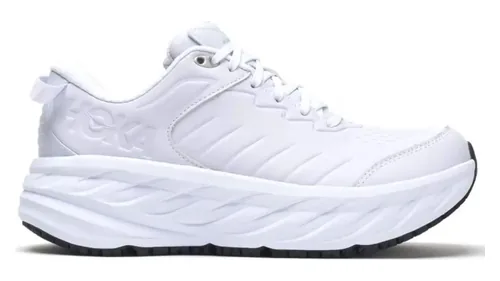
The Bondi SR makes sense for warehouse jobs where the main enemy is the floor rather than falling objects. It takes Hoka’s deep Bondi cushioning, wraps it in water-resistant leather and adds a slip-resistant outsole. That combination is useful for workers who spend most of a shift walking concrete aisles, staging orders or standing at a packing station.
The cushioning is the reason to choose it. A warehouse floor does not give, so the midsole has to do more of the impact-management work. The leather upper also wipes clean more easily than a mesh running shoe. The trade-offs are weight, warmth and price. More importantly, the Bondi SR is not a safety-toe shoe. If your site requires protective footwear, move to one of the KEEN or Reebok options below.
- Maximum cushioning for concrete floors
- Slip-resistant rubber outsole
- Water-resistant leather upper
- Regular and wide sizing
- Launch/list price: $180
Who should skip it: workers required to wear a safety toe, and anyone who wants a light, highly breathable shoe.
Read our full Hoka Bondi SR review
KEEN Utility Vista Energy is the better choice when you need a safety toe
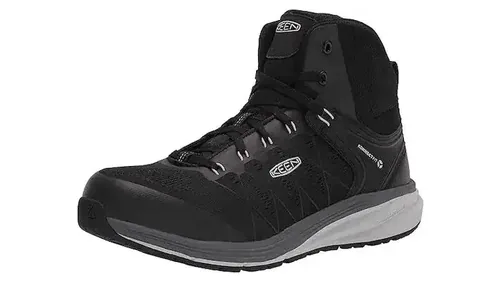
The Vista Energy is closer to an athletic shoe than a traditional work boot, which is exactly why it fits warehouse work well. Safety-toe versions use a lighter nonmetallic carbon-fiber toe, while the low-cut shape and cushioned midsole reduce some of the bulk workers associate with protective footwear.
KEEN Utility also tends to leave more space around the toes than narrow running-shoe-shaped work sneakers. That matters late in a shift when feet have warmed up and spread. Depending on the exact Vista Energy version, you can also find electrical-hazard or static-control features, so check the model designation against your workplace rules rather than assuming every Vista Energy has identical certifications.
- Carbon-fiber safety-toe versions available
- Athletic low-cut construction
- Roomier forefoot than many work sneakers
- Work-rated outsole and safety configurations
- Launch/list price: about $125, depending on version
Who should skip it: workers who do not need a safety toe and would rather prioritize maximum cushioning, or jobs requiring a specific certification not offered by the exact Vista Energy version you are considering.
See our KEEN work footwear guide
Brooks Addiction Walker 2 is the stronger support choice
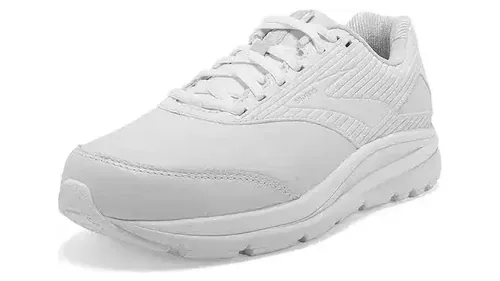
The Addiction Walker 2 is built for workers who care more about support and control than softness. Its Rollbar guidance system helps limit excess motion, while the leather upper and slip-resistant outsole make it more work-friendly than a normal stability running shoe. It is especially useful for people who overpronate or who feel unstable in very soft, tall cushioning.
It also has unusually broad width coverage, including extra-wide options. The downside is that it feels heavier and firmer than the Bondi SR. For warehouse workers who cover a lot of ground, that weight can be noticeable. For someone whose feet and ankles feel better in a structured platform, the trade can be worthwhile.
- Strong motion-control support
- Slip-resistant outsole
- Durable leather upper
- Widths through extra-wide
- Launch/list price: about $150
Who should skip it: workers who prefer a light, soft athletic feel or who require a protective safety toe.
Read our full Brooks Addiction Walker 2 review
Skechers Work Arch Fit 2.0 Slip Resistant is the value pick
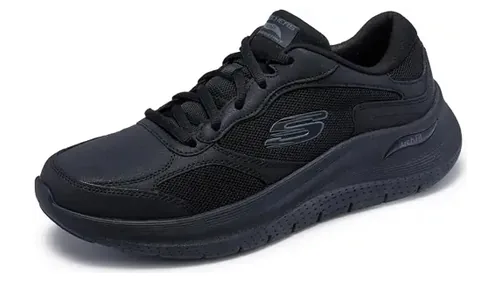
Skechers is useful when you want a work-specific shoe without moving into premium pricing. The Work Arch Fit 2.0 Slip Resistant combines a contoured Arch Fit footbed with a work outsole and a more conventional sneaker feel. It is a practical fit for warehouse jobs that require traction but do not require a safety toe.
The support feels different from the Brooks. Instead of a strong motion-control system, the Skechers relies more on its shaped insole and a relatively stable base. That works well for many people who simply want more under-arch structure than a flat work sneaker provides. Wide versions also make it easier to fit feet that swell during a shift.
- Arch Fit contoured insole
- Slip-resistant work outsole
- Wide versions available
- Lower price than Hoka or Brooks
- Launch/list price: about $110
Who should skip it: workers who need a safety toe, maximum cushioning or stronger motion control.
Reebok Sublite Cushion Work is the lightweight safety-shoe alternative
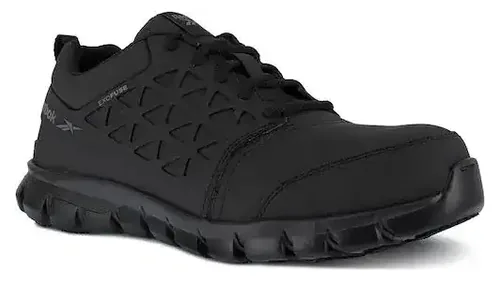
Reebok’s Sublite Cushion Work line is a good example of why warehouse workers should shop by exact model number rather than only by shoe name. Reebok sells Sublite Cushion Work versions with composite toes, alloy toes and soft toes, and its warehouse and manufacturing collection includes several of them. The RB4051 composite-toe version, for example, carries a regular price of $139.99.
The appeal is weight. A lighter athletic work shoe is easier to move in than a traditional boot when your job involves constant picking, packing and walking. Reebok also offers electrical-hazard and slip-resistant versions. Again, make sure the exact SKU matches the requirement on your safety sheet because the features vary across the Sublite family.
- Composite-, alloy- and soft-toe configurations
- Athletic low-cut design
- Slip-resistant versions available
- Electrical-hazard versions available
- List price: $139.99 for RB4051
Who should skip it: workers who want maximum underfoot cushioning or who prefer the roomier forefoot shape of KEEN Utility footwear.
Match the shoe to what your warehouse actually requires
Before comparing cushioning, find out what your employer requires. “Warehouse shoe” is not a safety standard. One building may allow athletic shoes with good traction. Another may require ASTM-rated protective toes, electrical-hazard footwear, static-dissipative footwear or puncture resistance. If your job requires a protective toe, compare our best steel-toe shoes before choosing a warehouse shoe. Those requirements should eliminate unsuitable shoes before comfort or price enters the decision.
If you work around heavy pallets, forklifts or equipment, toe protection may matter more than shaving a few ounces from the shoe. If you work primarily in order fulfillment with no safety-toe requirement, a well-cushioned soft-toe work shoe can be more comfortable for the thousands of steps you take during a shift. Static-sensitive electronics facilities are another category entirely: electrical-hazard and static-dissipative footwear solve different problems, so do not treat the labels as interchangeable.
Concrete-floor comfort is about more than soft foam
Very soft cushioning can feel impressive for five minutes and still be tiring after hours of side-to-side movement, ladder use and pushing carts. Warehouse shoes need a stable base under the cushioning. Heel hold matters too. If your heel slides or your foot moves inside the shoe, you spend energy stabilizing yourself with every step.
Fit your work shoes in the type of socks you wear on shift, and if possible try them later in the day when your feet are closer to their working size. Leave useful toe room without buying extra length simply to solve a width problem. If your toes are crowded, see our guide to shoe brands for wide feet and roomy toe boxes.
Order pickers: shoes for long picking routes
Order pickers are a specific kind of warehouse worker: they may walk long routes through aisles, pivot at shelving, crouch to pull stock and travel between picking zones many times during a shift. Rather than buying the bulkiest boot available, choose the lightest footwear that still meets the site’s protective-toe, traction and other hazard requirements. Ask your supervisor for the exact specification: a model described only as a “work shoe” is not automatically certified safety footwear.
For pickers required to wear safety toes on mostly dry indoor routes, the Reebok Sublite Cushion Work RB4041 offers an athletic-style alloy-toe option. A correctly rated KEEN Utility Vista Energy can provide a different toe-box shape and protective fit. Where soft-toe footwear is permitted, the Brooks Addiction Walker 2 offers structured support, while the Hoka Bondi SR emphasizes cushioning and slip resistance. Those are different choices for different site policies, not interchangeable safety recommendations.
If you also unload trucks or work outside, check whether your role requires waterproofing, a metatarsal guard or a puncture-resistant plate. Heavy protective boots can be suitable for those hazards but may be unnecessarily tiring for all-day indoor picking. A protective toe cap does not protect the top of the foot unless the exact model has an appropriate metatarsal rating. Check the label on the version sold, not a similar shoe from the same family.
For fit, test the shoes with work socks after your feet have been active. Your heel should not slide when pushing carts or turning, and your toes should not strike the inside of a safety cap when crouching. Use a wide size when needed instead of adding extra length to a narrow model. Replace shoes when tread wears down or protective components are damaged, even if the upper still looks clean.
Frequently asked questions about warehouse shoes
The best warehouse shoe depends first on workplace safety rules. For soft-toe jobs, cushioned slip-resistant shoes such as the Hoka Bondi SR can work well on concrete. If a safety toe is required, choose a properly rated model such as a KEEN Utility Vista Energy or Reebok Sublite Cushion Work safety-toe version.
Not always. Some warehouses require protective toes and others do not. Your employer’s safety policy determines whether you need steel, composite, carbon-fiber or alloy protection. Do not assume an ordinary work sneaker meets the requirement.
Running shoes can be comfortable on concrete, but many lack work-rated slip resistance, durable uppers and required safety protection. They are only appropriate when your workplace allows them and the outsole provides enough traction for the surfaces you encounter.
A work sneaker is usually lighter and easier for high-mileage indoor jobs. A work boot can provide more ankle coverage, weather protection or rugged durability. The correct choice depends on the hazards and safety rules of the job rather than the warehouse label alone.
Enough cushioning to reduce the harsh feel of concrete is useful, but more is not automatically better. The platform should also remain stable when turning, pushing carts, climbing steps and carrying loads. Workers who feel unstable in very soft shoes may prefer a firmer, more structured model.
Slip resistance is useful in most warehouses and essential where dust, water, oil or other contaminants can make floors slick. If your employer specifies a particular slip standard, verify the exact model rather than relying only on a ‘non-slip’ marketing claim.
Replace work shoes when cushioning is compressed, tread is worn smooth, the upper no longer holds the foot securely or required protective components are damaged. High-mileage workers can wear shoes out much faster than someone who mainly stands at one station.