Last Updated on October 14, 2026
Thick cushioning and a grippy, wipe-clean build in a heavy, warm shoe
Quick Answer: Hoka Bondi SR Review: The Bondi SR is Hoka’s Bondi cushioning wrapped in water-resistant leather and fitted with a slip-resistant sole, built for nurses, chefs, hospitality staff and anyone else who spends a shift on hard, wet floors. The cushioning is the deepest in any mainstream work shoe, and the smooth leather wipes clean after a spill. In exchange you get a heavy, warm shoe that costs more than most work footwear. Check latest price.
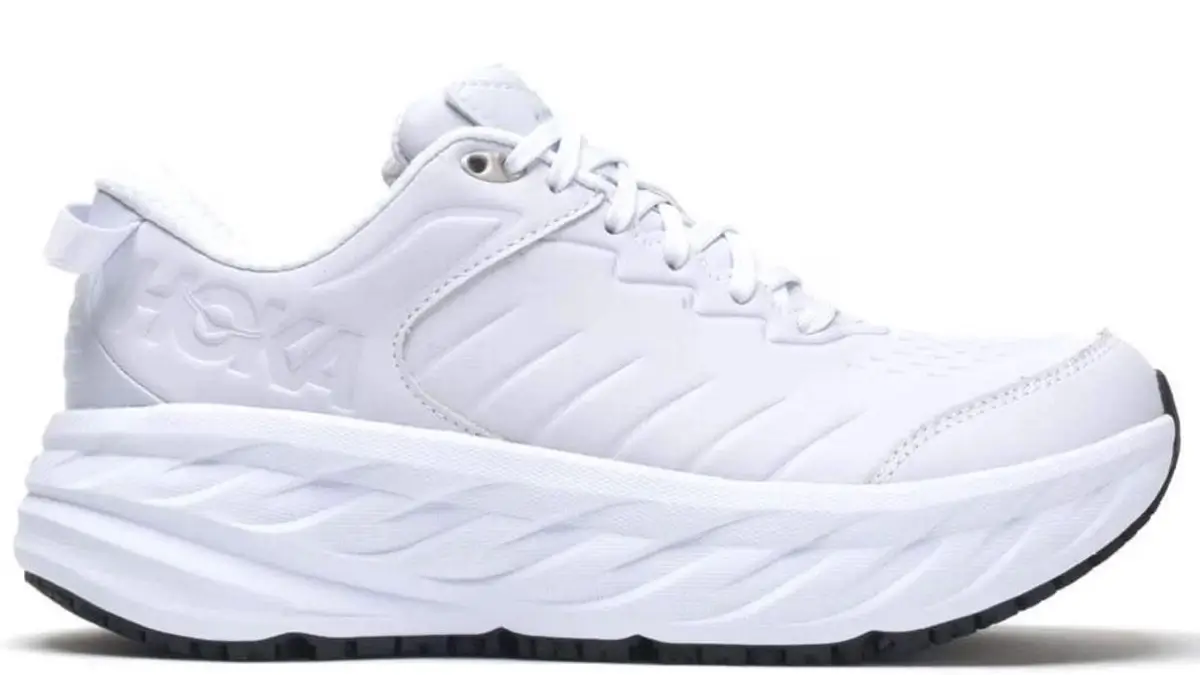
The Hoka Bondi SR takes the Bondi, Hoka’s most heavily cushioned everyday shoe, and rebuilds it for work. The mesh upper is replaced with water-resistant leather, the outsole is swapped for a slip-resistant compound and the whole thing is finished so a spilled drink wipes off instead of soaking in. Hoka lists it at $180. We could not confirm an original launch month from a primary source, so treat the release date as approximate.
Work footwear is usually a compromise. Clogs are easy to clean and easy to kick off but firm underfoot. Sneakers are comfortable but soak up whatever lands on them and slide on a wet floor. The Bondi SR exists to close that gap: it is as cushioned as a max-cushion running shoe and as practical as a clog.
It is also the shoe you see most often on hospital wards, and that is not an accident. If you are on your feet for 10 or 12 hours on a hard floor, the single biggest factor in how your legs feel afterwards is how much your shoes absorb, and this absorbs more than almost anything else you are allowed to wear at work.

Specs
Here are the specifications for the Hoka Bondi SR:
| Shoe type | Slip-resistant work and standing shoe on a max-cushion platform |
| Best for | Long shifts on hard floors: healthcare, hospitality, retail and food service |
| Midsole | EVA foam, the same soft, lightweight cushioning used across the Bondi line |
| Stack height | Reported at about 42 mm at the heel and 36 mm at the forefoot, so treat as approximate |
| Heel-to-toe drop | 6 mm, meaning your heel sits only slightly higher than your toes |
| Upper | Water-resistant full-grain leather |
| Outsole | Slip-resistant rubber, using a Hoka compound tested against industry slip standards |
| Weight | About 11.5 oz in a women’s shoe and 14 oz in a men’s |
| Sizes | Women’s 5 to 11, men’s 7 to 15 |
| Widths | Regular and wide |
| Podiatric recognition | American Podiatric Medical Association Seal of Acceptance |
| Price | $180 as listed by Hoka. Original launch month not confirmed. Check latest price |
Pros
- The deepest cushioning of any mainstream work shoe, which is the whole reason to buy it if you stand all day.
- Water-resistant leather wipes clean, so a spill is a nuisance rather than the end of the shoe.
- The slip-resistant outsole is tested against industry standards, not just marketed as grippy.
- A wide width is available, and the sizing runs from women’s 5 to men’s 15.
- The rocker shape rolls you forward, which reduces how hard your calves work over a long shift.
Cons
- At around 14 oz in a men’s shoe it is heavy, and you feel that on a long shift.
- Leather does not breathe like mesh, so your feet run warm and sweaty by hour eight.
- $180 is a lot for work footwear, particularly for anyone replacing shoes every year.
- The tall, soft platform can feel tippy at first if you are coming from a firm clog or a flat sneaker.
- It is a plain white or black work shoe, with none of the color choice the running Bondi gets.
What is new versus the standard Hoka Bondi
The Bondi SR is not a new generation of an older SR model. It is a work-specific version of the regular Bondi, and comparing the two is the useful exercise.
Two things change. The upper goes from engineered mesh to water-resistant full-grain leather, which is the difference between a shoe that absorbs a spilled coffee and a shoe you wipe with a cloth. And the outsole changes to a slip-resistant compound tested against industry slip standards, rather than the standard rubber the running Bondi uses. If you want to understand what those ratings actually measure, our guide to slip-resistant shoe standards covers it.
What does not change is the part that matters most: the thick EVA midsole and the rocker shape underneath it. You get the same soft landing and the same forward roll, in a shoe your employer will let you wear. The costs are weight, because leather is heavier than mesh, and heat, because leather does not breathe.
Who should buy the Hoka Bondi SR
Buy it if you stand and walk on hard floors for long shifts and your legs hurt afterwards. Hospital corridors, kitchen tile and retail concrete are unforgiving surfaces, and the depth of foam here does more to blunt them than any insole you can buy separately.
It also suits anyone whose workplace requires a closed, wipeable shoe. Healthcare and food service dress codes usually rule out mesh, and the leather upper meets that requirement without giving up comfort. It carries the APMA Seal of Acceptance, which means the podiatric association reviewed it and considers the design good for foot health. That is a recognition of design, not a medical claim.
Finally, it suits people who find clogs uncomfortable. Clogs are firm and open at the heel, and plenty of people find them unstable or hard on the joints. The Bondi SR is the opposite in both respects: enclosed, laced and soft. If you have tried a clog and disliked it, this is the natural next thing to try.
Who should probably skip it
Skip it if your feet get hot easily. Leather traps heat, and a 12-hour shift in a warm kitchen is exactly the situation where that becomes miserable. Skip it if you want something light on your feet, because 14 oz in a men’s size is a lot of shoe. Skip it if you need to slip your shoes on and off repeatedly, since this is a laced shoe and a clog does that job far better. And if you are replacing work shoes every six months on a tight budget, $180 a time is hard to justify.
Three shoes that suit that person better:
- Crocs Neria Pro II: a light, fully washable work clog for wet floors, at a fraction of the price and easy to step in and out of (check price)
- New Balance 626v2: a slip-resistant leather work shoe that is lighter and cheaper than the Hoka, with a much lower profile underfoot (check price)
- Dansko XP 2.0: the lighter modern Dansko clog, with a rocker sole and a slip-resistant outsole, for people who want the convenience of a clog with more give than the classic (check price)
Also see our guide to slip resistant shoes
How does the Hoka Bondi SR fit?
The Bondi SR fits like a roomy, slightly structured sneaker rather than a work boot. Length runs true for most people and the shape is generous through the middle and front. The leather adds a little firmness that mesh does not have, so it takes a couple of shifts to settle.
Fit and sizing
Order your usual size. Hoka offers a wide width, which is worth taking if you know your feet spread over the course of a shift, and the size run is unusually broad at women’s 5 to 11 and men’s 7 to 15. Leather has some structure to it and will mold slightly to your foot with wear, though it will not stretch the way a soft upper does, so do not buy something that pinches on day one hoping it will give. The insole lifts out, which matters if you wear a prescribed orthotic. This shoe has plenty of depth to take one.
Upper and step-in comfort
The upper is water-resistant full-grain leather, which is the good stuff: dense, smooth and easy to wipe. Step-in comfort is soft underfoot and firm around the edges, a slightly odd combination the first time. The collar and tongue are padded and the heel is held securely. What you will notice most is airflow, or the lack of it. This is a closed leather shoe with no ventilation panels, and by the end of a long warm shift your socks will know about it. Good moisture-wicking socks make a real difference here.
How does the Hoka Bondi SR perform?
Judge this shoe on how you feel at the end of a shift rather than on how it moves. It cushions harder floors better than anything comparable and it grips wet surfaces reliably. The costs are weight and heat.
Cushioning and ride
The midsole is EVA, a light foam that compresses easily, and there is a lot of it: reported stack heights are around 42 mm at the heel and 36 mm at the forefoot, meaning there is roughly an inch and a half of material between your heel and the ground. That is what soaks up the shock of thousands of steps on tile. The 6 mm drop, which means your heel sits just slightly higher than your toes, is gentle and feels natural to most people. Underneath it all is a rocker, a curved sole shape that tips you forward through each step so you do not have to push off as hard. If that is a new idea, our explainer on what a rocker does in a shoe covers it in more detail.
Stability and support
This is a neutral shoe, which means it does not try to steer your foot in one direction or another. Support comes from the shape rather than from a corrective wedge: the base is wide, and the foam walls rise up around the edges of your heel so your foot sits down inside the platform rather than perching on top of it. That matters, because soft foam this tall would otherwise feel wobbly. Coming from a firm clog it can still feel tall and a little unsettled for the first shift or two. It will not change how your foot rolls, and it is not a treatment for any condition. If you have persistent foot, knee or back pain from standing, see a professional rather than relying on footwear alone.
Outsole, grip and durability
The outsole uses a slip-resistant rubber compound that Hoka has tested against industry slip standards, which is a meaningful difference from a shoe simply described as grippy. On wet tile and greasy kitchen floors it holds where a running outsole would let go. Coverage is generous, which also helps the shoe last: the rubber takes the wear rather than the exposed foam. Expect the leather to scuff and crease long before the sole gives out, and expect the midsole foam to soften gradually with heavy use, which is normal for EVA and the usual reason work shoes stop feeling new.
Is the Hoka Bondi SR good for walking?
Yes, and that is a large part of the appeal. Nurses cover several miles a shift without ever leaving the building, and this shoe is built for exactly that kind of walking: continuous, on hard flat surfaces, at a steady pace. The deep cushioning and the rocker shape work together to reduce how much your feet and calves have to do, and the wide, stable base means you are not fighting the softness.
For walking outside work it is a heavier, warmer choice than a dedicated walking shoe, and the leather is overkill unless you want a shoe that survives rain and mud. As a travel shoe it is decent, since it wipes clean and cushions long airport days, though the weight counts against it in a carry-on. For standing all day, on the other hand, it is one of the best shoes on the market at any price.
Bondi SR versus the standard Bondi
| Feature | Bondi SR | Standard Bondi |
| Upper | Water-resistant full-grain leather | Engineered mesh |
| Outsole | Slip-resistant compound tested to industry standards | Standard road rubber |
| Midsole | Thick EVA with a rocker | Thick EVA with a rocker |
| Weight | Heavier, because leather weighs more than mesh | Lighter |
| Best use | Work shifts on hard, wet floors | Running and everyday walking |
Buy the SR when your floor is slippery, when your dress code requires leather or when you need a shoe you can wipe clean. Buy the standard Bondi when you want the same cushioning for running and walking and you would rather have a lighter, cooler shoe.
Shop the Bondi line on Amazon.
Hoka Bondi SR Alternatives
The Bondi SR is the cushioned, enclosed option. Different priorities point to different shoes.
Dansko Professional: the classic work clog and the opposite approach, firm underfoot with a rocker sole and an open heel you can step out of in a second. It suits people who want convenience and a roomy toe box more than they want softness (check price | read review).
Where the leather is the problem, the Hoka Transport 2 is the same brand’s answer for people who walk to work rather than stand in one. It is lighter and cooler, with a more casual look and a grippy outsole, though it gives up the wipe-clean surface and the slip-resistant rating that make the SR a work shoe (check price | read review).
Anyone who wants the Bondi feel without the work-shoe constraints should simply look at the Hoka Bondi 9. It is the running version: same deep cushioning, mesh upper, lighter on the foot and available in far more colors, with no slip-resistant sole and nothing that will survive a spill (check price).
For more options in this space, our roundup of the best Hoka shoes for nurses compares the wider range.

Price and value
At $180 the Bondi SR is priced like a premium running shoe rather than like work footwear, and there is no getting around that. What you are paying for is the combination: nothing else offers this much cushioning with a tested slip-resistant sole and a wipe-clean leather upper. If you work long shifts and your feet and legs are the limiting factor on how you feel at the end of the day, the calculation is simple and the shoe pays for itself in comfort. If you are on your feet for four hours at a time, or you go through work shoes quickly, cheaper options do most of the job.

Final verdict
Best for: long shifts on hard, wet floors, especially in healthcare and food service, where you need a closed leather shoe and want the most cushioning you can get.
Avoid if: your feet run hot, you want a light shoe, you need to slip your shoes on and off or you are working to a tight footwear budget.
Fit: true to size, roomy through the middle and front, available in regular and wide with a broad size run.
Verdict: The Hoka Bondi SR is the most comfortable work shoe we can point you at for standing all day, and the leather and slip-resistant sole mean you can actually wear it to work. It is heavy, it runs warm and it costs real money, but for the person it is built for those are easy trade-offs.
Frequently Asked Questions for Hoka Bondi SR
No. The leather is water resistant, which means it repels splashes and wipes clean, but it is not sealed and it is not a waterproof boot. Standing in a puddle will eventually get your socks wet.
You can, but you should not need to. It is heavier and warmer than the running Bondi and the slip-resistant outsole is tuned for smooth indoor floors rather than roads. For running, buy the standard Bondi.
Yes. Hoka offers regular and wide, and the size run covers women’s 5 to 11 and men’s 7 to 15. The wide is worth considering if your feet swell over a long shift. For current sizes and availability, check Hoka Bondi SR sizes on Amazon.
Wipe the leather with a damp cloth and mild soap and let it air dry away from direct heat. Do not put it in a washing machine or a tumble dryer, since heat degrades the foam midsole and the adhesives.
Usually yes. The insole is removable and the shoe is deep, which gives a prescribed orthotic room to sit properly. Try it with your insert in place before a long shift, and consider the wide width if it feels tight.
That depends on your shift length, your weight and your floor, so no honest figure fits everyone. The signal to replace is not how the shoe looks but how it feels: when the foam stops springing back and your legs start aching again, the midsole is done.