Last Updated on October 1, 2026
Quick Answer: The Hoka Bondi SR is our best work shoe for men who spend long shifts walking or standing on hard floors and do not need a safety toe. Choose the New Balance 626v2 for wide and extra-wide sizing, the Brooks Addiction Walker 2 for stronger support and overpronation, and the Reebok Sublite Cushion Work RB4041 when your job requires ASTM-rated toe protection. If your workplace has specific slip-resistance, steel-toe or electrical-hazard rules, start with those requirements before comparing comfort. Compare the picks.
The best work shoes for men depend on what the job actually asks your feet to do. A nurse, warehouse picker, restaurant manager and construction worker can all spend eight to 12 hours on their feet, but they do not need the same shoe. Cushioning matters on concrete. Slip resistance matters around wet or greasy floors. Toe protection matters when an employer requires it. Width, arch support and cleanability can matter just as much by the end of a long shift.
This guide focuses on current work shoes that solve different problems rather than pretending one model fits every workplace. Looking for women’s options? See our best work shoes for women. If you work mainly on concrete, also see our best shoes for walking on concrete all day. For wet floors, use our best slip-resistant work shoes. If your employer requires protective toes, compare our best steel-toe shoes and warehouse-shoe guide.
Best work shoes for men compared
Shoe | Best for | Main strength | Safety toe | Launch or original price |
|---|---|---|---|---|
Most comfortable work shoe for hard floors | Maximum cushioning, slip resistance, wipe-clean leather | No | $180 | Check latest price | |
Wide and extra-wide feet | ABZORB cushioning, work outsole, broad width range | No | Original MSRP not confirmed | Check latest price | |
Support and overpronation | Motion control, leather upper, slip-resistant outsole | No | About $150 | Check latest price | |
Lightweight safety-toe work | Alloy toe, flexible athletic feel, EH protection | Alloy | $123.99 | Check latest price |
The price column uses manufacturer launch or regular list pricing where we could confirm it. If we could not verify a historical manufacturer price, we say so rather than hard-code a temporary sale price. Retail prices change as colors, sizes and older work-shoe models move through inventory, so use the “Check latest price” links for the current selling price.
Hoka Bondi SR: Best overall for long shifts on hard floors
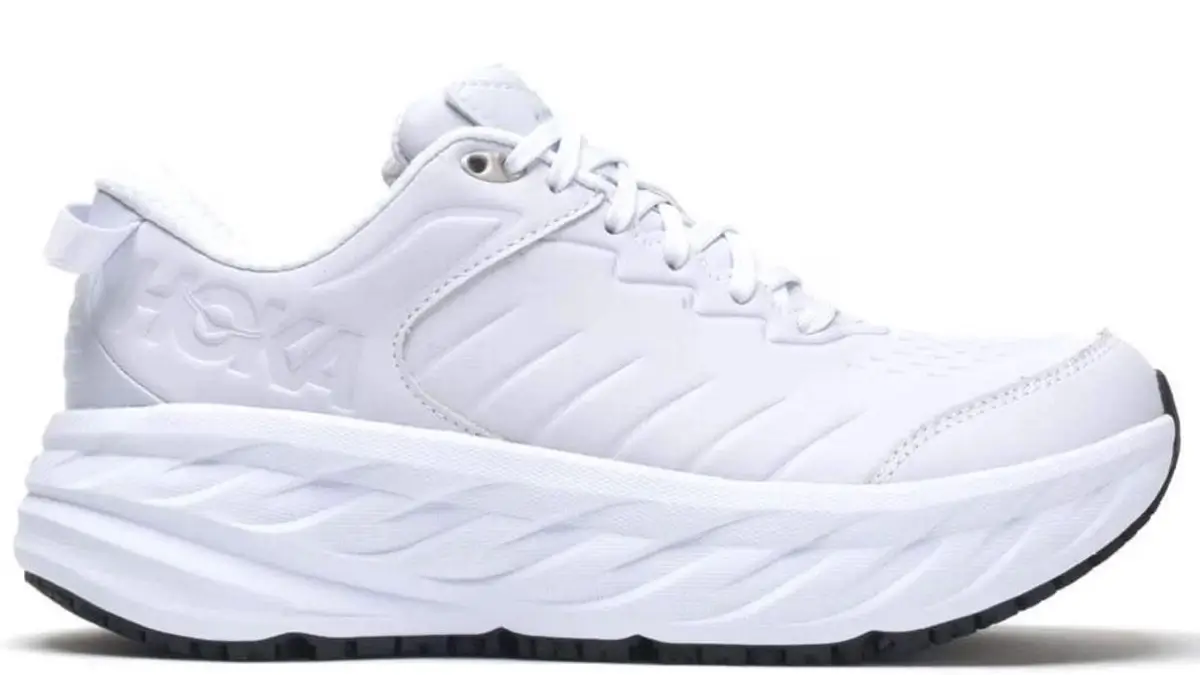
The Hoka Bondi SR is the strongest starting point when comfort on hard floors is the main problem and your job does not require a protective toe. Hoka takes the deep cushioning of the Bondi platform, replaces the running-shoe mesh with water-resistant leather and adds a slip-resistant work outsole. That combination makes it especially useful for healthcare, hospitality, retail and other jobs where you spend most of the shift walking or standing on tile or concrete.
The cushioning is the reason to choose it. The Bondi SR puts more foam underfoot than a traditional leather work shoe, which can make a long shift feel less punishing when your workplace allows a soft-toe shoe. The leather upper is also easier to wipe clean than ordinary mesh. The trade-offs are weight, warmth and price. This is a substantial shoe, and people who prefer a low, firm or highly breathable work sneaker may find it excessive.
Choose the Bondi SR if your workday is dominated by hard floors, repeated walking and standing. Skip it if your employer requires steel, composite or alloy toe protection. A comfortable soft-toe shoe is not a substitute for required safety footwear. Read our full Hoka Bondi SR review.
Check latest Hoka Bondi SR price and sizes.
New Balance 626v2: Best work shoe for wide feet

The New Balance 626v2 is a practical choice for men who need a true work shoe but struggle to find enough width. It is sold in standard, wide and extra-wide fittings and uses a leather upper with a slip-resistant industrial outsole. Under the heel, New Balance uses ABZORB cushioning to soften repeated impact. That makes it a good match for hospitals, hospitality, retail and some warehouse jobs where the main hazards are hard or slippery floors rather than falling objects.
The 626v2 is not a safety-toe shoe. That distinction matters. It works best for indoor environments where the employer allows soft-toe footwear but still expects a work-oriented outsole and durable upper. The shoe is heavier and warmer than a mesh walking sneaker, but the leather construction is easier to clean and the width range is unusually useful in this category. If a normal work shoe pinches the forefoot or forces you to size up just to gain width, the 626v2 deserves a closer look.
Choose it for width, cushioning and slip resistance. Skip it if your workplace requires toe protection or if you want the deepest possible cushioning. For more roomy options, see our best wide work shoes. Read our full New Balance 626v2 review.
Check latest New Balance 626v2 price and sizes.
Brooks Addiction Walker 2: Best for support and overpronation
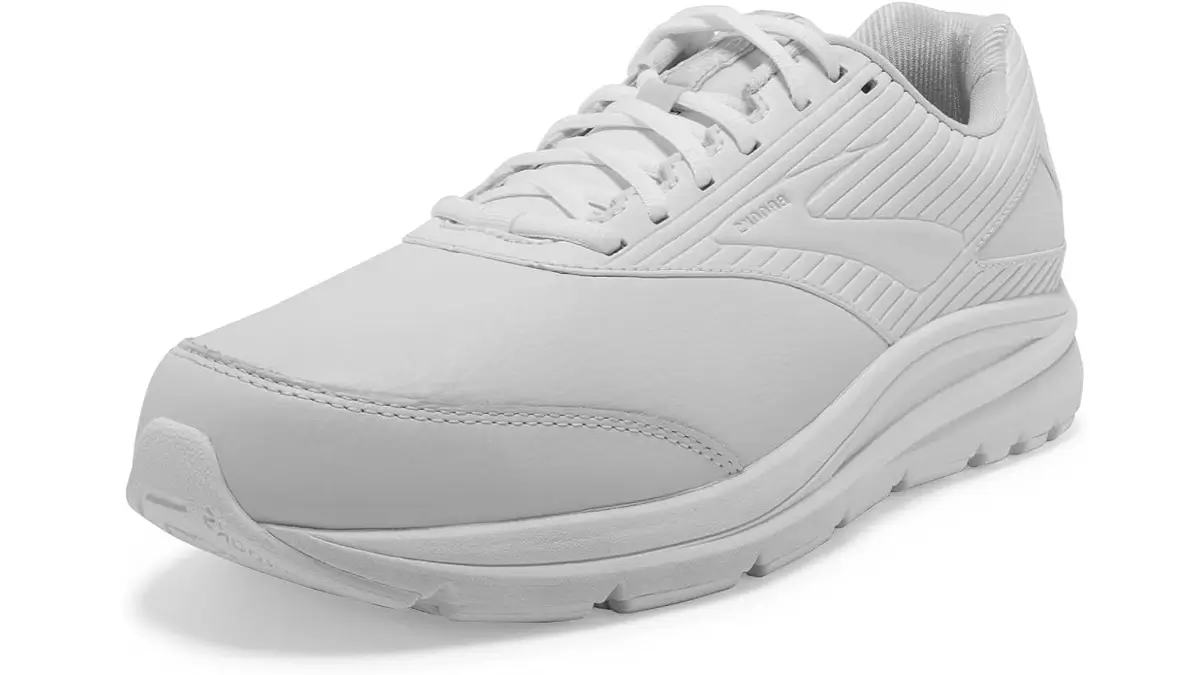
The Brooks Addiction Walker 2 is the more structured option in this group. It uses a full-grain leather upper, Brooks’ Extended Progressive Diagonal Rollbar for motion control and a slip-resistant outsole. The result is a firm, supportive walking shoe that makes sense for men who already know they feel better in structured footwear or who tend to overpronate during long periods of walking and standing.
It is not the softest work shoe here, and that is part of its purpose. The Bondi SR emphasizes cushioning; the Addiction Walker 2 emphasizes control and stability. Its broad width range and leather build also make it useful for workers who need durability and a secure fit rather than a light athletic feel. The trade-off is bulk. If you are comfortable in neutral shoes and do not want noticeable guidance, this may be more structure than you need.
Choose the Addiction Walker 2 if firm support, stability and long-term leather durability matter more than low weight. Skip it if you want a soft max-cushion platform or if your job requires a safety toe. Read our full Brooks Addiction Walker 2 review.
Check latest Brooks Addiction Walker 2 price and sizes.
Reebok Sublite Cushion Work RB4041: Best lightweight safety-toe work shoe
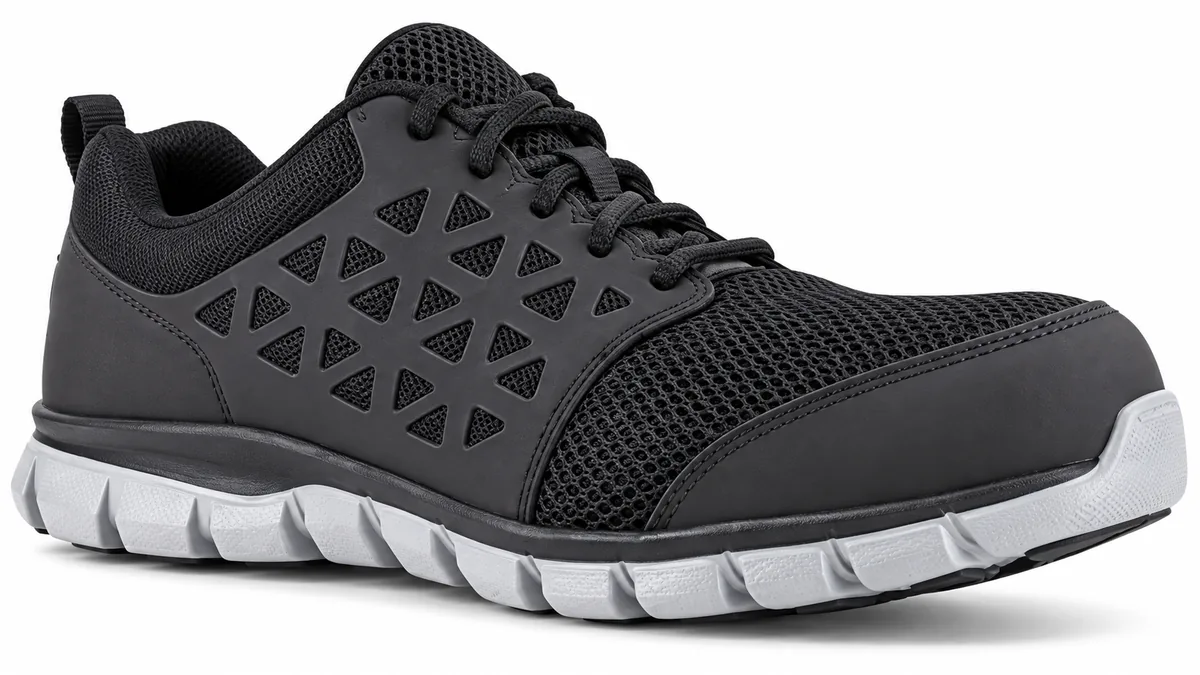
The Reebok Sublite Cushion Work RB4041 is the pick when a soft-toe walking shoe is not enough. It uses an XTR alloy safety toe, is listed by Reebok as meeting ASTM F2413 requirements and carries electrical-hazard protection. Unlike a traditional heavy work boot, it is built more like an athletic shoe, with a microfiber-and-mesh upper, flexible Sublite EVA cushioning and rubber traction pads concentrated at the heel and forefoot.
That design is especially useful for warehouse, distribution and light-manufacturing workers who spend a large part of the shift walking on relatively smooth indoor floors. The RB4041 gives up waterproofing and ankle coverage to stay lighter and more flexible. It is therefore a poor substitute for a rugged outdoor work boot, but a strong alternative when your workplace requires legitimate toe protection and you do not want to carry unnecessary bulk through thousands of steps.
Choose it when your job requires an ASTM-rated safety toe but an athletic work shoe makes more sense than a boot. Skip it for wet outdoor work, deep mud or jobs that require a different exact certification. Always verify the model number and your employer’s rule before buying. Read our full Reebok Sublite Cushion Work RB4041 review.
Check latest Reebok RB4041 price and sizes.
How to choose men’s work shoes by job
Start with the workplace requirement, not the softest shoe. If your employer requires a steel, composite or alloy safety toe, choose only from footwear that satisfies that requirement. If the floor is frequently wet, greasy or polished, look for a purpose-built slip-resistant work outsole. If neither applies and the job is mainly walking or standing, cushioning, fit and support can move higher on the list.
Work situation | Start here | Why |
|---|---|---|
Healthcare, hospitality or retail on hard floors | Maximum cushioning with a work-focused leather upper and outsole | |
Wide or extra-wide feet | One of the broader width ranges in a slip-resistant work sneaker | |
Overpronation or preference for strong support | Structured motion control and a stable leather platform | |
Warehouse or manufacturing with required toe protection | ASTM-rated alloy toe in a lighter athletic build | |
Steel toe specifically required | Choose a shoe whose exact certification matches the job | |
Wet or greasy floors | Traction becomes a safety requirement, not just a comfort feature |
What makes a work shoe comfortable for a long shift?
Comfort over eight or 12 hours is different from step-in softness in a store. A very soft shoe can feel impressive for five minutes and still leave you tired if the platform is unstable, the fit is wrong or the heel moves around. Long-shift comfort usually comes from a combination of enough cushioning, a stable base, a secure heel and enough forefoot room for your feet to swell as the day goes on.
Hard floors also change the equation. Concrete and tile return more impact than carpet or softer surfaces, so men who walk several miles during a shift often benefit from more underfoot protection. Standing in one place can favor a slightly firmer, steadier platform. If hard floors are your main problem, compare our work-shoe comfort and arch-support guide and best shoes for standing all day.
Do you need slip resistance or a safety toe?
These features solve different problems. Slip resistance is about traction on workplace floors. A safety toe protects against impact and compression. Some shoes include both, but one does not imply the other. A cushioned hospital shoe may be slip resistant without having a protective toe. A safety shoe may meet an impact standard but still be the wrong footwear for a greasy restaurant floor if its outsole is not designed for that environment.
Do not rely on marketing words such as “work shoe” or “non-slip” when your employer specifies a standard. Check the exact model and certification. This is especially important in construction, warehousing, manufacturing and electrical work. Our slip-resistance standards guide explains common traction labels, while the steel-toe and warehouse guides cover protective footwear in more detail.
Fit matters more after eight hours
A work shoe that feels merely snug in the morning can become painful after hours of standing because feet often swell through the day. Your toes should have usable room, your heel should stay secure and the shoe should be wide enough across the forefoot without forcing you to buy unnecessary extra length. If the shoe is available in multiple widths, use the correct width rather than automatically sizing up.
Men with especially wide feet should compare our wide work-shoe guide. If you are unsure whether width is actually the problem, see Do I Need Wide Shoes?. And if you use custom orthotics or a substantial insert, check that the original insole is removable and that the shoe has enough internal volume for the replacement without crowding your toes.
Frequently asked questions
For men who spend long shifts on hard floors and do not need a safety toe, the Hoka Bondi SR is our comfort-first pick because it combines deep cushioning with a work-focused leather upper and slip-resistant outsole. The best choice changes if your job requires toe protection or stronger motion control.
The New Balance 626v2 is a strong work-shoe option for wide feet because it is sold in wide and extra-wide fittings and combines a leather upper, ABZORB cushioning and a slip-resistant work outsole. Men who need protective toes should use a wide safety-shoe guide instead.
Sometimes, but only when the workplace allows them. A cushioned running shoe can be comfortable for dry, low-risk environments, but ordinary running shoes usually do not provide workplace slip resistance, easy-clean uppers or safety-toe protection. Match the shoe to the job rather than comfort alone.
The Brooks Addiction Walker 2 is our structured-support pick. It uses a motion-control system, a stable leather platform and a slip-resistant outsole. Not everyone who works on their feet needs motion control, so choose it when you already know you prefer a more guided shoe.
The Reebok Sublite Cushion Work RB4041 is our lightweight safety-toe pick for indoor warehouse and manufacturing work. It uses an alloy safety toe and is listed as meeting ASTM F2413 requirements. Verify your employer’s exact required standard before buying.
Your toes should be able to move without hitting the front or sides of the shoe, while the heel stays secure. Work shoes should not feel cramped at the start of a shift because feet can swell during long hours. A width problem is usually better solved with the correct width than extra length.
Replace work shoes when cushioning has flattened, the outsole has lost meaningful traction, the upper no longer holds the foot securely or protective components are damaged. There is no single replacement interval for every job because surface, body weight, mileage and workplace conditions change wear rates.