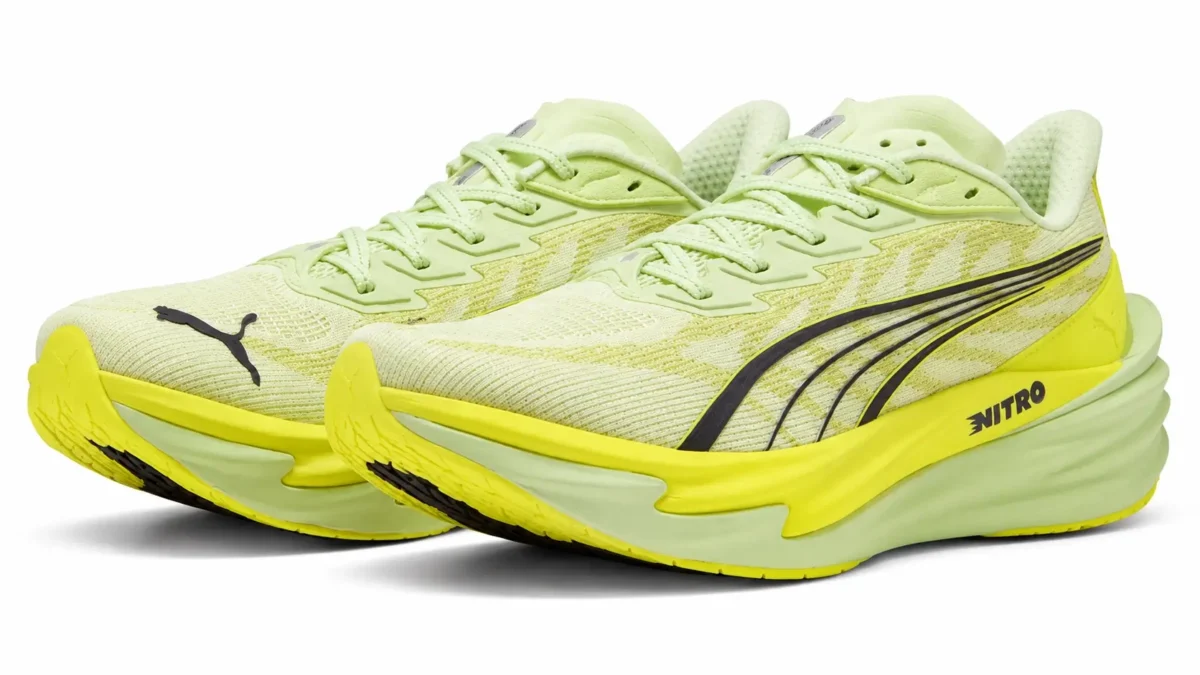
Puma’s best ever marathon shoe
Quick Answer: Puma Deviate Nitro Elite 4 Review: The Puma Deviate Nitro Elite 4 is a carbon-plated marathon racing shoe for neutral runners chasing a personal best. A much lighter build and a stiffer plate give it a snappy, propulsive feel that holds together over long distances, and it is now one of the strongest race-day options on sale. It is expensive, and the narrow, stripped-back fit means it earns its keep on race day only. Check latest price.
The Puma Deviate Nitro Elite 4 sits at the top of Puma’s road racing line, above the everyday Deviate Nitro 4 and beside the shorter-distance Fast-R and Fast-FWD models. Puma has been in the carbon-plate business for several years now without ever quite producing the shoe that made people switch. This is the version that changes that.
Two things have happened. The foam has been reworked into a compound Puma calls Nitrofoam Elite, and the shoe has lost a substantial amount of weight: 24 grams compared with the previous version, which is around 12 percent. In a category where everyone is shaving grams, that is a big jump in one generation. The result is a shoe built for one purpose, which is to get you through a half marathon or a marathon faster than you otherwise would.
Specs
Here are the specifications for the Puma Deviate Nitro Elite 4:
| Type | Carbon-plated road racing shoe |
| Gait type | Neutral |
| Midsole | Nitrofoam Elite, a nitrogen-infused supercritical foam |
| Plate | Carbon fiber PWRPLATE, stiffer than the previous version and reshaped to reduce forefoot stress |
| Stack height | 38 mm heel, 30 mm forefoot (manufacturer). Independent measurements report about 37.2 mm and 28.3 mm |
| Heel-to-toe drop | 8 mm |
| Weight | 6.0 oz (170 g) men’s 9; 5.2 oz (147 g) women’s 8 |
| Upper | Ultra-thin engineered mesh with minimal padding |
| Outsole | PumaGRIP rubber in strategic patches |
| Widths | Standard only; Puma does not publish alternative width fittings for this model |
| Best for | Half marathons and marathons, plus long race-pace sessions |
| Price | Launched at about $250 in February 2026. Check latest price |
Pros
- At 6 ounces it is among the lightest marathon shoes on sale, and you feel that in the last few miles.
- The stiffer plate gives a genuinely snappy push-off that keeps working when your legs are tired.
- Nitrofoam Elite is soft and springy without collapsing under sustained effort.
- PumaGRIP is one of the best outsole rubbers in the business, wet or dry.
- The reshaped plate is designed to reduce stress across the forefoot, which addresses a real complaint about earlier plated racers.
Cons
- At around $250 it costs as much as three pairs of budget trainers.
- The paper-thin upper and narrow last leave no room for feet that swell, and there is no wide fitting.
- Published and measured stack heights do not agree, which matters if you race under governing-body rules.
- Far too aggressive for easy running, so it is a single-purpose shoe.
- Race shoes of this kind have short usable lives, so the cost per mile is high.
What is new versus the Deviate Nitro Elite 3
The weight saving is the headline. The previous version came in at 194 grams and this one at 170, a cut of about 12 percent achieved through a thinner upper, less rubber on the outsole and a lighter foam formulation. Twenty-four grams sounds trivial until you multiply it by the number of times your foot leaves the ground over 26 miles, at which point it becomes one of the more meaningful upgrades a racing shoe can offer.
The plate has changed too. Puma has made the carbon PWRPLATE stiffer, which gives a firmer, more definite push at toe-off, and reshaped it specifically to spread load away from the metatarsal area, the long bones behind your toes that take a beating in stiff racing shoes. The foam is a reworked Nitrofoam Elite, nitrogen-infused so it is lighter and bouncier than standard foam. Together those changes turn a shoe that was merely good into one that competes with anything on a start line. Puma does not publish a confirmed launch price for the previous version that we can verify, so we have not listed one.
Who should buy the Puma Deviate Nitro Elite 4
Buy it if you are racing a half marathon or a marathon and you want the shoe to help. This is a proper race-day tool, and over long distances the combination of very low weight, a stiff plate and a springy foam adds up to something you can measure on a clock. It is best suited to runners with an efficient stride who land on the midfoot or forefoot, because that is where the plate does its work.
It also suits runners who have found other carbon racers punishing across the forefoot, since the reworked plate geometry is aimed squarely at that problem. And if you have used earlier Deviate Elites and liked them without quite loving them, this is the version worth coming back for. Anyone with narrow feet will find the fit excellent, and the outsole grip means a wet race day is not a worry, which is more than can be said for some rivals that scrimp on rubber to save weight.
Who should probably skip it
Skip it if you are not racing. A shoe like this is wasted on easy running and will wear out fast if you use it that way, and the stiff plate is tiring at slow paces. Skip it if you have wide feet: the last is narrow, the upper is thin enough that it will not stretch to accommodate you and there is no wide fitting on offer. Skip it too if $250 for a shoe you will use a handful of times is more than you want to think about.
Runners who need stability should also stay away, since there is nothing here resisting the foot rolling inward. Better choices:
- Hoka Mach X 2: a plated super trainer you can use every week, with enough cushioning for daily miles (check price | read review).
- Asics Superblast 3: far roomier through the forefoot and comfortable enough for everyday miles, with no plate to manage (check price | read review).
- Saucony Endorphin Azura: a plateless super trainer that gives you a lively ride without the race-day commitment or price (check price | read review).
How does the Puma Deviate Nitro Elite 4 fit?
This is a racing fit, which means close, low and held. The shoe wraps the foot with almost no spare material anywhere, and the upper is thin enough that you can feel the shape of your foot through it. It fits true to size in length but runs narrow, and it is not a shoe that forgives a poor match.
Fit and sizing
Take your usual size for length. The midfoot is snug and the forefoot is narrow, so if you are between sizes or have any width to your foot at all, try before you commit. Puma offers no wide fitting here. The heel is held by a minimal counter with very little padding, which works well when the shoe fits and rubs when it does not. Bear in mind that feet swell over a marathon, so a fit that feels perfect standing in a shop can feel tight at mile 20.
Upper and step-in comfort
The upper is about as thin as engineered mesh gets, with almost nothing in the way of padding or overlays. That is where a good part of the weight saving comes from, and the trade-off is honest: it breathes beautifully and weighs nothing, but it offers no protection and no give. Step-in comfort is minimal by design. There is a hint of padding at the collar and nothing else. It is the kind of shoe you put on twenty minutes before a race and take off an hour or three later.
How does the Puma Deviate Nitro Elite 4 perform?
Judged on the only thing it is designed for, this shoe performs extremely well. It feels quick from the first step, it holds its shape and its bounce over long distances, and it does not punish the forefoot the way stiff racers often do. Everything else about it, comfort, versatility, longevity, is secondary and the design says so.
Cushioning and ride
Nitrofoam Elite is a supercritical foam, which means gas is forced into it under high pressure so it ends up lighter and springier than ordinary foam. At 38 mm under the heel there is plenty of it, and the feel is soft on landing and quick to return. The important quality in a marathon shoe is not how soft the foam is on the first mile but whether it still behaves the same on the twenty-second, and this one does. It resists the flattening out that makes some racing foams feel dead in the closing stages.
Ride and running performance
A carbon plate is a stiff sheet of composite buried in the foam. It does not act like a spring, whatever the marketing says. What it does is stop your toes bending as much, which reduces the work your foot muscles have to do and rolls you forward off the front of the shoe. The PWRPLATE here is stiffer than before, and the result is a definite snap at toe-off that carries you along. The shoe wants to be run fast: at easy paces it feels awkward and stiff, and at race pace it comes together. The 8 mm drop, meaning your heel sits 8 mm above your toes, is more generous than some rivals and suits runners who are not pure forefoot strikers.
Stability and support
This is a neutral shoe with no support features at all. Tall, soft, plated racers are inherently less stable than ordinary trainers, because there is a lot of compressible material between you and the ground and a stiff plate can amplify any wobble. The Deviate Nitro Elite 4 handles this better than most, thanks to a reasonably broad forefoot and a plate shaped to keep the foot centered, but it is still a shoe that rewards an efficient, straight-ahead stride. If you overpronate noticeably or if you feel unsteady in tall shoes, this is not the racer for you, and no shoe corrects a gait in any case.
Outsole, grip and durability
PumaGRIP is one of the genuine advantages Puma has over its rivals, and it is applied here in patches to keep weight down while covering the areas that actually touch the road. Grip in the wet is excellent, which removes one of the real anxieties of racing in a $250 shoe on a rainy morning. Durability is a different matter. Racing shoes are not built to last, the exposed foam wears quickly and most runners get a few hundred miles at best from this category. Treat it as a shoe for races and a handful of key sessions, and budget accordingly.
Is the Puma Deviate Nitro Elite 4 good for walking?
No, and it is worth being direct about that. A carbon plate stops the shoe bending where your foot naturally wants to bend, and walking involves far more forefoot flex than running does, so the shoe fights you with every step. The tall, soft midsole also feels unstable at walking speed, when you are not moving quickly enough for the geometry to work as intended. Add a thin upper with no padding, a narrow fit and a $250 price tag attached to a sole that wears quickly, and there is no sensible argument for wearing this shoe to walk anywhere further than from the bag drop to the start line. If you want a Puma you can walk in, the Deviate Pure Nitro or the Deviate Nitro 4 are far better suited.
Puma Deviate Nitro Elite 4 versus the Deviate Nitro Elite 3
Deviate Nitro Elite 4 | Deviate Nitro Elite 3 | |
Weight | 170 g men’s 9 | 194 g men’s 9 |
Plate | Stiffer carbon PWRPLATE, reshaped to ease forefoot stress | Less stiff, earlier geometry |
Midsole | Reworked Nitrofoam Elite | Earlier Nitrofoam Elite |
Feel | Lighter, snappier, more efficient | Capable but less urgent |
Launch price | About $250, February 2026 | Not confirmed |
Buy the new model if you are racing seriously, because every one of the changes points the same way. Buy the previous version if you find it discounted and you want most of the benefit for considerably less money.
Puma Deviate Nitro Elite 4 Alternatives
Within Puma’s own range, the Fast-R Nitro Elite 3 is the shoe to weigh this against. It is even lighter and more extreme in its design, and it suits shorter races and runners who like an unmistakably aggressive shoe. The Deviate is the more forgiving of the two over a full marathon (check price | read review).
Anyone who needs more room should go straight to the New Balance FuelCell SuperComp Elite v6, which is one of the only marathon racers offered in a wide fitting and has a softer, springier feel. Its outsole is thinner, so wet-weather grip is not in the same league (check price | read review).
The Saucony Endorphin Pro 5 offers a smoother, less aggressive interpretation of the same idea, with a slotted plate that lets the shoe bend a little more naturally. Runners who found the Puma’s stiffness abrupt will get on better with it (check price | read review).
If a rolling, energetic ride is what you are after rather than a snappy one, the Hoka Cielo X1 3.0 takes a different route to the same destination and suits runners who prefer to be carried along rather than flicked forward (check price | read review).
Price and value
At about $250 on launch in February 2026, the Deviate Nitro Elite 4 sits right in the middle of the racing-shoe market, which has normalized prices that would have been unthinkable a decade ago. Judged against its peers it is fairly priced, and the PumaGRIP outsole arguably makes it better value than rivals that use less rubber and grip worse in the wet. Judged in absolute terms it is a great deal of money for a shoe you will wear a handful of times before it loses its spring. The case for it rests entirely on whether racing faster matters to you. If it does, this is now one of the shoes worth spending on. If it does not, almost any super trainer will serve you better for less.
Final verdict
Best for: neutral runners racing half marathons and marathons who want one of the lightest, snappiest shoes available and have narrow to standard feet.
Avoid if: you have wide feet, you need stability, you want a shoe for everyday running or the price is hard to justify.
Fit: true to size in length, narrow through the midfoot and forefoot, no wide fitting available.
Verdict: the Puma Deviate Nitro Elite 4 is the marathon shoe Puma has been trying to build for years. The weight cut and the stiffer plate make it genuinely competitive with the best racers on sale, and the outsole grip is a real advantage. The fit and the price are what will decide it for you.
Check the latest price on the Puma Deviate Nitro Elite 4.
Frequently Asked Questions for Puma Deviate Nitro Elite 4
Puma lists the stack height at 38 mm, which is within the 40 mm limit World Athletics applies to road racing shoes, and independent measurements come in slightly lower still. Rules and the approved shoe list do change, so if you are competing at a level where it matters, check with the race organizer before entering.
Fewer than an ordinary trainer. Racing shoes use light foams and minimal outsole rubber, and most runners find the bounce fades after a few hundred miles. Save them for races and one or two key sessions rather than daily running, and they will stay sharp much longer.
No. Puma offers a standard fitting only, and the last is narrow even by racing-shoe standards. If you have any width to your foot, the New Balance FuelCell SuperComp Elite v6 is one of the very few marathon racers sold in a wide.
It is a stiff sheet buried in the foam that stops your toes bending as far as they otherwise would. That reduces the work your foot muscles do and helps roll you forward off the front of the shoe. It is not a spring, and it only really works when you are running at pace.
You can, but it is a poor use of the shoe. The stiff plate feels awkward at easy paces, the thin upper offers no comfort and you will use up the foam’s bounce on runs where it makes no difference. A super trainer like the Hoka Mach X 2 is a far better everyday choice.
About 24 grams, or roughly 12 percent, dropping from 194 g to 170 g in a men’s 9. That comes from a thinner upper, less outsole rubber and a lighter foam. Over the tens of thousands of steps in a marathon, that saving is worth having.
Compare this model with the rest of the current lineup in our Puma shoes hub and Puma running shoes comparison.