Last Updated on October 16, 2026
Lighter, springier marathon racing with an outsole that will wear out fast
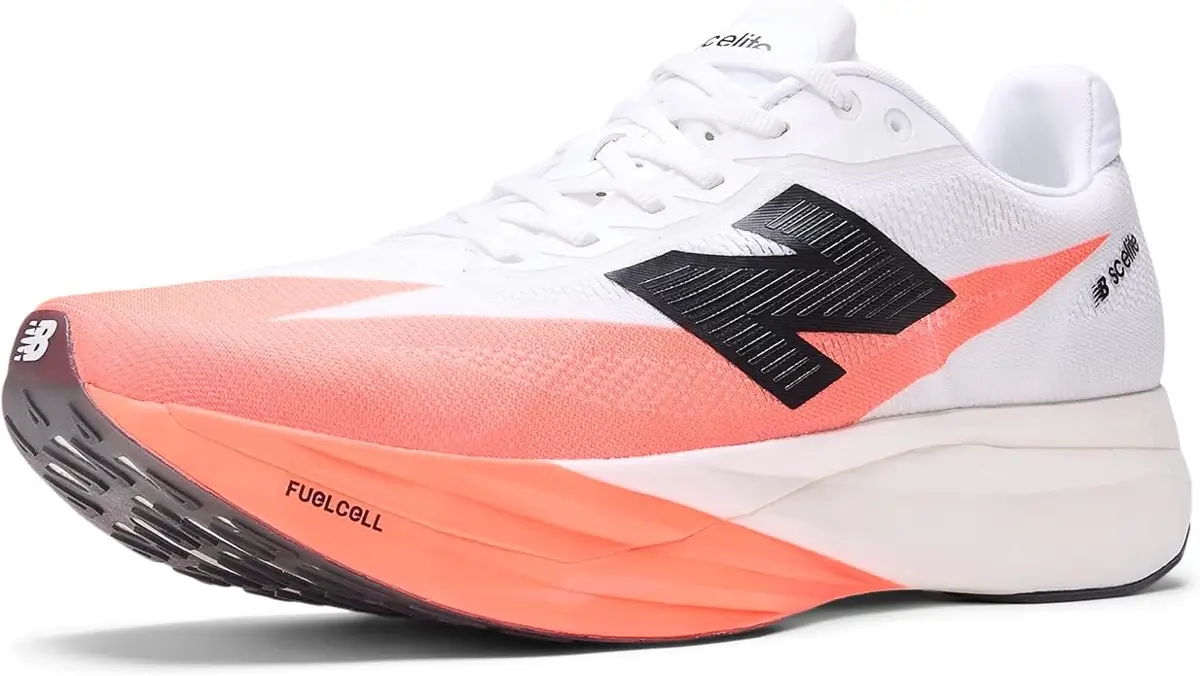
Quick Answer: New Balance FuelCell SuperComp Elite v6 Review: The SuperComp Elite v6 is New Balance’s carbon-plated marathon racing shoe, and it is the best race shoe the brand has built. A new midsole foam called Infinion makes it noticeably softer and springier than the shoe it replaces while cutting around 20 grams of weight, and it is one of very few elite racers you can buy in a wide. The paper-thin rubber on the bottom is the catch, because it will not survive many hard miles. Save it for goal races from the half marathon upward. Check latest price.
The New Balance FuelCell SuperComp Elite v6 is a road racing shoe built for one job: helping you run a personal best over a long distance. It belongs to the category runners call super shoes, which means a very tall, very springy midsole with a stiff carbon fiber plate running through it. The midsole is the thick slab of foam between your foot and the ground, and the plate is a curved sheet that stiffens the shoe so it rolls forward instead of bending flat.
In the New Balance range this sits right at the top. The SuperComp Rebel is the lighter, cheaper, plateless option for shorter races and fast training, and the SuperComp Trainer line handles everyday mileage. The Elite is the marathon shoe, and at $274.99 it is priced accordingly.
This one suits a runner who has a race on the calendar and wants the shoe to do some of the work. If you are shopping for something to run in three or four times a week, this is the wrong shoe and we say so plainly further down.
Specs
Here are the specifications for the New Balance FuelCell SuperComp Elite v6:
| Category | Road racing shoe, carbon-plated |
| Best for | Half marathon and marathon race days, plus the occasional sharpening workout |
| Support type | Neutral, which means it has no built-in features aimed at controlling how your foot rolls inward |
| Midsole foam | Infinion, a new supercritical TPEE foam, replacing the FuelCell PEBA of the previous version |
| Plate | Full-length carbon fiber plate, thicker and stiffer under the forefoot, exposed through a midfoot cutout |
| Stack height | 40 mm at the heel, 32 mm at the forefoot, which is the maximum permitted for World Athletics road racing |
| Heel-to-toe drop | 8 mm, so your heel sits a little higher than your toes, a familiar feel for most runners |
| Weight, men’s | 6.7 oz, 190 g, in a size 9.5 (manufacturer figure) |
| Weight, women’s | 5.5 oz, 155 g, in a size 7 (manufacturer figure) |
| Upper | FANTOMFIT engineered mesh, thin and very breathable |
| Outsole | Minimal rubber patches, measured by independent testers at about 1.1 mm thick |
| Widths | Standard and 2E wide |
| Surface | Road and smooth pavement |
| Price | $274.99 at its August 2026 launch, with some outlets reporting a late-July drop. Check latest price |
Pros
These are the reasons to put the SuperComp Elite v6 on your shortlist:
- Very light for a shoe with this much foam underneath, which matters over 26.2 miles where every ounce you lift gets lifted thousands of times.
- The new Infinion foam is softer and bouncier than the old FuelCell PEBA, so landings are kinder and the shoe gives more back as you push off.
- Available in a 2E wide, which almost no other top-end racing shoe offers, so runners with broad feet finally have a real option here.
- The thin, breathable upper holds your foot without pressure points and dries quickly if you get caught in rain or dump a cup of water over your head.
- The ride is smoother and less demanding than the previous version, so you do not have to be a fast, efficient runner to get something out of it.
Cons
These are the drawbacks worth knowing before you spend the money:
- The outsole rubber is roughly a third as thick as it was on the previous version, so the tread will smooth off quickly and the shoe is best saved for races rather than regular use.
- At $274.99 it is a serious outlay for a shoe with a short competitive life.
- The softer foam absorbs a little less impact than the old one, so heavier runners and heel strikers may feel more road at the end of a long race.
- The tall, soft platform takes some getting used to at slow speeds, so it feels awkward if you jog in it.
- Nothing about it suits everyday training, walking or standing, so it cannot double as your only pair.
What is new versus the SuperComp Elite v5
The headline change is the foam. The v5 used FuelCell PEBA, a light and lively material that nonetheless felt firm and a bit unforgiving. The v6 swaps it for Infinion, a supercritical TPEE foam that is new to New Balance racing shoes. Supercritical simply means gas is forced into the foam under pressure to make it lighter and springier. In practice the v6 feels softer under the heel and gives back more energy as you roll through your stride, and independent lab testing found better energy return than the v5 delivered.
Weight came down too. New Balance lists 6.7 oz for a men’s 9.5 against about 7.3 oz for the v5, and at least one independent weighing of a smaller sample came in lighter still. The stack height and 8 mm drop carry over unchanged, so the shoe is the same height off the ground.
The plate was redesigned as well. It is thicker and stiffer under the forefoot, and a cutout through the middle of the shoe leaves the carbon visible from the sides and the bottom. The result is a sharper push-off than the v5 gave. The upper is a lighter, more breathable mesh with better lockdown, and the outsole lost most of its rubber. That last change is where the savings came from, and it is the one you will regret if you treat this as a training shoe.
Who should buy the SuperComp Elite v6
Buy it if you have a half marathon or marathon on the calendar and you want the shoe working with you rather than just protecting you. The combination of a tall springy midsole and a stiff plate genuinely reduces the effort of holding a pace, and that effect grows as the distance grows. If you have been running in an ordinary trainer on race day, the first mile in this will feel like someone gave you a push.
It suits mid-pack runners better than the v5 did. The older shoe rewarded a fast, light, efficient stride and punished anything slower. The v6 is softer and more forgiving, which means a four-hour marathoner gets real benefit from it rather than just an expensive stiff shoe.
It is also the obvious pick if you have wide feet and have been priced out of this category. Racing shoes are almost always cut narrow and sold in one width only. A 2E option in a shoe this good is rare enough to be the deciding factor on its own.
Finally, buy it if you are willing to ration it. Runners who keep a race pair separate from a training pair will get several race cycles out of these. Runners who wear their newest shoe every day will not.
Who should probably skip it
Skip it if you want one shoe that does everything. The thin outsole and the specialized ride make this a poor daily trainer, and at this price the miles cost far too much. Skip it too if you are newer to running and have not yet built up the calf and foot strength that a tall, stiff, unstable shoe demands, because the platform asks a lot of your lower legs on landing.
It is also the wrong choice if your races are short. Over a 5K the extra foam is mostly weight you are carrying, and a lower, leaner shoe will feel quicker. And if you need any help keeping your feet steady, look elsewhere, because there is nothing here doing that job.
If that sounds like you, these three suit you better:
- Nike Vaporfly 4: a lower, lighter racer that feels sharper over 5K and 10K distances where the marathon-height foam is just baggage (check price | read review)
- Asics Novablast 6: a bouncy everyday trainer you can run in most days of the week without worrying about the outsole (check price | read review)
- Asics GT-2000 15: a supportive daily shoe for anyone who wants their feet held steady rather than launched forward (check price | read review)
How does the New Balance SuperComp Elite v6 fit?
This is a racing shoe, so it is cut close and snug, but it is not the vacuum-sealed fit some competitors go for. The upper is thin enough that you feel the shape of the shoe rather than a lot of padding. Most runners will be fine in their normal size, and for once there is a wide option if the standard last feels tight.
Fit and sizing
Go with your usual running size. The length is honest and the toe box gives you enough room to splay without leaving the foot sliding around. The midfoot is where New Balance improved things, because the v5 had a narrow waist that some runners never got locked down properly. The v6 is wider through the middle and the laces bite better, so the foot sits still. Anyone whose feet spread at the forefoot should go straight to the 2E, which is genuinely wider through the front rather than just longer.
Upper and step-in comfort
The FANTOMFIT mesh is very thin and very open, which is exactly what you want in a shoe you will wear for a hot marathon. Air moves through it freely and it does not hold water. There is almost no padding, including around the heel collar, so it is a firm rather than plush step-in. That is normal at this end of the market and it keeps the weight down. The trade-off is that thin race uppers are less tolerant of a bad sock choice, so wear something you have run long in before.
How does the New Balance SuperComp Elite v6 perform?
This shoe comes alive when you run fast and feels clumsy when you do not. That is true of every shoe in the category, but the v6 has a wider useful speed range than its predecessor because the foam is softer. The sections below cover what that means underfoot, how steady it feels and how long the bottom will last.
Cushioning and ride
There is a lot of foam here, 40 mm of it under the heel, and the new Infinion material is the softest New Balance has used in a racer. Landings feel cushioned rather than harsh, and the foam compresses and rebounds quickly enough that you feel a push rather than a squish. Independent lab work found higher energy return than the previous foam gave, which is the technical way of saying more of the force you put in comes back out.
There is one honest caveat. The same testing showed the new foam absorbs slightly less impact than the old PEBA did. For most runners over a half marathon that is irrelevant. For a heavier runner late in a marathon, the legs may feel a little more beaten up than the plush first impression suggests.
Ride and running performance
The forward motion here comes from the plate and the curved shape of the sole working together rather than from the foam alone. The stiffened forefoot and the upward curve at the toe mean the shoe rolls you onto your toes instead of letting your foot bend, so each step finishes quickly. It is a rolling, rhythmic feel rather than a violent flick.
Marathon pace is where it makes most sense. It also handles a fast half marathon and long tempo efforts well. At easy jogging speeds the shoe is simply too tall and too stiff to feel natural, so do not judge it on a warm-up.
Stability and support
This is a neutral shoe with no support features at all: no firmer wedge on the inside edge, no raised sidewalls, nothing that guides your foot. Stability comes only from the geometry, meaning the width of the base and where the plate sits. On that count the v6 improved, because the wider midfoot and better lockdown leave less room for the foot to wobble on the platform than the v5 did.
Even so, a 40 mm stack of soft foam is inherently tippy. If your ankles feel unsteady in tall shoes, or if you know your feet roll inward a lot, this will not hold you and no racing shoe of this type will. Nothing here corrects how you run, and we would not suggest it as a fix for any foot problem. If you have ongoing pain, talk to a physical therapist or podiatrist before changing shoes.
Outsole, grip and durability
Grip on dry pavement is good and it copes with damp roads well enough for a race. The problem is how little rubber there is. Independent measurement puts it at around 1.1 mm, against roughly 3.5 mm on the v5, and large areas of foam are left exposed. That is a deliberate weight saving and it works, but it means the bottom of the shoe will smooth off fast.
The usual 300 to 500 mile guideline for running shoes is only a rough guide at the best of times, and for a shoe like this it is optimistic. Treat these as a race and workout shoe, keep them off gritty paths and rough concrete, and do not expect them to see out a full training block.
Is the New Balance SuperComp Elite v6 good for walking?
No, and it is worth being blunt about it. Walking speed never loads the foam or engages the plate, so all you get is the awkward part: a tall, soft, tippy platform with a stiff sole that will not bend as your foot rolls through a step. On hard floors and long days on your feet it feels unstable rather than cushioned, and the thin outsole will scuff away on pavement for no benefit at all.
It is a poor travel shoe too, because the sparse upper offers no protection and the shoe is too specialized to be worn casually. It also will not take a custom insole comfortably, since the low-volume race fit leaves no depth to spare. If you want one pair for walking, standing and the occasional run, a cushioned daily trainer or a dedicated walking shoe is a far better use of the money.
SuperComp Elite v6 versus SuperComp Elite v5
| SuperComp Elite v6 | SuperComp Elite v5 | |
| Midsole foam | Infinion supercritical TPEE | FuelCell PEBA |
| Stack and drop | 40 mm / 32 mm, 8 mm | 40 mm / 32 mm, 8 mm |
| Weight, men’s | About 6.7 oz | About 7.3 oz |
| Outsole rubber | About 1.1 mm (independently measured) | About 3.5 mm (independently measured) |
| Feel | Softer, bouncier, smoother, more forgiving | Firmer, leaner, more demanding |
| Widths | Standard and 2E | Standard |
Buy the v6 when you want the better shoe and you are racing longer than a 10K. It is lighter, kinder underfoot, steadier on the platform and available in a wide. For almost every runner it is the clear upgrade.
Buy the v5 while stock lasts if you can find it discounted, if you prefer a firm and direct race feel, or if durability matters more to you than weight. The thicker outsole is a real advantage for anyone who wants to use a racing shoe for workouts as well as races.
New Balance SuperComp Elite v6 Alternatives
If the price is the sticking point rather than the shoe, the Saucony Endorphin Pro 5 is the sensible comparison. It is a marathon racer with a slotted carbon plate and a smoother, less aggressive character, which suits runners who find the v6 platform a handful. You can read our full review for the detail.
Runners chasing outright lightness should look at the Asics Metaspeed Sky Tokyo, which weighs less than the v6 and rewards a runner who lengthens their stride as they speed up. It is firmer than the New Balance, so pick it only if the softer Infinion ride is not what you want. Our Metaspeed Sky Tokyo review covers who that stride-length point applies to.
A third option pulls in the opposite direction. The Hoka Cielo X1 3.0 is more shoe in every sense: more aggressive rocker, more energy, more presence underfoot. Choose it if you liked what the plate did for you here and want more of it, and see the Cielo X1 3.0 review for the caveats.
For anyone who wants the plated feel without a race-only outsole, the Hoka Mach X 2 is the practical answer. It has a plate and plenty of foam but enough rubber to survive real training weeks, so it can be the workout shoe that sits alongside the Elite v6 rather than replacing it. The Mach X 2 review explains where it fits in a rotation.
Price and value
At $274.99 the SuperComp Elite v6 sits in the normal band for a top-end racing shoe, and what you are paying for is a genuine performance benefit over a long distance plus roughly 20 grams less weight than the last version. On those terms the money is defensible for a runner with a goal race.
The value question is how many miles you get. With so little rubber on the bottom, the cost per mile here is high even by racing shoe standards, and that is the honest weakness of the purchase. If you already own a good workout shoe and can keep these for races only, the price works out. If this would be your only fast shoe, a plated super trainer will serve you better for less.
Final verdict
Best for: runners with a half marathon or marathon goal, including mid-pack runners, and anyone who needs a wide racing shoe.
Avoid if: you want one shoe for everything, your races are 5K and 10K, you need support features, or you are early in your running and still building lower-leg strength.
Fit: true to size, snug race cut, improved midfoot hold, with a 2E available.
Verdict: New Balance has finally built a racing shoe that competes at the front of the category rather than sitting politely near it. The new foam does the heavy lifting, the weight saving is real and the wide option is a gift to a group of runners this category has ignored. We rate it highly, with the plain warning that the outsole means these are race-day shoes and nothing else.
Frequently Asked Questions for New Balance FuelCell SuperComp Elite v6
Yes. Its 40 mm heel stack sits at the maximum height permitted for road racing, and it uses a single plate, so it meets the current rules for road events.
Fewer than from a normal trainer. With only about 1.1 mm of outsole rubber, most runners should plan on a handful of races plus a few sharpening workouts rather than a full training block.
It can be, because the softer foam makes it more forgiving than the previous version. Run at least a couple of long runs and one race-pace session in them first, so your legs are used to the tall platform before race day.
Yes, and it is a reasonable way to protect the outsole while still getting used to the ride. The belt is smooth and gentle on the sparse rubber, though the tall platform can feel unsettling at slower treadmill speeds.
It works for longer track repetitions at goal marathon or half marathon pace. For short, sharp intervals the height and stiffness get in the way, and a lighter, lower shoe will feel better.
Not usually. Take your normal running size and choose the 2E width instead if the standard fit feels tight across the forefoot, since sizing up adds length you do not need.