Room and adjustable arch support for painful feet
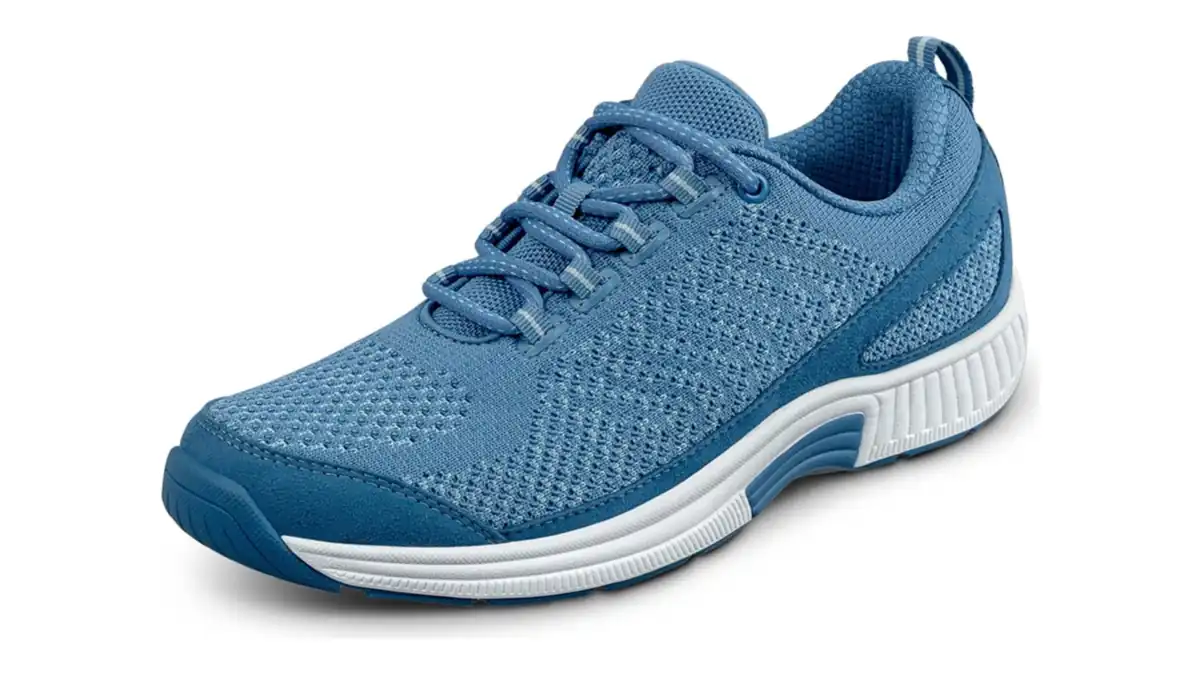
Quick Answer: Orthofeet Coral Stretch Knit Review: The Coral Stretch Knit is a women’s walking sneaker for feet that hurt in normal shoes. The upper stretches in every direction and has no seams inside, so bunions, hammertoes and swollen feet get room instead of pressure, and the removable insole comes with spare wedges that let you raise the arch to suit you. It is roomy, soft and easy to live with all day. The trade-off is looks: it is chunky and obviously orthopedic, and it is not built for running. Check latest price.
The Orthofeet Coral Stretch Knit is a women’s comfort sneaker from a brand that makes footwear specifically for people with foot problems. Orthofeet does not really compete with running brands. It competes with the pair of shoes you have given up wearing because they rub, pinch or press on a sore spot.
The Coral is one of the brand’s core women’s athletic styles, and it comes in several versions: this stretch knit, a water-repellent version, a wool version and a no-tie version with a stretchy bungee lace. They share the same sole and the same insole system, so the choice between them is mostly about the upper material and how you get the shoe on and off.
It is aimed at a woman who wants to walk comfortably again: to do the shopping, get round the garden, manage a day out or stand through a shift without her feet complaining. If you want a shoe for running, or you simply want something that looks like a normal trainer, this is not it.
Specs
Here are the specifications for the Orthofeet Coral Stretch Knit:
| Type | Women’s comfort and walking sneaker, extra depth for orthotics |
| Upper | Four-way stretch knit with a seam-free lining |
| Closure | Lace-up, with a no-tie bungee version sold separately |
| Insole | Removable orthotic insole, roughly a quarter of an inch thick, supplied with spare arch wedges |
| Midsole and sole | Orthofeet Ortho-Cushion System: a cushioned sole with a gentle curve front and back |
| Toe box | Wide, with extra depth |
| Widths | Medium, wide and extra wide |
| Accreditation | Carries the American Podiatric Medical Association Seal of Acceptance |
| Materials | Vegan friendly, no animal materials |
| Weight and drop | Not published by Orthofeet, and we have not found a reliable independent figure, so we have not guessed |
| Price | Orthofeet does not publish a launch price or date for this style, and prices differ across its own site and specialist retailers, so we are not quoting one. Check latest price |
Pros
- The stretch upper moves out of the way of a bunion or a hammertoe instead of pressing on it, which is the whole reason to buy this shoe
- No stitching inside means nothing to rub a sensitive spot raw over a long day
- The spare arch wedges let you raise the arch support at home until it sits where your foot wants it
- Three widths up to extra wide, plus extra depth, so it works if your own orthotic needs to go in
- The rounded sole makes walking on hard floors feel easier, which matters if you are on your feet for hours
Cons
- It looks like what it is: chunky, wide and clearly a comfort shoe rather than a trainer
- Orthofeet does not publish a weight, drop or stack height, so you cannot compare it on paper with a mainstream shoe
- Pricing varies a lot between Orthofeet’s own site and specialist retailers, so it pays to shop around
- The knit upper is warm and not water resistant, so it is a poor choice for wet weather
- It is not built for running, and treating it as a running shoe will disappoint you
What is new versus the earlier Orthofeet Coral
Orthofeet does not number its shoes the way running brands do, so there is no Coral 2 to compare against. Instead the Coral exists as a family of uppers built on one platform, and the stretch knit is the softest and most forgiving of them.
The difference that matters is the material. A four-way stretch knit gives in every direction, so the shoe takes the shape of your foot rather than asking your foot to take the shape of the shoe. On the water-repellent version the upper is more structured and holds its form, which is better in bad weather but less accommodating over a swollen joint. The wool version splits the difference and adds warmth.
Everything under the foot is shared. The same removable insole, the same spare arch wedges, the same cushioned and gently curved sole, the same three widths and the same extra depth. So if you have worn any Coral before and the fit worked, this one will feel familiar underfoot and kinder across the top.
Who should buy the Orthofeet Coral Stretch Knit
Buy it if the top of your foot is the problem. Bunions, hammertoes, a bony lump on the joint, feet that swell through the day: all of these are about pressure from above and from the sides, and a stretch knit upper with no internal seams is the most direct answer to that. You will feel the difference in the first ten minutes.
Buy it if you want to fine-tune the arch. Most shoes give you one fixed level of arch support and you either get on with it or you do not. Here the insole lifts out and the box includes wedges you slide underneath it to raise the arch. That is genuinely useful if you have flat feet or if your arch has dropped over the years, because you can adjust in small steps rather than gambling on one setting.
Buy it, too, if you already wear a custom orthotic. The shoe is built deeper than normal so that a prescribed insole fits without pushing your foot up against the top of the shoe, and the three widths mean you can get the length right without your foot spilling over the edges.
Who should probably skip it
Skip it if appearance matters to you. This is a wide, deep, softly built shoe and it looks it. Plenty of buyers are glad to trade style for comfort, but if you want something that passes for a fashion sneaker you will be disappointed, and there is no point pretending otherwise.
Skip it if your feet need to be held firmly rather than cushioned gently. The Coral supports by cradling the foot and letting you raise the arch. It does not have a rigid frame or a stiff leather upper, so if your feet roll inward heavily and you have been advised to use a motion-control shoe, this will feel too soft. And skip it if you want to run: it is a walking and standing shoe, and the sole is not built for the repeated impact of running.
These are better fits for those readers:
- Brooks Addiction Walker 2: a firm leather walking shoe with a proper support frame, for feet that need holding rather than cushioning (check price | read review)
- Hoka Bondi SR: a wipe-clean, slip-resistant version of a deeply cushioned shoe, for wet floors and long shifts at work (check price | read review)
- Skechers GO WALK 8: much lighter, cheaper and more ordinary looking, if your feet are basically fine and you just want easy comfort (check price | read review)
How does the Orthofeet Coral Stretch Knit fit?
Fit is the entire point of this shoe, and it is handled better than almost anything at this price. You get three widths, extra depth, a wide toe box and an upper that gives rather than resists. The result is a shoe that adapts to an awkward foot instead of forcing the foot to adapt.
Fit and sizing
Take your usual size and choose the width honestly. Medium, wide and extra wide are all offered, and Orthofeet’s medium is not narrow, so a lot of women who buy wide elsewhere will find medium works here. The extra depth is designed to swallow a custom orthotic, which is worth knowing when you order: if you plan to swap in your own insole, the shoe will feel slightly loose on the standard one, and that is normal. The removable liners and arch pieces also give you a way to take up a little slack if your heel lifts.
Upper and step-in comfort
The knit is soft, light and stretches four ways, meaning up and down as well as side to side. Push a knuckle against it and it moves. That is why it works over a bunion: the shoe simply gives at that spot instead of grinding against it. Inside there is no stitching at all, so there is nothing to raise a blister on a long day. Step-in comfort is immediate and there is no breaking in to do. The catch is that a soft knit traps heat and soaks up rain, so this is a fair-weather and indoor shoe.
How does the Orthofeet Coral Stretch Knit perform?
Judge this shoe by hours on your feet rather than miles at pace. It is designed to make ordinary walking and standing comfortable for people for whom neither is currently comfortable, and on that measure it does well. Ask it to do anything athletic and its limits show quickly.
Cushioning and ride
Orthofeet calls the combination of insole and sole its Ortho-Cushion System. Stripped of the branding, that means a thick padded insole sitting on a soft foam sole with a curve built into the front and back. The curve, which shoe people call a rocker, tips you gently from heel to toe so your foot does not have to bend as much at the ball. If the joints in your forefoot are stiff or sore, that reduces how much they have to work with every step. The overall feel is soft and slightly springy rather than firm.
Ride and everyday performance
Walking, the shoe feels easy and unhurried. The rocker does some of the work for you, and the soft sole absorbs the jolt of concrete and tiled floors. It is not quick and it does not want to be. There is no plate, no snappy foam and no attempt at a fast toe-off, so a brisk fitness walk feels fine and a jog for the bus feels wrong. We would not use it for running, and Orthofeet does not market it that way.
Stability and support
We would classify this as a cushioned shoe with adjustable arch support rather than a stability or motion-control shoe. The support comes from the shape of the insole under your arch, which you can raise using the wedges supplied, and from a broad, flat sole that gives you a stable base. There is no firm wedge on the inner edge and no plastic frame around the heel, which are the parts that make a true stability shoe work. The design is intended to spread pressure more evenly across the foot, and many people find that eases sore spots. It does not correct how you walk, and no shoe does.
Outsole, grip and durability
The sole is rubber with a simple tread, which grips well on dry pavement, supermarket floors and carpet. It is not a slip-resistant work sole, so if you need certified grip for a wet kitchen or a hospital floor, buy a shoe built for that. Because this shoe is worn for walking rather than running, the sole itself usually outlasts the upper and the insole. The insole is the part that flattens first, and since it lifts straight out, replacing it is the cheapest way to make the shoe feel new again.
Is the Orthofeet Coral Stretch Knit good for walking?
Walking is what it is for, so yes. On pavement and hard indoor floors the padded insole and rockered sole take the sting out of each step, and the wide, deep fit means nothing tightens up as your feet swell over the afternoon. That combination suits a day of errands, a slow lap of a museum or a long shift standing behind a counter. For travel it is light and packs flat, though the knit is warm in summer and useless in rain. Distance walkers should be realistic: it is comfortable for hours of ordinary walking, not for brisk miles, because the soft sole and easy flex give you nothing to push against. If you use orthotics, this is one of the easier shoes to fit them into.
Orthofeet Coral Stretch Knit vs the other Coral versions
Coral Stretch Knit | Coral water-repellent | Coral no-tie | |
|---|---|---|---|
Upper | Four-way stretch knit | Structured, water-repellent | Stretch knit |
Closure | Standard laces | Standard laces | Elastic bungee, no tying |
Best for | Bunions, swelling, sensitive skin | Damp weather and outdoor use | Limited reach or grip strength |
Insole and sole | Same removable insole, arch wedges and cushioned rockered sole across all three | Same | Same |
Buy the stretch knit when the pressure on the top or sides of your foot is the problem you are trying to solve, and when the shoe will mostly be worn indoors or in dry weather.
Buy one of the other versions when you need the shoe outdoors in the wet, or when bending down to tie laces is itself the difficulty, in which case the no-tie bungee version solves a problem the stretch knit does not.
Orthofeet Coral Stretch Knit Alternatives
What this shoe offers is room, adjustable arch height and a seam-free interior. The useful alternatives are the ones that keep one of those qualities while fixing the looks, the price or the weather resistance.
Skechers Arch Fit 2.0: a far cheaper way to get a shaped, supportive insole under your arch, in a shoe that looks like an ordinary trainer, though you lose the stretch upper and the ability to adjust the arch height (check price | read review).
Brooks Ghost Max 3 is worth a look if you want the roomy toe box and the easy rolling feel in a mainstream shoe. It comes in wide fittings, has a much broader sole and will not mark you out as wearing orthopedic footwear (check price | read review).
Where the knit upper falls down is weather, and the Hoka Transport 2 answers that. It is built for commuting and walking outdoors, with a tougher upper and a grippier sole, while keeping the deep cushioning and the easy rocker that make long days bearable (check price | read review).
Should your feet need genuine support rather than gentle cradling, the Hoka Gaviota 6 pairs deep cushioning with a built-in frame that keeps the foot upright, which is the one thing the Coral deliberately does not attempt (check price | read review).
Price and value
Orthofeet does not publish a single launch price for this style, and what you pay varies between the brand’s own store and specialist retailers, so it is worth comparing before you buy. What the money is buying is not technology, it is fit: three widths, extra depth, a seam-free interior and an insole you can adjust. Against a mainstream trainer it looks expensive for what appears on the spec sheet. Against the cost of a shoe you cannot wear, it is reasonable. The insole is replaceable, which extends the value.
A note on foot pain
Whether a shoe feels comfortable depends on your own fit, gait, foot shape, arch, injury history, weight, the surfaces you walk on and simple preference, so no shoe suits everyone. Nothing here is medical advice. If you have foot pain that is severe, persistent or getting worse, or if you have diabetes or reduced sensation in your feet, speak to a podiatrist or your doctor before choosing footwear.
Final verdict
Best for: women whose feet hurt in normal shoes, especially with bunions, hammertoes, swelling or sensitive skin, and anyone who wears a custom orthotic.
Avoid if: you want a shoe that looks like a normal sneaker, you need certified slip resistance for work, you walk in wet weather, or you want to run.
Fit: true to size, generous, available in medium, wide and extra wide with extra depth for your own insoles.
Verdict: the Orthofeet Coral Stretch Knit does one thing extremely well: it gets out of the way of a foot that other shoes press on, and then lets you tune the arch until it suits you. If that is your problem, the chunky looks are a small price. If it is not, you can spend less elsewhere.
Frequently Asked Questions for Orthofeet Coral Stretch Knit
Some Orthofeet styles are approved under the Medicare therapeutic shoe program for people with diabetes, but coverage depends on the specific style, your diagnosis and a supplier who is set up to bill it. Check the individual style with a certified fitter rather than assuming.
It is a mark from the American Podiatric Medical Association given to products a panel of podiatrists has reviewed and judged to be good for foot health. It is a quality signal, not a medical claim or a guarantee that a shoe will suit you.
They are thin shaped wedges that sit underneath the removable insole. Adding one lifts the arch support a little higher, and you can use one or leave them out entirely, so you can experiment until it feels right.
Take the insole out and clean the knit by hand with mild soap and cool water, then air dry it away from direct heat. Machine washing and tumble drying can distort the sole and shrink the knit.
The Coral is a women’s style. Orthofeet builds equivalent men’s athletic shoes on the same insole and sole system, so the features carry across even though the name does not.
Give it a few short wears rather than a full day straight away. A higher arch than you are used to can feel odd at first, and starting with the wedges removed and adding one later is the gentler way in. If anything hurts rather than simply feeling different, stop and get advice.