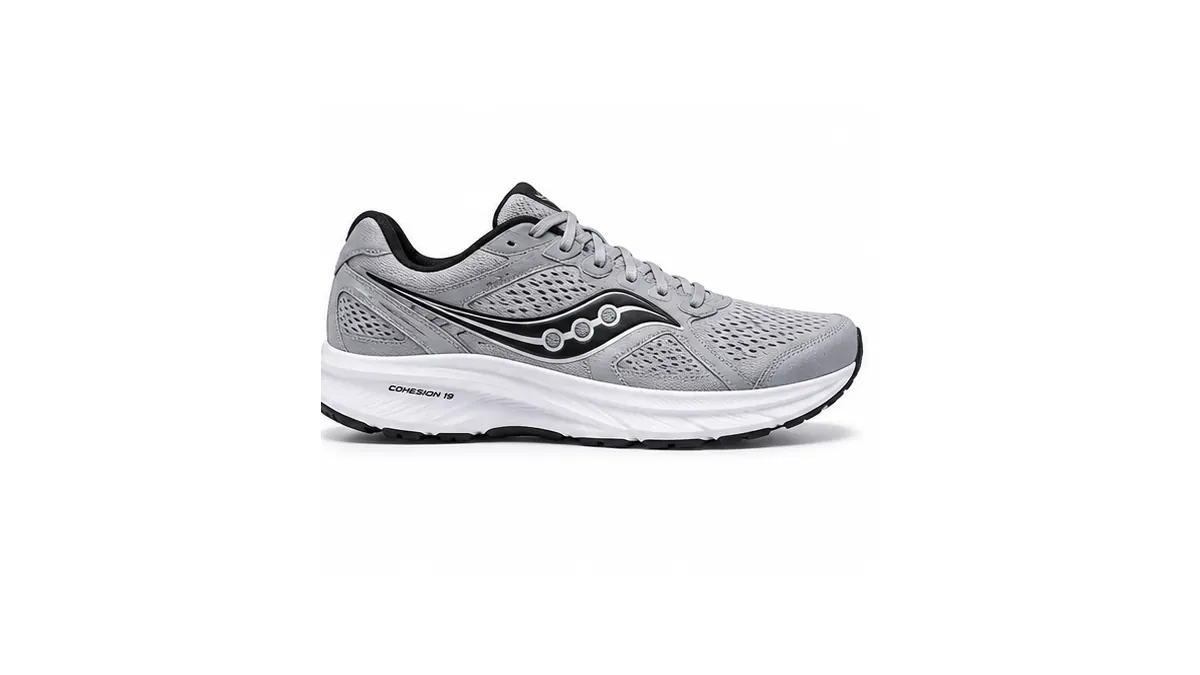
Built to last on a small budget, with almost no spring in return
Quick Answer: Saucony Cohesion 19 Review: The Cohesion 19 is Saucony’s cheapest neutral trainer, and it is the one to buy if durability and a tall heel matter more to you than a lively ride. A new VersaRun foam adds a little softness, and the hard-wearing rubber outsole should long outlast the price tag. The ride stays firm and flat, though, and there is not much foam under the front of the foot, so anyone who lands on their forefoot will find it harsh. Check latest price.
Gender-specific buy links: Men’s version | Women’s version
The Saucony Cohesion 19 is the entry point to the Saucony road range, sitting well below the Ride and a long way below the Triumph. It is the shoe you find on the wall at a department store, and Saucony builds it to a price rather than to a performance target. That is not a criticism so much as a description: everything here is chosen to be cheap and hard-wearing.
The one genuine piece of news this time is the midsole, meaning the layer of foam between your foot and the road. Saucony has moved the Cohesion onto VersaRun, a foam it describes as softer and more energetic than what came before. It does make a difference, though it is a modest one: this is still a firm shoe by any current standard.
The other thing that sets the Cohesion apart is its shape. Your heel sits a long way above your toes in this shoe, much further than in most modern trainers. If you land heel first, which most walkers and a majority of casual runners do, that suits you. If you land flat or on the ball of your foot, it does not. Everything below follows from those two facts.
Specs
Here are the specifications for the Saucony Cohesion 19:
| Type | Neutral road running and walking shoe, entry level |
| Gait type | Neutral, best suited to runners and walkers who land heel first |
| Midsole | VersaRun foam, new for this version |
| Plate | None |
| Stack height | About 29 mm heel and 17 mm forefoot |
| Heel-to-toe drop | About 12 mm, which is high by modern standards |
| Weight | About 9.8 oz (278 g) in a men’s sample; light for a shoe in this class |
| Upper | Engineered mesh with stitched overlays and a padded collar |
| Outsole | XT-600 carbon rubber, chosen for durability |
| Widths | Standard and wide |
| Best use | Walking, gym and treadmill work, easy runs up to a few miles |
| Price | Launched at about $80 in July 2026. Check latest price |
Pros
These are the reasons to put the Cohesion 19 on your list:
- It is one of the cheapest shoes any major running brand sells, and it does not feel cheaply made.
- The XT-600 carbon rubber outsole is the hard, dense kind used on shoes meant to survive, so the sole will take a lot of pavement before it wears smooth.
- The tall heel and the curve at the back of the sole roll heel strikers forward neatly, which makes it an easy shoe to walk in.
- The low, firm platform is genuinely stable, so there is no wobble to manage on uneven sidewalks.
- It is lighter than most shoes at this price, which keeps it from feeling clumpy.
Cons
These are the compromises that come with the price:
- There is very little foam under the front of the foot, so pushing off feels hard and unprotected.
- The ride is flat. VersaRun is an improvement on what came before, but the shoe still gives back very little of the energy you put into it.
- Anyone who lands mid-foot or on the forefoot will find it uncomfortable rather than just firm.
- The very high heel-to-toe difference is an acquired taste and can feel unusual if you are coming from a modern low-drop shoe.
- The upper is plain and dense, so it runs warmer than better-ventilated trainers in summer.
What is new versus the Saucony Cohesion 18
The headline change is the foam. Saucony has replaced the older midsole compound with VersaRun, which is billed as adding both cushioning and energy return. Energy return is simply how much of the force you put into a shoe comes back out to help you along, and this is the area where budget shoes usually fall down badly. The Cohesion 19 is better than its predecessor here, but the bar it clears is a low one.
What has not changed is the geometry, and that is the more important point for anyone deciding whether to upgrade. The heel still sits far higher than the forefoot, the platform is still low and firm, and the shape of the sole still favors heel strikers. If the Cohesion 18 suited your stride, the 19 will too, and if it did not, this version will not change your mind.
The outsole continues with XT-600 carbon rubber, the same durable compound, and the upper is a light refresh rather than a redesign. In short: same shoe, slightly nicer foam. If your Cohesion 18s still have tread left, keep wearing them.
Who should buy the Saucony Cohesion 19
This is a shoe for someone who wants dependable footwear for walking and occasional running without spending much. If you walk a few miles most days, use a treadmill, run once or twice a week for fitness and want a shoe that will last, the Cohesion 19 does that job and leaves money in your pocket for the next pair.
Heel strikers get the most out of it. Because the heel is tall and the back of the sole is curved, your foot rolls from landing to mid-step without effort. Walkers almost always land heel first, so this design flatters the way most people actually move. Older walkers in particular often find a taller heel more comfortable, because it takes a little tension off the calf and the Achilles tendon.
It also suits anyone who wears through soles quickly. Heavier walkers, people who drag their toes and anyone who logs long miles on abrasive pavement will get more wear out of that hard rubber than out of the softer, grippier compounds on more expensive shoes. Wide fittings are available, which widens the appeal again.
Not sure this is the right shoe? Use our free Shoe Finder to narrow your choices by fit, cushioning, support and how you plan to use the shoe.
Who should probably skip it
If you land anywhere other than your heel, this is not your shoe. There is very little foam under the forefoot, and every step you take on the ball of your foot lands on a thin, firm platform with nothing to soften it. That gets uncomfortable quickly, and it is the single most common complaint about shoes built this way.
Distance runners should also look elsewhere. The Cohesion has neither the depth of cushioning to protect your legs over an hour of running nor the bounce to keep the effort down, so the further you go the more you pay for it afterward. And if you have come from a modern trainer with a low heel, the tall drop here will feel strange and can nudge your stride in ways you do not want.
If that describes you, start with these instead:
- Asics Gel-Cumulus 26: a proper neutral daily trainer with real depth of foam under both the heel and the forefoot, for runners going past a few miles (check price | read review).
- Nike Winflo 12: still a budget shoe, but with an air unit and far more forefoot cushioning, so forefoot strikers are not punished (check price | read review).
- Saucony Triumph 24: the opposite end of the Saucony range, deeply cushioned and soft, for anyone whose priority is comfort over cost (check price | read review).
How does the Saucony Cohesion 19 fit?
The Cohesion 19 fits like a traditional running shoe rather than a modern one: a little roomier through the midfoot than a performance trainer, with a normal toe box and a well-padded heel. Most people will be fine in their usual size. The details below cover the sizing and what the upper is like to put on.
Fit and sizing
Order your normal size. The Cohesion has a conventional last, meaning the foot-shaped mold the shoe is built around, and it does not run notably long or short. There is enough room at the end of the toes for most feet without the shoe feeling loose.
Saucony offers a wide fitting, which is worth seeking out if the standard version feels tight across the ball of the foot. Because the shoe sits low to the ground, a slightly snug fit is more noticeable here than it would be in a taller, softer trainer: there is less foam to absorb the pressure of a seam sitting in the wrong place.
Upper and step-in comfort
The upper is engineered mesh with stitched overlays holding the sides in place, which is the older and cheaper way of building a shoe but also a durable one. There is generous padding around the collar and under the tongue, so the shoe feels comfortable the moment you put it on, even though the foam underfoot is firm.
Breathability is adequate rather than good. The mesh is denser than what you find on pricier shoes, which helps it survive but means warmer feet on a hot day. Lockdown is secure once laced, and the heel counter holds the foot without pinching.
How does the Saucony Cohesion 19 perform?
The Cohesion 19 performs exactly like what it is: a well-made shoe with inexpensive materials. It is steady, predictable and tough, and it works best at walking pace or on short, easy runs. The sections below break down what that feels like underfoot.
Cushioning and ride
Stack height is the amount of foam between your foot and the ground, and there is not much of it here: about 29 mm under the heel and roughly 17 mm under the forefoot. In practice the heel does a decent job of absorbing landings, which is why heel strikers get on with the shoe, while the forefoot feels thin and hard.
VersaRun takes the edge off compared with the previous foam, but the overall character is still firm and controlled. You will feel the texture of the road. Some walkers genuinely prefer that, because it makes the ground easier to read, and it is part of why the shoe feels so planted.
Ride and running performance
On an easy run the Cohesion 19 is perfectly usable. The curve at the back of the sole tips heel strikers from landing into mid-step smoothly, and the shoe is light enough not to feel like a boot. What it will not do is help you. There is no plate, no bouncy foam and no forefoot rocker doing any of the work, so every bit of forward motion comes from you.
That makes it a shoe for short, relaxed miles. Pick up the pace and the thin forefoot becomes the limiting factor: there is simply not enough underfoot to absorb the harder push-off. Keep runs to a few miles at a conversational effort and it does the job without fuss.
Stability and support
The Cohesion 19 is a neutral shoe, which means it has no built-in features designed to guide a foot that rolls inward. It is nevertheless a very steady one, for the same reason a low chair is harder to tip over than a tall one: there is not much height for your foot to move on, and the foam is too firm to compress unevenly.
If you need real support rather than incidental steadiness, this is not the shoe. Saucony’s own Guide line and the Asics GT-1000 sit at the affordable end of the support category and do that job properly. For a walker who simply wants to feel secure underfoot, though, the Cohesion delivers that without any extra cost or weight.
Outsole, grip and durability
The XT-600 carbon rubber outsole is the best thing about this shoe. Carbon rubber is harder and denser than the blown rubber used in lighter trainers: it grips slightly less but wears far more slowly. On a shoe that costs this little, that is the right trade.
Grip on dry pavement, concrete and treadmill belts is reliable. On wet ground it is acceptable rather than reassuring, so ease off on painted lines and smooth tile in the rain. Durability should comfortably reach the usual 300 to 500 mile guideline, and in many cases exceed it, though that range is only a rough guide and depends on your weight, stride and surfaces. The upper will likely give out before the sole does.
Is the Saucony Cohesion 19 good for walking?
Yes, and for a lot of people it will be a better walking shoe than a running shoe. Walking is a heel-first activity for almost everyone, and this shoe is built around the heel: a tall stack at the back, a curved heel that rolls you forward and a firm base that does not tip. The thin forefoot that hurts it on a run barely registers at walking pace, because you simply are not loading it as hard.
For long days on hard floors it is more limited. There is not a lot of foam to soak up hours of standing, so nurses, retail staff and anyone on concrete all day should look at a deeper-cushioned shoe. For errands, dog walks, travel days and a daily few miles around the neighborhood, though, it is comfortable, cheap, steady and will take the abuse. The wide fitting and the removable insole also make it workable with a thin orthotic.
Saucony Cohesion 19 vs. Saucony Cohesion 18
Here is how the two generations compare:
Feature | Cohesion 19 | Cohesion 18 |
Midsole | VersaRun, new for this version | Previous Saucony budget foam |
Drop | About 12 mm | About 12 mm |
Outsole | XT-600 carbon rubber | XT-600 carbon rubber |
Upper | Refreshed engineered mesh | Engineered mesh |
Ride | Firm and stable, slightly softer than before | Firm and stable |
Buy the Cohesion 19 when you are replacing a worn pair anyway, or when you want the small step up in softness the new foam brings.
Buy the Cohesion 18 when it turns up cheaper in your size and width. The shape and the outsole are the same, so you are giving up very little.
Saucony Cohesion 19 Alternatives
Most people who rule out the Cohesion do so for one of two reasons: the thin forefoot or the very tall heel. If the heel height is what puts you off but the budget is not negotiable, the Brooks Revel 9 sits at a similar level with a much more conventional shape underfoot and a wider, flatter base, which suits anyone who lands flatter or just prefers a level platform.
Where the issue is that your feet roll inward as they tire, the Asics GT-1000 15 adds genuine mild support on a wide platform for not much more money. That matters more than extra foam for a lot of walkers, and our review covers how far that guidance actually goes.
Staying inside Saucony, the Ride is the natural step up: a full daily trainer with far more cushioning at both ends of the foot, aimed at runners who are logging real weekly mileage rather than the occasional couple of miles. It costs roughly twice as much, and for anyone running four or more times a week that gap is money well spent.
- Brooks Revel 9: a similarly priced budget trainer with a lower heel and a broad, planted base (check price).
- Asics GT-1000 15: affordable support for feet that flatten as they tire, without much weight penalty (check price | read review).
- Saucony Ride 19: the step up within Saucony, with much deeper cushioning for runners doing real weekly mileage (check price).
Price and value
At its roughly $80 launch price in July 2026, the Cohesion 19 is one of the cheapest ways to get a real running shoe from a real running brand, in two widths, with an outsole that will not wear out in a season. As a walking and light-running shoe that is strong value. As a training shoe it is less good value than it looks, because the thin forefoot limits how much you can actually use it. Buy it for the job it does well and it is hard to fault on price.
Final verdict
Best for: walkers and casual runners who land heel first, anyone who wears through soles quickly, and buyers who want a dependable shoe for as little money as possible.
Avoid if: you land mid-foot or on your forefoot, you run more than a few miles at a time, or you want a soft, springy ride.
Fit: true to size, conventional shape, with a wide fitting available.
Verdict: the Cohesion 19 is a tough, honest budget shoe that flatters heel strikers and punishes everyone else. Know which one you are before you buy. Check the latest price.
Frequently Asked Questions for Saucony Cohesion 19
Yes. Saucony offers the Cohesion 19 in a wide fitting alongside the standard version, which is helpful because the shoe sits low to the ground and a tight fit is more noticeable as a result.
VersaRun is the midsole foam Saucony uses in its more affordable shoes. It is designed to add cushioning and return a little more energy than the compound it replaced, though it is still firmer and less lively than the premium foams in Saucony’s higher-priced models.
It can be, provided the running is short and easy and you land heel first. It is an inexpensive way to start without committing much money. Once you are running regularly or going beyond a few miles, a shoe with more foam under the forefoot will serve you better.
The Ride is Saucony’s mainstream daily trainer, with a much deeper and softer midsole built for regular running. The Cohesion is the entry-level shoe: less foam, a firmer feel, a taller heel and roughly half the price, aimed more at walking and light use.
A tall heel is a traditional running shoe design that suits people who land heel first, which is most walkers and many casual runners. It rolls the foot forward easily and can reduce strain on the calf and Achilles. The trade-off is very little foam under the forefoot.
The XT-600 carbon rubber outsole is one of the harder-wearing compounds in use, so the sole should last well past the usual 300 to 500 mile guideline for many people. That figure is only a broad guide, and the mesh upper is more likely to wear out first.