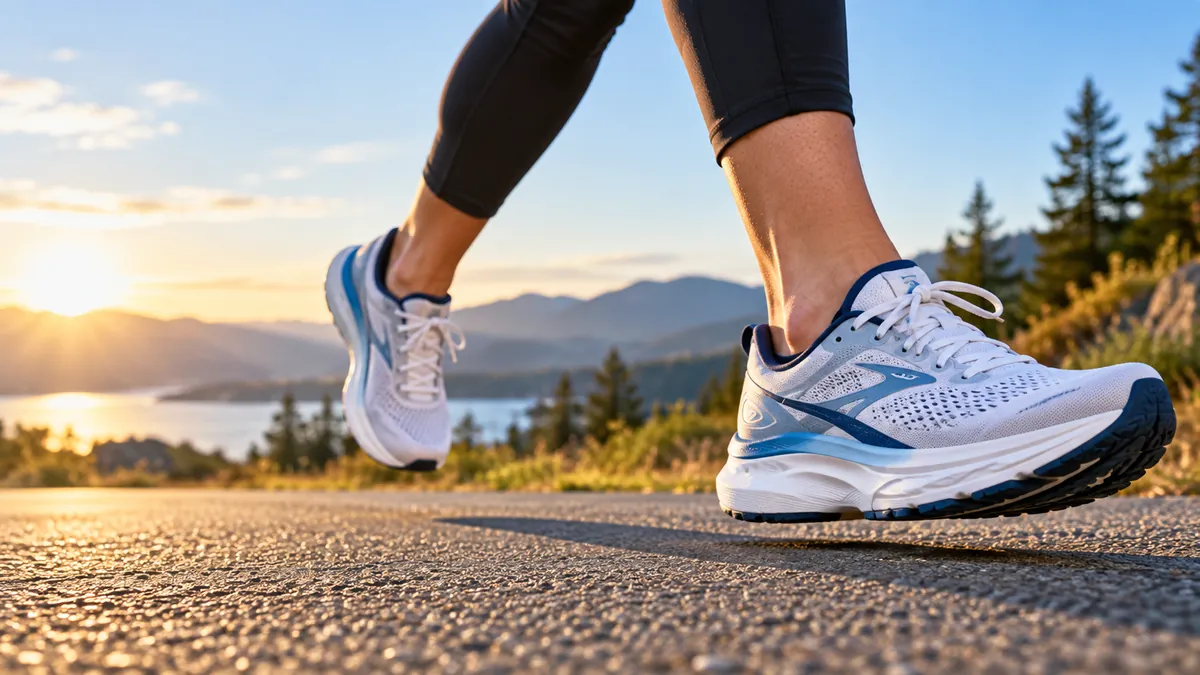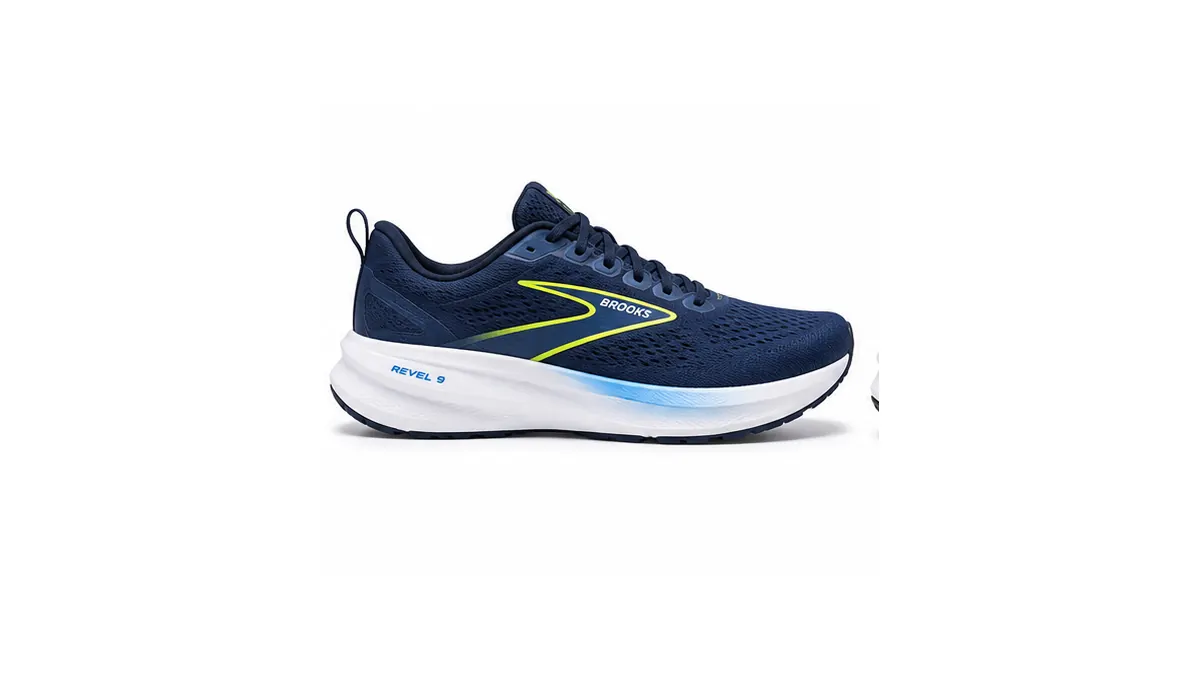
Rock-solid footing at the cost of a flat, firm ride
Quick Answer: Brooks Revel 9 Review: The Revel 9 is Brooks’ entry-level neutral road shoe, and it is best understood as a walking and everyday shoe that can also handle a short run. The wide, firm platform feels unusually planted underfoot, and it comes in standard and wide fittings for a lot less than the rest of the Brooks range. The catch is the midsole: it is thin and firm, so it does little to soften repeated impact once you go past a few miles. Check latest price.
Gender-specific buy links: Men’s version | Women’s version
The Brooks Revel 9 sits at the bottom of the Brooks road range, below the Ghost and a long way below the Glycerin. It is the shoe Brooks builds for someone who wants the badge, a dependable fit and a sensible price, rather than the newest foam. Everything about it is deliberately simple: one slab of midsole, no plate, a plain mesh upper and a hard-wearing rubber sole.
That simplicity has a consequence, and it is worth being upfront about it. Midsole means the layer of foam between your foot and the road, and the Revel 9 uses DNA LOFT v2, an EVA-based foam that Brooks also uses in its cheapest models. It is durable and stable, but it is not the soft, springy stuff found in the pricier shoes. You feel the ground more, and you feel it for longer.
So who is it for? Someone who walks a lot, stands a lot, uses the treadmill before a gym session, or runs a couple of easy miles at a time and wants one shoe to cover all of it. Read on for the fit, the ride, how it handles walking specifically, and whether the $100 is better spent elsewhere.
Specs
Here are the specifications for the Brooks Revel 9:
| Type | Neutral road running and walking shoe, entry level |
| Gait type | Neutral, with a naturally steady, wide platform |
| Midsole | DNA LOFT v2, an EVA-based foam |
| Plate | None |
| Stack height | Listed at about 32 mm heel and 24 mm forefoot; independent lab measurement put it at 33.8 mm and 24.9 mm |
| Heel-to-toe drop | 8 mm listed; measured at 8.9 mm in independent lab testing |
| Weight | About 9.3 oz (264 g) in a men’s US 9 as independently weighed; women’s listed at about 8.6 oz (244 g) |
| Upper | Engineered mesh, non-gusseted tongue, flat laces |
| Outsole | Rubber, full coverage across the high-wear areas |
| Widths | Standard and wide, men’s and women’s |
| Best use | Walking, standing, gym and treadmill work, short easy runs |
| Price | Launched at $100 in July 2026. Check latest price |
Pros
These are the things the Revel 9 does genuinely well:
- The base is wide and the foam is firm, so the shoe does not roll or wobble under you. That is reassuring on uneven sidewalks and at the end of a long day.
- It fits true to size, and the forefoot and arch widths are close to average, so most people can order their normal size with confidence.
- Standard and wide fittings in both men’s and women’s, which is rare at this price.
- The firm heel makes it a steady shoe to walk in, because your heel does not sink and tip as it lands.
- At $100 it undercuts almost everything else Brooks makes, and the rubber sole is built to last rather than to save grams.
Cons
These are the trade-offs you are accepting:
- The midsole gives very little back. Lab testing found low energy return at both the heel and the forefoot, which in practice means the shoe feels flat and you do more of the work yourself.
- Impact protection falls away quickly once you run more than a couple of miles, so your legs will feel beaten up sooner than in a proper daily trainer.
- There is no meaningful roll to the shoe. The front of the sole is soft enough that it flattens under load instead of tipping you forward.
- The toe box is a little low over the top of the toes, which can rub if you have tall toes or thick toenails.
- It is not light for what it is, so it feels sluggish if you try to pick up the pace.
What is new versus the Brooks Revel 8
The Revel has never been a shoe Brooks reinvents, and the ninth version continues that. The recipe is the same: a single DNA LOFT v2 midsole, roughly 32 mm of foam under the heel and 24 mm under the forefoot, an 8 mm drop and a full rubber outsole. Drop is simply the difference in height between the heel and the forefoot, and 8 mm is a middling figure that suits most people who land heel first.
What has changed sits on top. The upper is reworked engineered mesh with a cleaner, less cluttered look and fewer stitched overlays, which makes the shoe a bit more forgiving across the top of the foot and easier to wear as an everyday sneaker. The color range has widened too, which matters more than it sounds for a shoe most people will wear to the shops as much as to the gym.
Underfoot, honestly, you would struggle to tell the two apart. If you own a pair of Revel 8s that still have life in them, there is no performance reason to replace them with the 9. If you are buying fresh, take whichever is cheaper on the day and in your size. Brooks also now offers a taller Revel Max variant, which is a different shoe rather than an update to this one.
Who should buy the Brooks Revel 9
This is a shoe for someone whose feet spend more time walking than running. If your week looks like a couple of miles around the neighborhood most evenings, a shift on your feet, a warm-up on the treadmill and the occasional weekend 5K, the Revel 9 covers every bit of it without complaint and without costing much.
It is also a sensible pick if steadiness matters more to you than softness. Older walkers, anyone coming back from an ankle problem and people who simply do not like the tippy feeling of a tall, soft shoe will appreciate how planted this one feels. The wide sole and firm foam work together here: there is very little sideways movement to manage.
Wide-footed buyers should take note as well. A genuine wide fitting in both men’s and women’s sizing, at $100, from a brand with a reliable last, is not something you find often. And if you are new to running and not yet sure how much of it you will actually do, this is a low-risk way to find out before spending $160 on a shoe you might not need.
Not sure this is the right shoe? Use our free Shoe Finder to narrow your choices by fit, cushioning, support and how you plan to use the shoe.
Who should probably skip it
If running is the main reason you are buying shoes, this is the wrong one. The foam simply does not have the depth or the bounce to protect your legs across regular training miles, and the effect compounds: the further you go, the harder you work and the more your calves and knees feel it afterward. Anyone building toward a 10K or half marathon should spend more.
It is also a poor match if you like a soft, cushioned feel, or if you are a heavier runner. Lab testing showed the forefoot protection drops away sharply as the load goes up, which is exactly the situation a heavier runner puts a shoe in on every stride. And if you want a shoe that feels like it is helping you along, look elsewhere: this one does not.
If that sounds like you, these suit you better:
- Nike Winflo 12: Nike’s own budget trainer has noticeably more foam underfoot and comes in wide and extra-wide, so it copes far better with real running mileage (check price | read review).
- Asics Gel-Cumulus 26: a proper neutral daily trainer with a softer, deeper ride, for anyone who wants running comfort rather than walking stability (check price | read review).
- Brooks Adrenaline GTS 25: the pick if your feet roll inward and you want Brooks’ guided support rather than just a wide, firm base (check price | read review).
How does the Brooks Revel 9 fit?
The Revel 9 fits the way most people hope a Brooks shoe will: normal. Length is accurate, the midfoot holds without pinching and the forefoot is neither tight nor sloppy. The one thing to check is height rather than width, because the roof of the toe box sits a fraction lower than average.
Fit and sizing
Order your usual size. Independent measurement put the length almost exactly on a standard fit, with the forefoot and arch widths within a couple of millimeters of average, so there is no need to size up or down. The wide fitting adds room across the ball of the foot rather than lengthening the shoe, which is the right way round for most people who need it.
The height over the toes is the exception. Measured clearance above the toes is a little under average, which will not bother most feet but is worth knowing if you have tall toes, hammertoes or thick nails. If that is you, try before you buy, or plan on the wide version, which relieves some of the pressure.
Upper and step-in comfort
The upper is plain engineered mesh with a thin tongue that is not stitched to the sides, so it can slide a little if you lace loosely. The flat laces hold their tension well and do not need retying mid-walk. There is a modest amount of padding around the collar and heel: enough to feel finished, not enough to feel plush.
Step-in comfort is fine rather than luxurious. You notice the firmness of the foam immediately, which some people read as supportive and others read as hard. Nothing rubs out of the box, and the heel counter holds without gripping. The mesh breathes adequately in warm weather, though it is denser than the airy uppers on more expensive trainers.
How does the Brooks Revel 9 perform?
Performance is where the price shows. The Revel 9 is steady and honest, and it will not let you down at walking pace or on a gentle jog. Ask it to cushion a long run or to help you go faster, though, and it runs out of answers quickly. Here is how it breaks down.
Cushioning and ride
There is not much foam here and it is not soft foam. Lab testing found the heel absorbs a passable amount of impact at walking and easy-jogging loads, but the forefoot gives up noticeably as the force increases, and the protection measured over a simulated long run barely holds up past about 6 miles. Translated: short outings feel fine, longer ones leave your feet and calves aching.
The flip side is ground feel. You always know what surface you are on, which some walkers actively prefer and which makes the shoe easy to move around in at the gym. It is a controlled, low-to-the-ground sensation rather than a floaty one.
Ride and running performance
Energy return is the measure of how much of the force you put into a shoe comes back out to help you, and the Revel 9 scores badly on it, at the heel in particular. You feel that as a dull landing and a push-off with no snap. On an easy run that is tolerable. Try to lift the pace and the shoe fights you, because there is nothing underfoot doing any of the work.
The sole is shaped with a rocker, meaning a curve at the front designed to tip you forward, but the foam is soft enough that it squashes flat before the curve can do its job. The result is a flat-footed transition rather than a rolling one. Keep your runs short, easy and few and the Revel 9 is perfectly pleasant. It is not a shoe for training blocks.
Stability and support
The Revel 9 is a neutral shoe, meaning it has no built-in correction for feet that roll inward. What it does have is inherent steadiness, and a lot of it. The outsole is broad, especially under the forefoot, and both the heel and forefoot foam are very firm, so there is almost nothing to wobble on. Lab testing rated its stability well above average.
That is not the same as support for overpronation, and it will not stop your foot rolling if it wants to. But for a walker who feels unsteady in soft shoes, or anyone who wants a confident, planted platform without a dedicated support shoe’s price, this is a real strength. If you need actual guidance, the Adrenaline GTS 25 is the Brooks shoe to look at instead.
Outsole, grip and durability
Brooks has used generous rubber coverage rather than trimming it back to save weight, which is part of why the shoe is not especially light. On dry pavement, treadmill belts and gym floors the grip is dependable. On genuinely wet surfaces it is adequate rather than confident, so take corners sensibly in the rain.
Durability should be a strong point. Firm EVA foam holds its shape far longer than soft, lively foam does, and the thick rubber sole is the sort that outlasts the upper. The familiar 300 to 500 mile figure is only a rough guideline and depends heavily on your weight, stride and surfaces, but this is the kind of construction that tends to sit at the upper end of it. There is no lifespan guarantee on any shoe.
Is the Brooks Revel 9 good for walking?
Yes, and walking is arguably what it is best at. Walking loads a shoe far more gently than running does, so the thin, firm midsole that struggles on a run copes fine at strolling pace. What you get instead is the part that matters most on foot: a wide, firm base that does not tip, a heel that stays put as it lands, and rubber that grips city pavement.
For all-day standing on hard floors it is a more mixed pick. There is not much foam to absorb hours of static pressure, so if you work a full shift on concrete you will want something deeper. For a few miles of city walking, travel days, dog walks and errands, though, it is comfortable, steady and cheap. The wide fitting and the ability to take a thin orthotic add to the case for anyone whose feet need a bit of room.
Brooks Revel 9 vs. Brooks Revel 8
Here is how the two generations compare:
Feature | Revel 9 | Revel 8 |
Midsole | DNA LOFT v2 | DNA LOFT v2 |
Drop | 8 mm listed | 8 mm listed |
Upper | Reworked engineered mesh, fewer overlays | Engineered mesh with more structured overlays |
Widths | Standard and wide | Standard and wide |
Ride | Firm, stable, low energy return | Firm, stable, low energy return |
Buy the Revel 9 when you want the newer, slightly roomier upper, a current color, or simply when the 9 is the one available in your size and width.
Buy the Revel 8 when you find it discounted. The ride is effectively identical, so paying full price for the newer shoe buys you an upper refresh and nothing underfoot.
Brooks Revel 9 Alternatives
The Revel 9 answers one question well and several badly, so the right alternative depends on which part of it does not suit you. If the problem is the thin midsole and you want to stay with Brooks, the Ghost 18 is the obvious step up: considerably more foam under the foot, a smoother roll through the stride, and enough protection to make daily running miles comfortable. It costs meaningfully more, and it is worth it if you actually run.
Where a little inward roll is the issue rather than cushioning, the Asics GT-1000 15 sits at a similar budget and adds a genuinely wider, steadier base with mild guidance built in, which suits walkers and short-distance runners whose arches flatten as they tire. Our review of it goes into how far that support actually goes.
Buyers watching every dollar have a cheaper option in the Saucony Cohesion 19, which undercuts the Revel by a useful margin and takes a similar firm, durable approach. You give up some of the Revel’s width options in exchange.
- Brooks Ghost 18: a real daily trainer with the cushioning the Revel lacks, for anyone whose running is more than occasional (check price).
- Asics GT-1000 15: budget support for feet that roll inward, on a wide and planted platform (check price | read review).
- Saucony Cohesion 19: the cheapest sensible way to get a durable, firm trainer for walking and light running (check price).
Price and value
At its $100 July 2026 launch price, the Revel 9 buys you a properly made shoe from a serious brand, in two widths, with a sole that will not wear through in a hurry. Judged as a walking and everyday shoe, that is good value. Judged as a running shoe, it is less convincing: spend another $40 or so and the jump in cushioning and comfort over distance is large. Decide which of the two you are actually buying, and the value question answers itself.
Final verdict
Best for: walkers, people on their feet at work, gym-goers and anyone whose running comes in short, easy doses, especially if they need a wide fitting on a budget.
Avoid if: you are training for a distance event, you are a heavier runner, or you want a soft and lively shoe.
Fit: true to size in length and width, with slightly less height over the toes than average. Standard and wide in men’s and women’s.
Verdict: the Revel 9 is an honest, sturdy, deliberately basic shoe that is better than its price suggests at walking and worse than its badge suggests at running. Buy it knowing which one you need it for. Check the latest price.
Frequently Asked Questions for Brooks Revel 9
Yes. Brooks offers the Revel 9 in standard and wide fittings in both men’s and women’s sizing, which is unusual for a shoe at this price.
The sockliner lifts out, so a thin custom or over-the-counter insert usually fits without crowding the foot. Bulkier orthotics are easier to accommodate in the wide version. If an orthotic was prescribed for you, check the pairing with whoever fitted it.
No. It is a neutral shoe with no guidance features. It happens to feel very steady because the base is wide and the foam is firm, but it does nothing to control a foot that rolls inward. For that, look at the Brooks Adrenaline GTS 25.
The Ghost is Brooks’ mainstream daily trainer, with a taller, softer midsole built for regular running mileage. The Revel is the entry-level model: less foam, a firmer feel and a lower price, aimed more at walking and casual wear than at training.
There is no guaranteed lifespan. The firm foam and heavy rubber coverage tend to age well, so it should sit toward the upper end of the usual 300 to 500 mile guideline, though that figure varies a lot with body weight, stride and surfaces.
It is only fair for that. The platform is steady and secure, but there is not much foam to soften hours of static pressure on a hard floor. For a full shift on concrete, a deeper-cushioned shoe will feel much better by the end of the day.