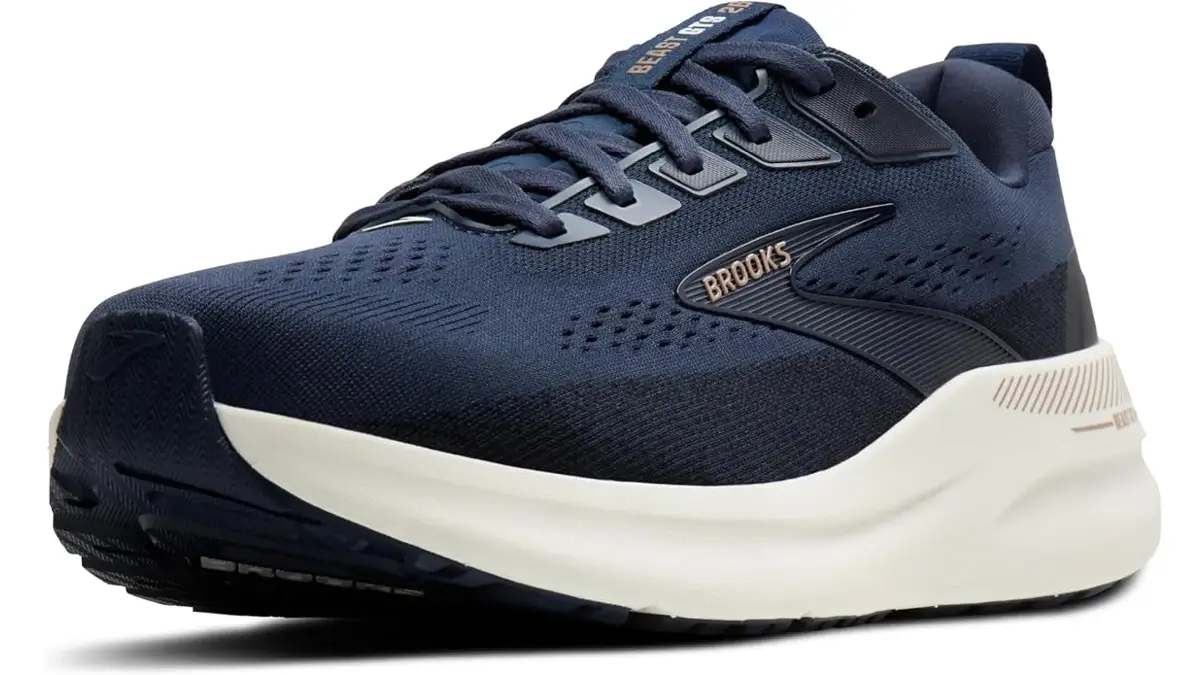
Softer and steadier than any Beast before it, and heaviest shoe Brooks makes
Quick Answer: Brooks Beast GTS 26 Review: The Beast GTS 26 is Brooks’ most supportive shoe, and this version is the first one that is genuinely comfortable. A switch to nitrogen-infused DNA Loft v3 foam and 2 mm more of it under the whole foot turn a famously firm shoe into a soft one, while the GuideRails system still limits how far your foot rolls inward. Wide and extra-wide fittings and plenty of room for orthotics make it a favorite for walking too. It is very heavy. Check latest price.
The Brooks Beast is the most structured shoe the brand makes, and it has been for a long time. It is built for people who need a lot of support and a lot of shoe underneath them: heavier runners, walkers who spend hours on hard ground, people whose feet roll noticeably inward, and anyone who wears a prescribed insole. The women’s version is called the Ariel, and it is the same shoe.
Within the Brooks range the Beast sits at the top of the support ladder. The Adrenaline GTS is the mainstream stability trainer, the Glycerin GTS is the plush one and the Beast is the maximum one, with the widest base, the most structure and the most material. Brooks skipped a number this time, so the GTS 26 replaces the GTS 24 directly.
This is not a subtle shoe and it is not trying to be. If you are a lighter runner looking for something responsive, look elsewhere in the Brooks range. If you are a heavier runner or a serious walker who has found ordinary stability shoes flimsy, this is the one that was designed for you, and it is worth understanding what changed.
Specs
Here are the specifications for the Beast GTS 26:
| Type | Maximum-support road running and walking shoe |
| Support | Structured, using the GuideRails system front to back |
| Midsole | Nitrogen-infused DNA Loft v3 |
| Heel-to-toe drop | 12 mm, one of the highest on sale, so your heel sits well above your toes |
| Heel stack | About 38 mm. Published forefoot figures are inconsistent, so we quote only Brooks’ official 12 mm drop. |
| Weight | 12.5 oz / 354.4 g in a men’s 9, 11.2 oz / 317.5 g in a women’s 8 |
| Outsole | RoadTack rubber |
| Widths | Medium (D), Wide (2E) and Extra Wide (4E) |
| Other | Carries the APMA Seal of Acceptance, orthotic friendly, heel pull tabs |
| Price | Launched at $180 in April 2026, a $10 increase over the outgoing Beast GTS 24. Check latest price |
Pros
These are the real improvements in this version:
- It is finally soft. DNA Loft v3 has nitrogen blown into it, which makes the foam lighter and more compliant, and it compresses under you instead of feeling like a plank.
- There is 2 mm more foam under both the heel and the forefoot, so there is more between you and the ground everywhere, not just at the back.
- Three widths, up to 4E extra wide, which almost no other max-support shoe offers.
- The upper is much plusher than before, with softer mesh and a roomy shape that suits swollen feet and thick orthotics.
- RoadTack rubber on the outsole is Brooks’ hard-wearing compound, and on a shoe this heavy that matters.
Cons
And these are the reasons it will not suit everyone:
- At 12.5 ounces in a men’s 9 it is one of the heaviest road shoes you can buy, and adding foam has not helped.
- Softer foam means slightly less stability than the old Beast delivered, which is a real trade for anyone who chose it for maximum control.
- A 12 mm drop is unusually high, and if you are used to modern shoes it will feel like leaning forward.
- $180 is a lot, and $10 more than the last version.
- It is slow. There is nothing in this shoe that wants to go quickly, and it will feel like hard work at anything above an easy pace.
What is new versus the Beast GTS 24
Brooks skipped a number, so the GTS 26 follows the GTS 24, and it is the biggest change to this shoe in years. The headline is the midsole. The Beast ran on BioMoGo DNA for a very long time, a firm and durable but distinctly old-fashioned foam. It now uses nitrogen-infused DNA Loft v3, the same compound Brooks put in its Glycerin GTS daily trainer, and that single change transforms how the shoe feels underfoot.
Brooks also added 2 mm of foam under the heel and 2 mm under the forefoot, so the whole shoe sits higher off the ground. Combined with the softer material, that turns the Beast from a shoe you tolerated for the support into one that is comfortable in its own right. It also, inevitably, makes it a little less rigidly stable, which is the trade Brooks decided to make.
Two other changes matter. The GuideRails system has been reworked so it integrates more closely with the medial sidewall, meaning the support structure is now part of the midsole rather than sitting alongside it. And the outsole moves to RoadTack rubber, Brooks’ more durable compound. The upper is softer and plusher too. Taken together, this is a genuine redesign rather than a refresh, and if you own a GTS 24 you should expect a different shoe.
Who should buy the Beast GTS 26
Buy it if you are a heavier runner or walker who has found normal stability shoes insufficient. A wide base, a tall stack and structure running the full length of the shoe are exactly what you need if lighter shoes feel like they collapse under you, and very few current models offer all three.
It is also the obvious choice if you wear orthotics or need a wide fitting. The upper is roomy, the sockliner lifts out cleanly and Brooks offers medium, wide and extra wide, which is more choice than the rest of the max-support category combined. The shoe also carries the American Podiatric Medical Association’s Seal of Acceptance, which means a panel of podiatrists reviewed it and judged it beneficial for foot health.
And it suits people who spend long hours on their feet rather than running fast. If your mileage is walking mileage, or your running is all easy pace, the Beast’s deep cushioning and steady platform are exactly the right priorities.
Who should probably skip it
Skip it if you are a lighter runner. This much shoe under a smaller frame feels sluggish and unnecessary, and you will get a better ride from a mainstream stability trainer. Skip it if you run anything faster than easy pace, because 12.5 ounces punishes you at speed. And skip it if a high heel-to-toe drop bothers your calves or your Achilles, since 12 mm is at the top of the current range.
- Asics GT-2000 15: a lighter, gentler support shoe that keeps your foot steady without the bulk, and a better everyday choice for a moderate runner (check price | read review)
- Brooks Ghost Max 4: neutral rather than supported, with a tall stack and a rocker that make it excellent for walking, if it turns out you wanted cushioning rather than structure (check price | read review)
- Asics GT-1000 15: the budget support option, firmer and much cheaper, for shorter runs and daily walks where the Beast is overkill (check price | read review)
How does the Beast GTS 26 fit?
The Beast fits true to size with an accommodating shape that is roomier than most running shoes through the forefoot and midfoot. Brooks designed it around feet that need space, including swollen ones and ones sharing the shoe with an orthotic. The upper is soft enough that it does not fight a wide foot.
Fit and sizing
Order your normal running shoe size. If you use an orthotic, take the stock sockliner out before you fit yours, and check that your foot still sits down inside the shoe rather than perched on top of the insole. Choose the width rather than sizing up: Brooks sells medium, wide and extra wide, and a 2E or 4E will give you room across the foot without adding length that lets your heel slip. Heel pull tabs make it easier to get on, which is a small kindness on a shoe this substantial.
Upper and step-in comfort
Step-in comfort is much improved, and it is one of the clearest differences from the previous Beast. The mesh is significantly softer, the tongue and collar are well padded, and the whole thing feels immediately welcoming rather than industrial. There is no break-in period. The shape holds the midfoot securely without squeezing, which matters because the GuideRails only work if your foot stays where it should. The one thing to note is warmth: a plush, densely padded upper on a large shoe runs warmer than a thin one, which you will notice on a hot day.
How does the Beast GTS 26 perform?
The Beast has always been a shoe you chose for what it does rather than how it feels. This version narrows that gap considerably. It is soft, it is smooth and it is still enormously steady, and the only thing it asks in return is that you accept the weight.
Cushioning and ride
This is the big change. Nitrogen-infused DNA Loft v3 means gas is whipped into the foam during manufacture, which makes it lighter and much more willing to compress. Landing in the GTS 26 you sink into the shoe in a way no previous Beast allowed, with a deep and even compression rather than a firm slap. It is soft rather than bouncy, so there is no springy push back, and the 12 mm drop means most of the sensation happens under the heel. For easy running and long time on your feet that combination is very comfortable. For anything quick it is dull.
Ride and running performance
The Beast rolls rather than snaps. The tall heel and the soft foam mean the shoe settles under you on landing and then transitions steadily forward, which is smooth at easy pace and increasingly laborious as you speed up. There is no plate, no rocker doing the work and no rebound to speak of, so the effort of moving 12.5 ounces per foot is entirely yours. Treat it as an easy-day and long-day shoe, and pair it with something lighter if you also do faster sessions. Anyone who runs only easy miles will not miss the speed at all.
Stability and support
The Beast GTS 26 is a structured stability shoe, the most structured Brooks makes. GuideRails are firmer sections of foam that sit either side of the heel and run the length of the shoe, and Brooks describes them as working like the bumpers on a bowling lane: they do nothing while your foot travels along its natural path and only engage when it moves outside it. On this version they are built into the medial sidewall rather than bolted alongside it, which makes the transition into support smoother. Note the honest caveat: because the foam underneath is now softer, the GTS 26 is slightly less rigidly stable than the GTS 24. It guides rather than restricts, and it does not correct anyone’s gait.
Outsole, grip and durability
RoadTack is Brooks’ hard-wearing rubber compound and it covers a generous amount of the sole, which is what a shoe this heavy needs. Grip on dry and damp pavement is dependable, and it handles gravel paths and packed dirt without complaint, though it is a road shoe and will not hold on mud. Durability should be a strong point, with the outsole rubber and the substantial midsole both built to last. The usual 300 to 500 mile guideline for replacing a running shoe applies here as a broad rule of thumb rather than a promise, and a heavier shoe on a heavier runner tends to sit at the upper end of that range for outsole wear and the lower end for foam.
Is the Beast GTS 26 good for walking?
It is one of the best walking shoes Brooks makes, and a large share of the people who buy it never run in it. Everything that makes it a mediocre fast shoe makes it a good walking one: deep soft cushioning that takes the punishment out of concrete, a broad platform that stays steady at slow speeds, and structure that keeps a tired foot from rolling inward at the end of a long day. Three widths and enough room for an orthotic solve the two problems that most often stop people walking comfortably. The high heel takes some getting used to if you have been in flatter shoes, and the weight is real, but for standing all day, walking hard floors or covering several miles at an easy pace, the Beast does exactly what you want. It is a genuine all-day shoe.
Beast GTS 26 versus Beast GTS 24
Here is what actually changed between generations:
Feature | Beast GTS 26 | Beast GTS 24 |
Midsole foam | Nitrogen-infused DNA Loft v3 | BioMoGo DNA |
Cushioning height | 2 mm more under heel and forefoot | Lower |
Feel underfoot | Soft, deep compression | Firm and flat |
GuideRails | Integrated into the medial sidewall | Separate structure alongside the midsole |
Outsole | RoadTack rubber | Previous rubber compound |
Launch price | $180, April 2026 | $170 |
Buy the new model when comfort matters to you as much as support. The foam change is substantial, and if the old Beast felt punishing underfoot, this one will not.
Buy the previous model when you chose the Beast specifically for maximum rigidity, and when you can find it discounted. The GTS 24 is the firmer and marginally more controlling of the two, and for some feet that is the point of the shoe.
If you are still deciding whether you need a supported Brooks at all, our guide to the difference between Brooks GTS and non-GTS shoes explains what the letters mean and who benefits.
Brooks Beast GTS 26 Alternatives
Three shoes cover the most common reasons the Beast is not quite right.
The Hoka Gaviota 6 is the closest thing to a direct rival. It reaches the same place by a different route, using a very tall stack and a frame around the foot instead of firmer foam wedges, and it rides with more of a rocker so it rolls you forward rather than asking you to push. If the Beast’s flatter, more deliberate transition feels like work, this is the one to try (check price | read review).
Runners who want support without quite this much shoe should look at the Asics Gel-Kayano 33. It is a premium stability trainer with a noticeably lighter, livelier feel and a lower drop, which suits anyone whose calves object to the Beast’s tall heel. It gives up some of the sheer breadth of the platform (check price | read review).
Staying with Brooks, the Glycerin GTS 23 is the softer, lighter supported option. It uses the same GuideRails idea on a plusher, more forgiving base, so it feels closer to a normal daily trainer that happens to keep you steady. Choose it if you liked the new Beast’s cushioning but not its weight (check price | read review).
Price and value
At $180 the Beast GTS 26 is priced with the premium stability shoes and $10 above the model it replaces. The increase buys a genuinely new midsole, more foam, a reworked support system, a more durable outsole and a much nicer upper, which is more than most annual updates deliver. Where the value is clearest is in the width range: if you need a 4E fitting with real support, your options are few and this is the best of them. Where it is weakest is versatility, because this is a one-job shoe and a heavy one. For the runner or walker it was built for, we think it earns the money.
Final verdict
Best for: heavier runners and walkers, orthotic users, wide and extra-wide feet, and anyone who wants maximum support with deep cushioning.
Avoid if: you are a lighter runner, you run anything faster than easy pace, or a high heel-to-toe drop bothers your calves.
Fit: true to size, roomy and accommodating, in medium, wide and extra wide. Pick the width rather than sizing up, and remove the sockliner before fitting an orthotic.
Verdict: Brooks has taken the shoe people bought out of necessity and made it one they might buy out of preference. The move to nitrogen-infused DNA Loft v3, plus 2 mm more foam everywhere, turns the Beast from firm and unforgiving into genuinely soft, while the reworked GuideRails keep the support that is the whole reason it exists. It is fractionally less rigid than before and it is still very heavy, so it is a shoe for going far rather than fast. For the people it was designed for, it is the best Beast yet.
Frequently Asked Questions for Brooks Beast GTS 26
There was not one. Brooks skipped the number, so the Beast GTS 26 replaces the Beast GTS 24 directly. That is also why this update is bigger than a normal annual refresh.
Yes. Ariel is the name Brooks uses for the women’s version of the Beast. The two are the same shoe with different last shapes and colorways.
They are firmer sections of foam running along the sides of the shoe. Brooks compares them to bumpers on a bowling lane: they stay out of the way while your foot moves along its natural path and only push back when it travels outside it. They guide movement and do not correct a gait.
Yes, in medium, wide (2E) and extra wide (4E). That is a broader width range than almost any other maximum-support running shoe, and it is one of the main reasons people choose the Beast.
Yes, and Brooks designs it with that in mind. Lift the stock sockliner out first, then fit your own, and check that your foot still sits down inside the shoe rather than raised up in it. The wide and extra-wide fittings help if your orthotic is bulky.
It is one of the better options for it. Deep soft cushioning, a wide steady base, three widths and room for an orthotic are exactly what long hours on hard floors ask for. The weight is the main thing to be aware of.
It is high by current standards, and it means your heel sits well above your toes. Most people adapt within a few outings, but if you have been running in flatter shoes, ease into it, and if you have a history of calf or Achilles trouble a lower drop may suit you better.