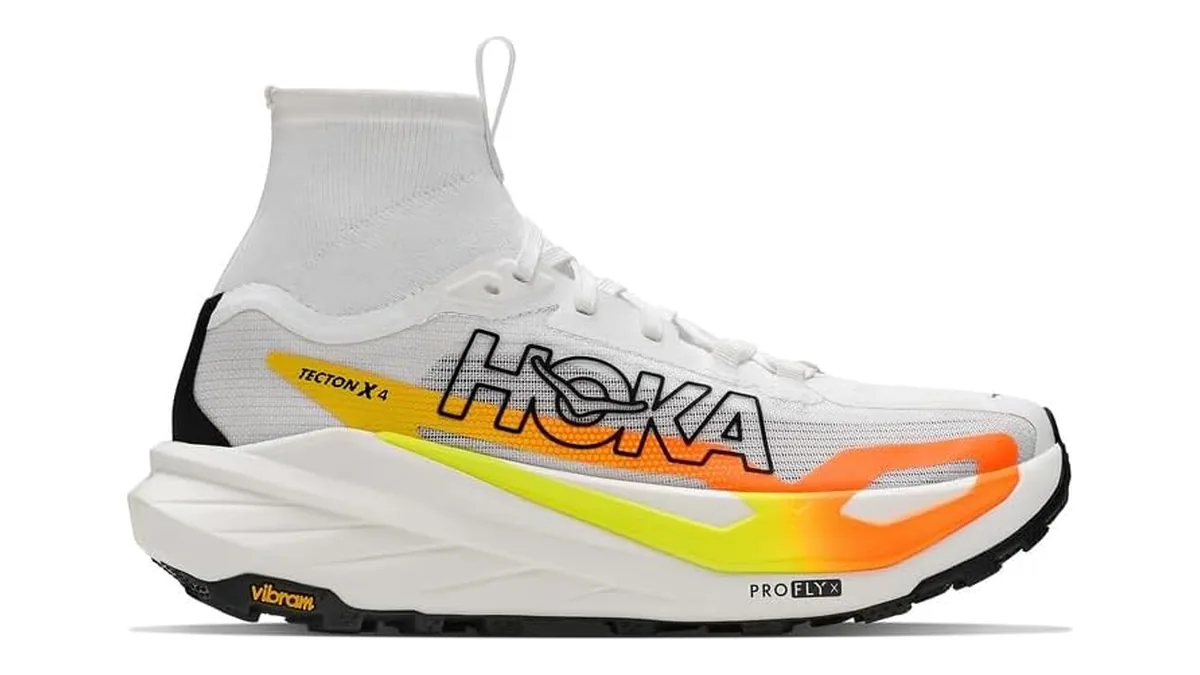
Genuine propulsion on rough ground, at a price only racers will justify
Quick Answer: Hoka Tecton X 4 Review: The Hoka Tecton X 4 is a trail racing shoe with two carbon plates and a thick layer of light, springy foam, built for people chasing times over long distances off road. It is the first Tecton that feels genuinely propulsive without getting twitchy on descents, and the Vibram sole grips wet rock and loose dirt confidently. It is expensive and too stiff for casual trail miles, so treat it as a race and long-run shoe. Check latest price.
The Hoka Tecton X 4 is the top of Hoka’s trail range and the shoe it puts on the feet of its ultra racers. It belongs to a small group usually called trail super shoes: tall, foam-heavy models with a stiff plate inside, borrowed from road racing and then rebuilt to handle rocks, mud and steep ground. Hoka has been at this longer than most brands, and it has taken four versions to get the recipe settled.
The Tecton has always used two separate carbon plates running side by side rather than one wide plate, which is the point of the whole design. A single stiff plate makes a shoe fast in a straight line but stubborn when the ground tilts. Two narrower plates can move independently, so one side can give while the other holds. Earlier versions promised that and did not quite deliver. This one does, which is why it is worth paying attention to even if the price makes you wince.
Specs
Here are the specifications for the Hoka Tecton X 4:
| Type | Trail racing shoe, for ultras and long mountain days |
| Gait type | Neutral |
| Midsole | Profly X, two layers of supercritical PEBA foam |
| Plate | Two parallel carbon fiber plates |
| Stack height | About 40 mm at the heel. Published forefoot figures vary between sources, so treat that number as unconfirmed |
| Heel-to-toe drop | 6 mm |
| Weight | 9.7 oz (275 g) men’s size 10; 8.3 oz (233 g) women’s size 8 |
| Upper | Lightweight woven mesh with a gusseted tongue |
| Outsole | Vibram Megagrip with Litebase, 4 mm lugs |
| Geometry | Hoka speed-focused MetaRocker, a curved sole shape that helps roll you forward |
| Widths | Standard only |
| Price | $275 at launch, August 2026. Check latest price |
Pros
Here is what the Tecton X 4 gets right:
- Real forward drive on climbs and rolling ground, which earlier Tectons only hinted at
- Remarkably steady for a shoe this tall, because the twin plates let each side of the foot move on its own
- Light for the amount of foam underneath it
- Vibram Megagrip with 4 mm lugs, which is proper mountain traction rather than a road sole with a pattern on it
- Enough cushioning to keep your legs working late in an ultra
Cons
And where it costs you:
- $275 is a lot for a shoe you will not want to use every day
- Too stiff and too tall for slow, technical scrambling
- The thin Litebase rubber saves weight but will not last like a standard trail outsole
- No wide fitting, and the upper is cut close
- Overkill for anyone whose trail running is an hour on local paths
What is new compared with the Tecton X 3
The Tecton X 3 was a frustrating shoe. It had the plates, the foam and the grip, but the ride never quite came together: too much stack for the amount of control on offer, and a gaiter-style upper that divided opinion. The Tecton X 4 addresses both. Hoka reworked how the two plates sit inside the midsole and paired them with the Profly X foam setup, and the result is a shoe that pushes back when you press on it instead of just cushioning the blow.
The upper is the other big change. It is simpler and less fussy, with a normal gusseted tongue rather than an integrated sleeve, so getting in and out is easier and the fit is less fiddly to dial in. Stability on descents is noticeably better too, which was the most common complaint about the previous version. This is the update the line needed, and it is one of the rare cases where the new model is worth the money over a discounted old one.
Who should buy the Hoka Tecton X 4
Buy it if you race off road and the result matters to you. That covers a 50K, a mountain marathon or a 100-miler, and it covers a hard training effort on a route you know well. The shoe rewards a runner who is moving with intent, because the plates and the rocker shape need force to do anything. Put that force in and you get a smooth, insistent roll that saves your legs over several hours.
It also suits runners who have tried other trail super shoes and found them unnerving. The usual complaint about the category is that a tall, stiff shoe feels tippy when the ground is uneven, and that is what the twin plate layout is designed to fix. On off-camber trail and loose descents the Tecton X 4 stays under you far better than its stack height suggests. If that was the thing stopping you buying into the category, this is the one to try.
Finally, buy it if your terrain is genuinely rough. The Vibram sole and the 4 mm lugs are not decoration. They handle wet rock, roots and loose dirt with real confidence.
Who should probably skip it
Most trail runners should skip it, and that is not a criticism of the shoe. If you run an hour on packed paths, or you hike as much as you run, or you go out for the scenery rather than the clock, none of this shoe’s expensive parts do anything for you. Slow technical ground is its weakest setting: tall and stiff is exactly wrong when you are picking your way over boulders. It is also a poor value proposition if you only own one pair of trail shoes, because the Litebase rubber will wear through faster than an ordinary trail outsole.
Any of these will serve you better:
- Hoka Speedgoat 7: the same brand’s do-everything trail shoe, with similar grip and cushioning at well under half the price, and far happier at a relaxed pace (check price | read review)
- Saucony Peregrine 16: lower, lighter and much more nimble, which is what you actually want on tight, technical trails (check price | read review)
- Brooks Caldera 8: deeply cushioned and stable for long days on your feet, and it walks as well as it runs, which the Tecton never will (check price | read review)
How does the Hoka Tecton X 4 fit?
The Tecton X 4 fits like a race shoe that expects to be on your foot for a long time. It is snug rather than tight, with enough room at the front that your toes are not fighting each other after four hours, and a heel and midfoot that hold firmly. If you have run in Hoka trail shoes before, it will feel familiar.
Fit and sizing
Take your usual Hoka size. Length is accurate and the toe box is moderately roomy for a racing shoe, which matters more in trail running than on the road because feet swell over a long day and downhills push you forward. The midfoot is cut close, so high-volume feet will feel the pressure from the laces. There is no wide fitting. The gusseted tongue, meaning a tongue joined to the sides of the shoe, keeps grit out and stops the tongue sliding, and it is a genuine improvement over the previous version’s setup.
Upper and step-in comfort
The upper is a thin woven mesh with minimal overlays, chosen for weight and drainage rather than protection. Step-in comfort is firm and race-like, and the shoe disappears on the foot once it is laced. It drains and dries quickly after a stream crossing, which is what you want from an ultra shoe. What it does not give you is much armor: there is only light reinforcement at the toe, so kicking a rock is unpleasant. On rough ground that is a fair trade for the weight saved, but it is worth knowing before you buy.
How does the Hoka Tecton X 4 perform?
This is a specialist, and it performs like one. Give it the conditions it was built for, which means runnable trail and a runner pushing the pace, and it is one of the best shoes of its kind. Take it outside those conditions and it becomes an awkward, expensive companion.
Cushioning and ride
The midsole is Profly X, which means two layers of supercritical PEBA. PEBA is the light, highly resilient foam that transformed road racing, and supercritical simply describes how it is foamed with gas to make it lighter and bouncier. Practically, that gives you a shoe that absorbs the sting of rocky ground while still springing back. About 40 mm of it sits under the heel, which is a lot of protection. On a long descent it is the difference between quads that still work at mile 40 and quads that do not.
Ride and running performance
The two carbon plates sit side by side under the foot, and combined with the curved MetaRocker sole they tip you forward through each stride. On smooth or rolling trail the effect is obvious and welcome: the shoe seems to want to keep going. On climbs it is better still, because the stiffness gives you something to push against instead of letting your foot bend and waste effort. The caveat is speed. Below a decent clip the plates do nothing and you are carrying a tall, rigid shoe for no return.
Stability and support
The Tecton X 4 is a neutral shoe with no pronation control, and it should not be confused with a stability model. Its stability is about staying upright on uneven ground, and that comes from the split plate design. Because the two plates are independent, the shoe can twist a little where a single plate would resist, so it follows the ground rather than fighting it. Add a reasonably wide base and the result is a 40 mm shoe you can take onto off-camber trail without holding your breath. It is still tall, so very technical ground remains a bad idea.
Outsole, grip and durability
Vibram Megagrip is the benchmark trail rubber for wet rock, and the 4 mm lugs bite into soft dirt without feeling clumsy on hard-packed sections. Grip is not a weak point. Durability is, and that is a deliberate choice. Litebase is a thinner backing layer under the rubber that cuts weight, and the cost is a sole that wears through sooner than a full-thickness one. Treat this as a race and key-session shoe rather than a daily trainer and it will last a long time. Use it for every run and you will be disappointed at how quickly the lugs round off.
Is the Hoka Tecton X 4 good for walking?
For ordinary walking, no. The plates and the rocker need running speed to do anything, so on a walk you get the weight and the stiffness with none of the benefit, and the tall platform feels unsteady at a stroll. It is also the wrong shoe for hard floors or town use, where the aggressive lugs are noisy and wear down quickly.
There is one exception worth noting, because it matters to the people who buy this shoe. Long trail races involve a great deal of fast hiking on steep climbs, and the Tecton X 4 handles that well. The stiff platform gives you something to drive against on a steep gradient and the Vibram sole grips when you are stepping rather than striding. So it is a poor everyday walker and a good race-day hiker, which is an unusual combination but the right one for its job.
Hoka Tecton X 4 vs Tecton X 3
The two versions are closer on paper than they are on the trail:
Feature | Tecton X 4 | Tecton X 3 |
Plates | Two parallel carbon plates, repositioned | Two parallel carbon plates |
Midsole | Profly X, dual-layer PEBA | Dual-layer PEBA |
Upper | Woven mesh, gusseted tongue | Integrated sleeve-style upper |
Descending stability | Much improved | The main complaint about the shoe |
Outsole | Vibram Megagrip Litebase, 4 mm lugs | Vibram Megagrip Litebase |
Price at launch | $275, August 2026 | Not confirmed |
Buy the Tecton X 4 if you are choosing between them at full price, because the ride and the downhill control are meaningfully better. Buy the Tecton X 3 only if you find it heavily discounted, you already know the fit suits you and you mostly run rolling ground where the stability gap matters less.
Hoka Tecton X 4 Alternatives
Three shoes cover the most likely reasons to look past it.
The North Face Vectiv Enduris 4 is the value answer. It also uses a plate and a firm, propulsive platform, and it costs a great deal less, so it suits a runner who wants the plated feel on hard-packed and rocky trails without paying race-shoe money (check price | read review). Its wet-weather grip is the compromise.
Where the ground turns soft and messy, grip matters more than propulsion. Salomon Thundercross has deeper, more aggressive lugs and handles mud and wet rock better than anything here, which makes it the smarter buy for a wet winter racing season (check price | read review).
Hoka Challenger 8 is the pick if most of your route is road or gravel with only a stretch of dirt in the middle. It has shallow lugs and a road-shoe ride, so it does not clatter on pavement the way a proper mountain shoe does, and it costs a fraction of the Tecton (check price | read review).
Price and value
At $275 on launch in August 2026, the Tecton X 4 sits at the top of the trail market, and it is not trying to be good value. What you buy is two carbon plates, a PEBA midsole and a Vibram outsole in a package under 10 ounces, which is genuinely hard engineering. For a runner with races on the calendar, spreading that cost across a season of key efforts is defensible. For someone whose trail running is recreational, it is a lot of money for parts you will not use, and the Speedgoat does 80 percent of the job for a third of the price.
Final verdict
Best for: trail racers and ultra runners on long, runnable routes, and anyone who wanted a trail super shoe but found the category too unstable.
Avoid if: you run slowly, you need one trail shoe to do everything, or your local terrain is technical and slow.
Fit: true to size, snug midfoot, moderately roomy toe box. Standard width only.
Verdict: The Tecton X 4 is the shoe the line has been aiming at since the first version. It is fast, protective and, at last, trustworthy when the ground drops away beneath you. We rate it highly and we would still tell most people not to buy it, because unless you are racing you are paying for engineering you will never call on.
Frequently Asked Questions for Hoka Tecton X 4
A single wide plate makes a shoe stiff in every direction, which is fine on a road and awkward on uneven ground. Two narrower plates running side by side let one side of the shoe flex while the other stays firm, so it can follow the trail without losing its forward push.
Expect less than from an ordinary trail shoe. The Litebase construction uses a thinner layer under the Vibram rubber to save weight, and it wears faster as a result. Saving it for races and key long runs is the sensible approach.
No. The upper is a thin woven mesh chosen to drain and dry fast rather than to keep water out, which is the right priority for long races with stream crossings. There is no Gore-Tex version of this model.
You can cover road sections between trails without trouble, and the cushioning is comfortable on pavement. The 4 mm lugs will wear down quickly on asphalt, though, so using it as a road shoe is an expensive mistake.
Yes. Order your normal Hoka size. The midfoot is snug and there is no wide version, so anyone who needs extra width across the ball of the foot should look at a different model.
Most trail and ultra events do not apply the stack height limits that govern road racing, so it is normally fine. Rules differ between governing bodies and specific events, so check with the race organizer if you are competing at a level where it could matter.