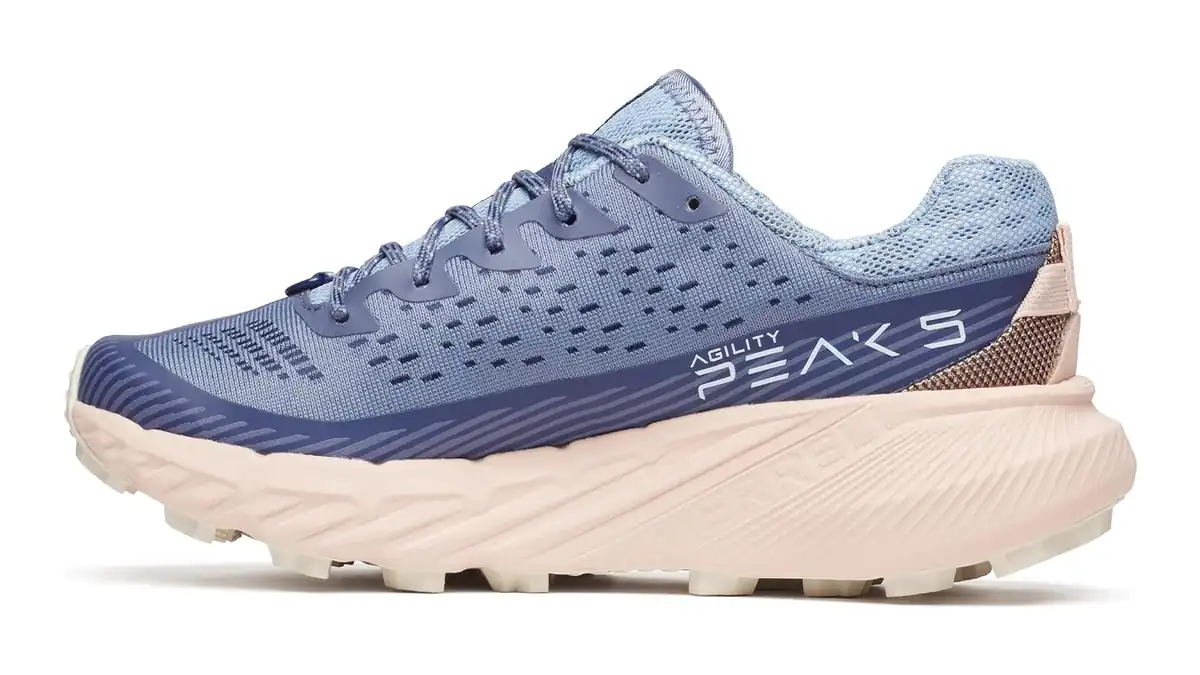
Quick Answer: Merrell Agility Peak 5 Review: The Merrell Agility Peak 5 is a neutral trail shoe that gives you a Vibram Megagrip outsole and a rock plate for noticeably less than most shoes with that combination. Deep lugs and sticky rubber make it dependable on wet rock, mud and loose ground, and the plate keeps sharp stones away from your feet. It is the sensible buy for anyone on rough trails who does not want to spend flagship money. The trade-offs are a firm, workmanlike ride and a little more weight than the lightest rivals. Check latest price.
Premium grip and protection in a firm and slightly heavy shoe
The Merrell Agility Peak 5 is the brand’s serious trail running shoe, and the one that gets recommended most often when someone asks for grip and protection without a premium price tag. Merrell is better known for hiking boots than for running shoes, and the Agility Peak carries a bit of that heritage: it is built tough, it is built to grip and it is not especially worried about being fashionable.
It is a neutral shoe, meaning there is no wedge or frame built in to slow the inward roll of the foot. What it does have is a rock plate, a thin stiff layer inside the sole that spreads the pressure of sharp stones so they do not press into one spot under your foot, plus a genuine Vibram outsole.
That specification is the reason to look at it. Vibram Megagrip and a rock plate together usually push a trail shoe well past $160, and the Agility Peak 5 came in comfortably under that.
Specs
Here are the specifications for the Merrell Agility Peak 5:
| Type | Trail running shoe, cushioned and technical |
| Gait type | Neutral |
| Midsole | FloatPro Foam with a rock plate |
| Stack height | 31 mm at the heel, 25 mm at the forefoot |
| Heel-to-toe drop | 6 mm, a modest step down from heel to toe that suits most running styles |
| Weight | About 10.2 oz (290 g) in a men’s US 9 and about 8.3 oz in the women’s version |
| Upper | Breathable engineered mesh with TPU reinforcement and recycled laces |
| Outsole | Vibram Megagrip with 5 mm staggered lugs |
| Widths | Standard; a wide fitting is not confirmed for this model |
| Best for | Rugged and technical trails, wet rock, mud, hiking |
| Price | Launched at $140 in 2024 (the exact launch month is not confirmed). Check latest price |
Pros
These are the reasons it is such a common recommendation:
- Vibram Megagrip with deep lugs, which is the best traction package available and rarely found at this price
- The rock plate means you can run rocky ground without feeling every stone through the sole
- The staggered lug pattern grips in all directions, so it brakes on descents as well as it drives on climbs
- Built to last, with a tough upper and hard-wearing rubber
- Comfortable enough to double as a light hiking shoe
Cons
These are the compromises:
- The foam is firm and fairly basic, so long days leave your legs working harder than a premium foam would
- Heavier than the lightest trail shoes in its class, which shows up on long climbs
- Not much bounce or energy return, so it never feels fast
- The fit is on the snug side through the midfoot, and no wide fitting is confirmed
- The deep lugs make it awkward on pavement between trail sections
What is new in the Merrell Agility Peak 5
The fifth version is a focused update rather than a redesign, and every change points the same way: better grip, better hold, slightly less weight.
The outsole is the biggest improvement. Merrell revised the Vibram Megagrip tread with a staggered lug layout, which means the lugs are offset from each other rather than lined up in rows. The effect is that the shoe grips more evenly as your foot rolls through a step, instead of tearing at the surface in one direction. On loose gravel and soft dirt that translates into a foot that stays put rather than skidding a few centimetres before it bites.
Merrell also worked on stability and on breathability. The midsole is shaped to hold the foot more securely at the heel, the upper mesh is more open so heat escapes faster, and the whole shoe came out about 5 grams lighter than the Agility Peak 4. None of that is dramatic, but the combination makes the Agility Peak 5 a more confident shoe on rough ground than the model it replaced.
Who should buy the Merrell Agility Peak 5
Buy this if your trails are rough and your budget is real. It is aimed squarely at people who run or hike on rocky, rooty, wet or loose ground and want the grip and protection that makes that comfortable, without paying for a premium foam they may not need.
It suits neutral runners with average feet on outings of an hour to three hours. It is particularly good for anyone who has been getting sore feet on rocky trails, because the rock plate does a genuinely effective job of taking the sting out of pointed stones.
Hikers are a natural audience too. The build quality is closer to a light hiking shoe than to a racing shoe, the grip is as useful walking as running and the firm midsole holds up well under a day pack. If you want one pair for weekend trail running and weekend hill walking, this is a sensible answer.
Who should probably skip it
If you run long, the firm FloatPro foam will eventually catch up with you. It protects well but it does not have the deep, springy give that keeps legs fresh over four or five hours, and that is the clearest limit on this shoe. Anyone training for an ultra should look at something with more modern cushioning.
It is also the wrong choice if your routes mix a lot of pavement with dirt, because the tall lugs are uncomfortable and wear quickly on hard surfaces. If either of those sounds like you, consider these:
- Asics Trabuco Max 4: a much taller, softer trail shoe with a rocker sole that keeps you rolling forward on long, easy hours (check price | read review)
- Hoka Challenger 8: a soft, flexible road-to-trail shoe with shallow lugs that stays comfortable on the pavement sections between trails (check price | read review)
How does the Merrell Agility Peak 5 fit?
The Agility Peak 5 fits securely rather than generously. Merrell holds the foot firmly through the heel and midfoot, with a toe box that is average in width and reasonable in height. It is the sort of fit that feels reassuring on technical ground and slightly tight if your feet are wide. Most people take their usual size.
Fit and sizing
Order your normal running size. Length is true and there is enough room ahead of the toes for descending. The midfoot wrap is firm, which is deliberate: a shoe with this much grip needs your foot to stay still, or the traction just twists your foot inside the shoe. Narrow feet do well here. Wide feet will find it snug, and since a wide fitting is not confirmed for this model, that is worth checking with a retailer before ordering.
Upper and step-in comfort
The upper is a fairly dense engineered mesh with TPU strips over the high-wear areas and a firm toe bumper, which is the piece that protects your toes when you clip a root. It is tougher than most running uppers and slightly less forgiving as a result. Collar padding is generous, the heel counter is firm and the laces are made from recycled material. Step-in comfort is good without being luxurious: the shoe feels solid and supportive straight away rather than soft, and there is no meaningful break-in period.
How does the Merrell Agility Peak 5 perform?
This shoe is about traction and protection, and it is very good at both. What it does not do is make you faster or keep your legs fresh over extreme distances. Here is how the pieces stack up.
Cushioning and ride
FloatPro Foam is Merrell’s own EVA-based midsole material, and it is firm and durable rather than soft and lively. Underfoot you get a moderate amount of it, which keeps you reasonably close to the ground and gives you a clear sense of what you are standing on. The rock plate does most of the protective work, and it does it well: pointed stones register as pressure rather than pain. The compromise is that the shoe absorbs impact instead of returning it, so it feels solid rather than bouncy.
Ride and running performance
There is no propulsion plate and no rocker shape, so the Agility Peak rolls forward on its own momentum. At easy and steady trail paces it is smooth and predictable, and the grip lets you keep your speed on descents where other shoes would have you braking. Push hard on flat, smooth ground and the weight and the firm foam both hold you back. This is a shoe for running rough ground confidently, not for running fast on easy ground.
Stability and support
The Agility Peak 5 is neutral, with no medial post or guidance frame, and it makes no attempt to change how your foot moves. Its steadiness comes from a moderate stack height that keeps you low, a firm midsole that does not compress unevenly and a heel shaped to cradle the foot. Low and firm is the most reliable recipe for stability on a trail, and this shoe has both. Runners who overpronate noticeably, meaning the foot rolls inward more than usual as it lands, will not find correction here and should consider a stability model or their own orthotics.
Outsole, grip and durability
This is the shoe’s reason to exist. Vibram Megagrip is the most trusted rubber compound in trail running because it stays tacky on wet rock and wet wood where ordinary rubber turns slick, and Merrell has paired it with 5 mm lugs, which is deep enough to bite into mud and loose dirt. The staggered arrangement means grip stays consistent as your foot rolls through the step rather than arriving in one sudden bite. Durability is excellent on both the rubber and the upper, and this is a shoe that tends to be retired because the foam has gone flat rather than because the sole has worn out. The common 300 to 500 mile guideline for replacing shoes is a rough guide rather than a promise.
Is the Merrell Agility Peak 5 good for walking?
On trails it is excellent, and Merrell’s hiking background shows. The grip is as valuable at walking pace as at running pace, especially on wet rock where a slip matters, and the rock plate takes the fatigue out of a long rocky path better than almost any running shoe at this price. The firm midsole also means the shoe does not squirm underneath you when you are carrying a pack.
For pavement walking, travel and standing all day it is a poor choice. The deep lugs are uncomfortable on hard flat surfaces and wear down fast, the firm foam gives standing feet nothing to sink into and the shoe is heavy for everyday wear. Treat it as a trail and hiking shoe, and keep something lighter for town.
Agility Peak 5 vs. Agility Peak 4
The two are close relatives, with the changes concentrated in the places that matter on rough ground.
Feature | Agility Peak 5 | Agility Peak 4 |
Outsole | Vibram Megagrip, staggered lugs | Vibram Megagrip, aligned lugs |
Weight | About 290 g in a men’s US 9 | About 5 g heavier |
Upper | More breathable mesh | Warmer, denser mesh |
Heel hold | Improved shaping and support | Less secure on side slopes |
Ride | Firm, unchanged in character | Firm |
Buy the Agility Peak 5 if you run in the heat or on loose, technical ground, where the new tread and the cooler upper both earn their keep. Buy a discounted Agility Peak 4 if you find one cheap, because the fundamentals are the same shoe.
Merrell Agility Peak 5 Alternatives
If the Agility Peak 5 is close but not quite right, these are the shoes to weigh against it.
- Hoka Speedgoat 7: the step up in cushioning for anyone who found the Merrell too firm, with comparable grip and a far softer landing (check price | read review)
- Saucony Peregrine 16: a lighter and more agile shoe with similar grip credentials, better suited to people who want to run quickly on technical ground (check price | read review)
- Brooks Cascadia 20: a roomier, more forgiving shape at a similar price, for feet the Merrell squeezes through the midfoot (check price | read review)
- Salomon Thundercross: the option when mud rather than rock is your problem, with a self-clearing tread that copes with genuinely soft ground (check price)
Price and value
At its $140 launch price the Agility Peak 5 is one of the best-value trail shoes available, and the reason is simple arithmetic: Vibram Megagrip and a rock plate normally cost more. Merrell saved the money on the midsole foam, which is the part most people notice least on the kind of runs this shoe is designed for.
Judged on grip, protection and durability per dollar it is excellent value. Judged on comfort over very long distances it is only average, and that is the honest limit of the bargain.
Final verdict
Best for: neutral runners and hikers on rocky, wet or technical trails who want top-grade grip and underfoot protection at a mid-range price.
Avoid if: you run ultra distances, you want a soft and springy ride, or your routes include a lot of pavement.
Fit: true to size, secure through the heel and midfoot, average width with no confirmed wide option.
Verdict: the Merrell Agility Peak 5 is the sensible choice rather than the exciting one. It puts the two things that matter most on rough ground, grip and protection, into a shoe that costs less than its rivals, and it builds them to last. The firm foam and the weight are the price of that, and if your runs are long enough for those to matter, spend more. For everyone else this is a lot of shoe for the money. Check the latest price.
Frequently Asked Questions for Merrell Agility Peak 5
Merrell sells Gore-Tex versions of several Agility Peak models, so check the product name for a GTX label. The standard shoe is not waterproof and uses a breathable mesh that drains and dries quickly, which is usually the better choice unless you run in cold, persistently wet conditions.
It is a thin, stiff layer built into the sole between the foam and the outsole. When you land on a pointed stone, the plate spreads that pressure across a wider area instead of letting it press into one spot under your foot. You still feel the rock, but as a general pressure rather than a jab, and your feet stay comfortable for much longer on stony ground.
A wide fitting is not confirmed for this model, and the standard shoe is average in width with a fairly snug midfoot. Merrell does offer wide options on some of its hiking shoes, so it is worth asking a retailer directly. Sizing up is not a good substitute, because it adds length without adding much width.
Yes, and it is one of the better running shoes for it. The Vibram sole, the rock plate and the tough upper all come from the same thinking that goes into hiking shoes, and the shoe is far lighter than a boot. It offers no ankle support, so a heavy pack or a history of ankle injuries still argues for a mid-height boot.
They are built for different speeds. The Moab is a hiking shoe: heavier, stiffer, more supportive and designed for walking with a load. The Agility Peak 5 is a running shoe with hiking-grade grip, so it is lighter, more flexible and better when you want to move quickly. For pure hiking the Moab is more comfortable; for mixed running and walking the Agility Peak wins.
Yes. The insole lifts out and the shoe has enough internal depth to take a standard orthotic. Because the midfoot is snug, a bulky orthotic will tighten the fit noticeably, so try the combination before a long run. The rock plate sits below the foam and is not affected by what you put on top of it.
This review covers the previous generation. See our Merrell shoes guide for the current lineup and Agility Peak 6 context.