Soft, roomy and cheap, with almost nothing published about what is inside it
Quick Answer: Nike Quest 7 Review: The Quest 7 is the cheapest road shoe Nike sells, and it works best as an everyday and walking shoe that can take a short run. Nike has put a softer foam underfoot and cut the forefoot roomier than its other trainers, which makes it comfortable straight out of the box and easy to live with. The limits are real, though: there is no wide fitting, no air unit and very little published detail about what you are standing on. Check latest price.
Gender-specific buy links: Men’s version | Women’s version
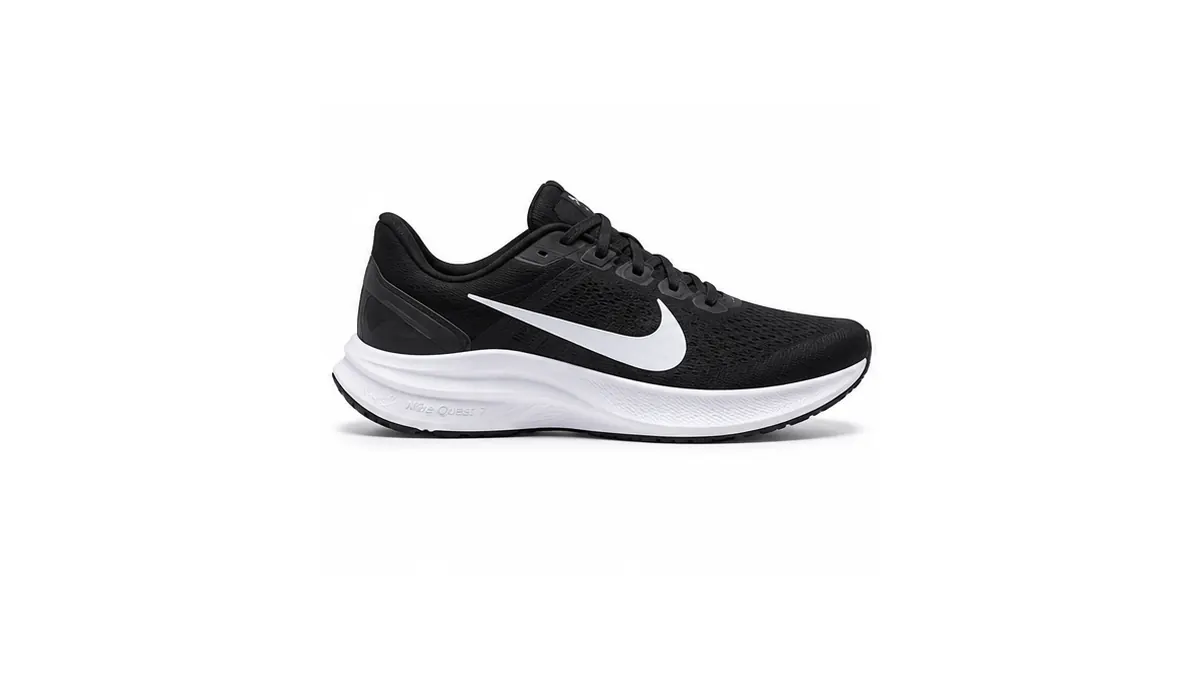
The Nike Quest 7 sits at the very bottom of the Nike road range, below the Winflo and a long way below the Pegasus. It is the shoe that shows up in department stores and on sale racks, and it is bought as often for wearing to work or the shops as for running. Nike knows that, and the Quest 7 is designed accordingly.
The midsole, meaning the layer of foam between your foot and the road, is Cushlon 3.0. That is Nike’s everyday cushioning foam, the softer and more forgiving end of its non-performance materials, and it is the reason the Quest 7 feels better than a shoe at this price has any right to. There is no plate and no visible air unit: this is a plain slab of foam and a rubber sole.
The other thing Nike has done, and it is worth knowing, is cut the front of the shoe with more room than its other trainers. Nike running shoes are famously narrow, and that puts a lot of people off the brand entirely. The Quest 7 is the exception. What follows covers how it fits, how it rides, how it handles a day of walking and where the corners have been cut.
Specs
Here are the specifications for the Nike Quest 7:
| Type | Neutral road running and walking shoe, entry level |
| Gait type | Neutral |
| Midsole | Cushlon 3.0, Nike’s soft everyday foam |
| Plate or air unit | Neither; the foam does all the work |
| Stack height | Not published by Nike for this model |
| Heel-to-toe drop | 10 mm in the men’s version and 9 mm in the women’s, per Nike’s own listings |
| Weight | Approximate: about 280 g (9.9 oz) in a men’s US 10 and about 224 g (7.9 oz) in a women’s US 8 |
| Upper | Two-toned engineered mesh, cut with extra room across the forefoot |
| Outsole | Rubber across the wear zones |
| Widths | Nike does not list extra widths for this model; the standard fit is cut roomier at the front than most Nike trainers |
| Best use | Walking, everyday wear, gym and treadmill work, short easy runs |
| Price | $85, available from 29 June 2026. Check latest price |
Pros
These are the things the Quest 7 has going for it:
- Cushlon 3.0 is genuinely soft, so the shoe feels comfortable the moment you put it on rather than needing to be broken in.
- The forefoot is cut with more room than Nike’s other running shoes, which opens the brand up to people who have always found it too narrow.
- At $85 it is one of the cheapest ways to get a current Nike road shoe rather than an old model on clearance.
- The two-toned engineered mesh is light and airy, so it does not cook your feet in summer the way denser budget uppers do.
- The women’s version uses a slightly lower heel than the men’s, which is a sensible piece of attention to detail at this price.
Cons
These are the compromises:
- No wide fitting is offered, so if the roomier standard cut is still not enough, there is nowhere to go.
- Nike does not publish a stack height for this shoe, which makes it hard to know how much foam you are actually getting.
- Soft foam without any structure means the shoe is not especially steady, and that becomes noticeable over longer distances.
- There is no air unit or plate, so nothing here helps you along. Every bit of forward motion is yours.
- Cushlon is not a durable performance foam, so the softness will fade before the shoe looks worn out.
What is new versus the Nike Quest 6
The foam is the story. Nike has specified Cushlon 3.0 here, the softer and more modern version of its everyday cushioning compound, which is a meaningful step up from what the Quest line used before. Budget shoes usually feel hard because the cheapest foams are dense, so a genuinely soft midsole at this price is the most useful thing Nike could have changed.
The fit has moved too. Nike has cut the forefoot with more room than its other road shoes, which addresses the single most common complaint about the brand. Anyone who has tried a Pegasus and found it pinched across the ball of the foot should find this noticeably easier to wear, even without a wide fitting on offer.
The upper is a two-toned engineered mesh, lighter and more breathable than the older, more heavily overlaid design. What has not changed is the basic recipe: one piece of foam, a rubber sole and no technology underfoot. That is what keeps the price at $85, and it is the right call for a shoe in this slot.
Who should buy the Nike Quest 7
This is a shoe for someone who wants one comfortable pair of sneakers that will cover everything ordinary: walking the dog, a day of errands, an hour at the gym and an occasional couple of miles of running. It does all of that well and it does not ask much in return.
It is also the Nike to try if Nike has never fit you. Plenty of people write the brand off because the Pegasus and the Vomero are cut narrow, and the Quest 7’s roomier forefoot is a genuine exception. If you like how Nike shoes look and have given up on how they feel, this is worth a try before you conclude the brand is not for you.
Newer runners get a mention too. At $85 this is a low-risk way to find out how much running you will actually do before committing $150 to a shoe you might wear four times. The soft foam is forgiving while you build up, and the upper is comfortable enough that the shoe keeps earning its place as a casual sneaker afterward.
Not sure this is the right shoe? Use our free Shoe Finder to narrow your choices by fit, cushioning, support and how you plan to use the shoe.
Who should probably skip it
If you are running regularly, this is not enough shoe. Soft foam with no structure holds up poorly once you are out for more than a few miles, because it compresses and stays compressed, and there is nothing in the design to keep your foot centered as you tire. A proper daily trainer will feel better and last longer.
It is also wrong if your feet roll inward or if you genuinely need a wide shoe. There is no guidance built in at all, and while the forefoot is roomier than Nike’s usual, a roomier standard fit is not the same thing as a 2E. Anyone in either camp should shop elsewhere rather than hope.
These are better places to start:
- Nike Winflo 12: still inexpensive, but with an air unit, more foam and genuine wide and extra-wide fittings (check price | read review).
- Brooks Adrenaline GTS 25: the answer if your arches collapse as you walk or run, with guidance and a wide range of fittings (check price | read review).
- Asics Gel-Cumulus 26: a proper neutral daily trainer for anyone whose running has become a habit rather than an occasional thing (check price | read review).
How does the Nike Quest 7 fit?
The Quest 7 fits more generously than anything else Nike makes for the road, which is the single most useful thing about it. The heel and midfoot are conventional and the toe box has real space. Here is what to expect when you try a pair.
Fit and sizing
Take your usual size. Nike shoes often run a little short, and the Quest 7 is no exception in length, but the extra room across the ball of the foot means you are less likely to need to size up just to get width. If you are between sizes, go up.
There are no extra widths. That is the hard limit of this shoe, and it is worth being clear about: a roomier standard cut helps a moderately broad foot, but it will not accommodate someone who is properly a 2E or 4E. If that is you, look at Nike’s own Winflo, which does come in wide fittings, or at Brooks and New Balance.
Upper and step-in comfort
The upper is a two-toned engineered mesh, light and open enough to breathe properly in warm weather. There are few stitched overlays, which means little to press on a bunion or a prominent joint, and the tongue and collar carry enough padding to feel finished without being bulky.
Step-in comfort is the shoe’s best first impression. The soft Cushlon foam gives immediately underfoot and the roomy forefoot means nothing is gripping your toes. Nothing needs breaking in. Lockdown is fine for walking and easy running, though the soft upper does not hold as firmly as a performance shoe if you try to move quickly.
How does the Nike Quest 7 perform?
The Quest 7 performs like a comfortable shoe rather than a capable one, and that distinction matters. It feels good for the first few miles and gives you very little beyond that. The sections below cover cushioning, ride, steadiness and how well it wears.
Cushioning and ride
Cushlon 3.0 is soft and pleasant underfoot, which is exactly what you want for walking on concrete and standing around. Nike does not publish a stack height for the Quest 7, so there is no official figure for how much foam is under you, but the feel is cushioned rather than minimal.
The character is soft and quiet rather than springy. The foam absorbs the impact and gives very little back, so the ride is comfortable and a bit dull. For its intended use that is the right balance, and a livelier foam at this price would almost certainly be a harder one.
Ride and running performance
On a short, easy run the Quest 7 is perfectly comfortable. The 10 mm heel on the men’s version suits people who land heel first, which covers most casual runners, and the transition from landing to push-off is smooth if unremarkable.
There is nothing here to help you go faster. No plate, no air unit and no pronounced curve at the front of the sole means all the propulsion is yours, and the soft upper starts to feel vague if you try to pick up the pace. Keep runs short and easy and it is a good shoe. Build toward a race and it will hold you back.
Stability and support
This is a neutral shoe with no support features, and the combination of soft foam and a soft upper means it is a less steady one than some budget rivals. Firm shoes feel planted because nothing compresses unevenly underneath you. Soft shoes trade some of that away for comfort, and the Quest 7 sits on the comfortable side of that line.
For walking and short runs that is not a problem. For anyone whose feet roll inward, or who finds soft shoes unnerving on uneven ground, it is. If you have been advised to look at support shoes, or the inside edges of your old pairs wear faster than the outside, this is not the shoe to buy.
Outsole, grip and durability
Rubber covers the areas that see the most wear, with exposed foam elsewhere to keep the cost and weight down. Grip on dry sidewalks, indoor floors and treadmill belts is reliable enough. In the wet it is adequate rather than confident, so be sensible on painted lines and smooth tile.
Durability is the honest weak point. Soft everyday foams lose their cushioning faster than firm ones, and exposed midsole between the rubber pads wears quickly if you walk on gravel. The usual 300 to 500 mile figure is a broad guideline only, it varies with your weight, stride and surfaces, and no shoe carries a guaranteed lifespan. Expect this one nearer the lower end of that range.
Is the Nike Quest 7 good for walking?
Yes, and walking is probably what most pairs will be used for. Walking is far gentler on a shoe than running, so the soft foam that fades under running mileage holds up fine, and the roomy forefoot and light, airy upper make it a pleasant thing to wear for hours. For errands, travel days, dog walks and a few miles at a time it is a sensible and inexpensive choice.
For standing all day on concrete it is more of a compromise. There is cushioning but no structure, so after six or eight hours the foam has given everything it has and your foot is sitting on a flattened platform. Nurses, retail staff and anyone on hard floors for a full shift will be better served by a deeper, firmer-framed shoe. The lack of any wide fitting also counts against it for feet that swell through the day.
Nike Quest 7 vs. Nike Quest 6
Here is how the two generations compare:
Feature | Quest 7 | Quest 6 |
Midsole | Cushlon 3.0, softer everyday foam | Earlier Cushlon formulation, firmer |
Forefoot fit | Cut with extra room across the ball of the foot | Narrower, in line with Nike’s usual fit |
Upper | Two-toned engineered mesh, light and breathable | Mesh with more structured overlays |
Drop | 10 mm men’s, 9 mm women’s | Comparable traditional drop |
Widths | Standard only | Standard only |
Buy the Quest 7 when you want the softer foam and the roomier front, which together make it a much more comfortable everyday shoe than the one it replaces.
Buy the Quest 6 when you find it heavily discounted and you prefer a firmer feel, or when the newer shoe is simply not available in your size.
Nike Quest 7 Alternatives
The usual reason to move up from the Quest is that you have started running properly. In that case the Pegasus 42 is the obvious Nike answer: firmer, more durable, with air units underfoot and enough structure to stay dependable when your form gets sloppy late in a run. It costs a good deal more, and it earns the difference if you are out three or four times a week.
Where steadiness matters more than softness, the Brooks Revel 9 is the better shoe at a similar price. Its wide, firm platform feels planted in a way the Quest does not, which suits older walkers and anyone who finds soft shoes wobbly on uneven ground. You give up the plush step-in feel entirely.
Broad feet are the one problem the Quest cannot solve, and the Asics Gel-Contend 10 can. It sits at almost exactly the same price and runs all the way to an extra-wide 4E in men’s sizing, with a soft foam and a GEL insert under the heel. It is heavier, which is the price of that extra room.
- Nike Pegasus 42: the step up within Nike, firmer and far more durable for regular running (check price | read review).
- Brooks Revel 9: a firmer, more planted budget shoe for anyone who wants steadiness over softness (check price).
- Asics Gel-Contend 10: the same money with widths up to 4E, for feet the Quest cannot accommodate (check price).
Price and value
At $85 from its June 2026 release, the Quest 7 buys a current Nike, a genuinely soft foam and a roomier fit than anything else the brand makes for the road. As everyday and walking footwear that is good value, particularly if you have always liked how Nike looks and never liked how it fits. As a running shoe it is limited, and the lack of any wide fitting and of published specifications both count against it. Buy it for what it is, not for what the swoosh suggests.
Final verdict
Best for: walkers, everyday wearers, new runners on a budget and anyone who likes Nike but has always found the brand too narrow across the toes.
Avoid if: you run regularly, you need a genuine wide fitting, or your feet roll inward and need support.
Fit: true to size in length, with more room across the forefoot than other Nike road shoes, and no extra widths offered.
Verdict: the most comfortable cheap shoe Nike makes, and the friendliest one for a normal foot. Just do not mistake it for a training shoe. Check the latest price.
Frequently Asked Questions for Nike Quest 7
Nike does not list extra widths for the Quest 7. The standard version is cut with more room across the forefoot than other Nike road shoes, which helps a moderately broad foot, but it is not a substitute for a 2E or 4E fitting.
Cushlon is Nike’s everyday midsole foam, used across its more affordable shoes. The 3.0 version is softer and more forgiving than earlier formulations, which is what makes the Quest 7 comfortable straight out of the box. It is not one of Nike’s performance foams.
The Winflo sits a step above the Quest. It has more foam underfoot, an air unit for extra cushioning and comes in wide and extra-wide fittings. The Quest is simpler and cheaper, with a plain foam midsole and no air unit, aimed more at walking and casual wear.
Nike publishes detailed specifications for its performance shoes but often leaves them off its entry-level models. There is no official stack height for the Quest 7, so any figure you see quoted elsewhere is an estimate rather than a manufacturer number.
It is a reasonable first running shoe if your runs are short and easy. The soft foam is forgiving and the low price means little risk. Once you are running several times a week or going beyond a few miles, a proper daily trainer will feel better and last longer.
Nike lists the men’s version at a 10 mm drop and the women’s at 9 mm. Brands sometimes build women’s models on a slightly different sole, and a 1 mm difference is small enough that most people will not notice it in use.