Last Updated on October 16, 2026
Softest, bounciest racing ride in a heavier shoe
Quick Answer: Saucony Endorphin Elite 3 Review: The Endorphin Elite 3 is Saucony’s top carbon-plated racing shoe, and nothing else on sale feels quite this soft and springy. This version widens the base and fixes the sloppy upper of the last one, so the fun is now available to ordinary runners rather than only to the very steady on their feet. It gained around 10 grams doing it, and at $289.99 it is competing with lighter shoes. Check latest price.
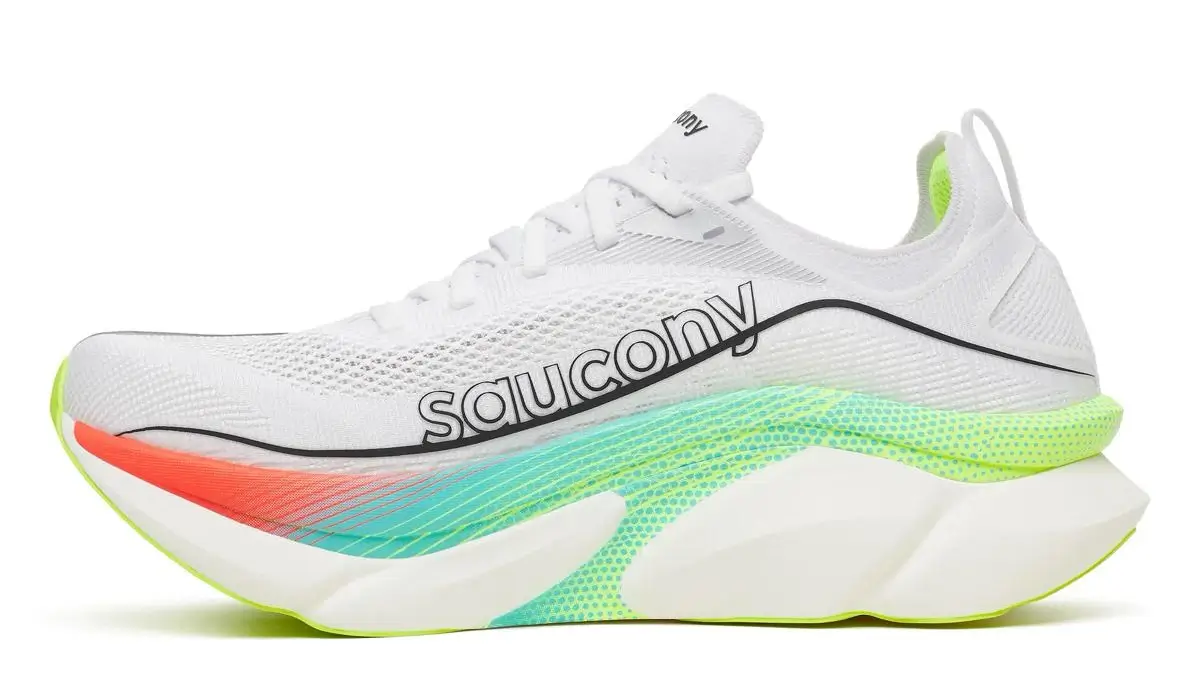
The Saucony Endorphin Elite 3 is a road racing shoe with a carbon fiber plate and a very tall stack of foam, the kind runners call a super shoe. Stack height means how much material sits between your foot and the road, and the plate is a stiff sheet that stops the sole bending flat so the shoe rolls you forward.
What sets this one apart is the foam and how much of it there is. Saucony uses two layers of IncrediRUN, its softest and most rebounding material, with the plate sandwiched between them. Most racers use one slab of foam. Doubling it up is why this shoe has a reputation for being the most fun thing in the category and, in earlier versions, the least controllable.
In the Saucony range it sits at the very top. The Endorphin Speed is the plated shoe for workouts, the Endorphin Pro is the more conventional marathon racer, and the Elite is the flagship. It went on sale on June 1, 2026 at $289.99. The runner it suits is someone chasing a personal best who wants a race shoe that feels exciting rather than efficient.
Specs
Here are the specifications for the Saucony Endorphin Elite 3:
| Category | Road racing shoe, carbon-plated |
| Best for | Half marathon and marathon racing, plus hard race-pace workouts |
| Support type | Neutral, with steadiness coming from the width of the base rather than from support features |
| Midsole foam | Two layers of IncrediRUN, Saucony’s softest and most rebounding foam, above and below the plate |
| Plate | Slotted carbon fiber plate, new for this version |
| Stack height | 39.5 mm at the heel, 31.5 mm at the forefoot |
| Heel-to-toe drop | Listed at 8 mm, although independent testers measuring a worn-in pair recorded closer to 5.7 mm, so treat the figure as approximate |
| Heel platform width | About 94.2 mm, roughly 3.6 mm wider than the previous version |
| Weight, men’s | About 7.2 to 7.4 oz, 207 to 210 g, in a size 9 depending on the source |
| Weight, women’s | About 6.5 oz, 184 g, in a size 8 |
| Upper | Lightweight mesh with a gusseted tongue and a reworked lacing setup |
| Outsole | Minimal rubber at the main wear points |
| Widths | Standard only |
| Surface | Road and smooth pavement |
| Price | $289.99 at its June 1, 2026 launch. Check latest price |
Pros
These are the reasons to want the Endorphin Elite 3:
- Nothing else feels like this. Two layers of IncrediRUN give a soft landing and a genuine spring off the ground, and independent reviewers are near unanimous that it is the bounciest ride in the category.
- The base is wider than before, most noticeably at the heel, which makes the shoe usable for runners who found the last version too unsettled.
- The upper is properly fixed. A gusseted tongue and better lacing replace the floppy one-piece setup that let feet slide around.
- The plate is now slotted, which softens how abruptly the stiffness arrives, so the shoe feels smoother through each step.
- Removing the cutout in the midsole means more foam under the middle of your foot, so the platform no longer collapses inwards where it used to.
Cons
These are the reasons to hesitate:
- It gained around 10 grams over the previous version, which is the wrong direction for a race shoe when rivals are getting lighter.
- At $289.99 it is among the most expensive shoes on the market, and lighter racers cost less.
- It is still a soft, tall shoe, and independent reviewers report that some runners continue to find it unsteady despite the wider base.
- The listed 8 mm drop does not match what independent testers measured, so the shoe may feel flatter than the spec sheet suggests.
- One width only, so there is nothing for runners who need a wide fitting.
What is new versus the Endorphin Elite 2
Every change here addresses the same complaint. The Endorphin Elite 2 was thrilling and hard to control, and runners who were not very stable on their feet could not use it. Saucony has spent this version making it behave.
The base is wider throughout, and the heel platform grew by about 3.6 mm to roughly 94.2 mm. That sounds small and is not: a wider heel gives your foot more to land on, and independent measurement confirms it improves side-to-side steadiness for anyone who lands on their heel. Saucony also removed the cutout that used to run through the midsole, so there is solid foam where there used to be a gap.
The plate changed too. It is now slotted, meaning cut with channels rather than being a solid sheet, which lets the stiffness build more gradually instead of hitting all at once. The toe curve was moved so it engages later in your stride, which makes the shoe feel less frantic.
Most welcome of all, the upper was rebuilt. The Elite 2 used a loose one-piece construction that many runners could never cinch down. The Elite 3 has a gusseted tongue, which means the tongue is stitched to the sides so it cannot slide, and a proper lacing arrangement. The cost of all this is weight: the Elite 2 came in around 6.9 oz for a men’s 9, and the Elite 3 is roughly 7.2 to 7.4 oz.
Who should buy the Endorphin Elite 3
Buy it if you want your race shoe to feel like an event. The bounce here is unlike anything else, and for a lot of runners that translates into running faster simply because the shoe makes the effort feel better. If you have tried firm, businesslike racers and found them joyless, this is the antidote.
It suits runners who liked the Elite 2 in theory but could not manage it in practice. The wider heel and the fixed upper together change the shoe from a specialist’s tool into something a mid-pack marathoner can use, and that is the real story of this version.
Heel strikers should take note. Landing on your heel in a narrow, soft racer is where things go wrong, and the extra platform width here is concentrated exactly where that happens.
And buy it if comfort over long races matters to you. Soft foam plus a properly fitting upper is a kind combination for two hours or more, and the Elite 3 is less punishing than most shoes at this level.
Who should probably skip it
Skip it if weight is your priority. Adding 10 grams while rivals shed them leaves the Elite 3 at a disadvantage on paper, and if you are chasing marginal gains there are lighter shoes at the same price or less. Independent reviewers have raised exactly this point.
Skip it too if soft shoes have never worked for you. The base is wider but the foam is still very soft, and reviewers report that some runners continue to feel unsettled in it. Preference for a firm, direct platform is not something a wider heel will change. And runners who need real support for feet that roll inward a long way should look at a stability trainer instead, because there is nothing in this shoe doing that job.
If that sounds like you, these three fit better:
- Saucony Endorphin Azura: the same brand’s plateless shoe on race foam, lighter on the foot and flexible, for runners who want speed without a stiff sole (check price | read review)
- Adidas Adizero Boston 13: firm, direct and fast, and durable enough to train in weekly, which is the opposite of this shoe in every way (check price | read review)
- Saucony Hurricane 26: a max-cushion shoe with a guidance system, for anyone who needs their feet held steady rather than launched (check price | read review)
How does the Saucony Endorphin Elite 3 fit?
The fit is the most improved part of the shoe. Where the previous version let your foot wander, this one holds it. The gusseted tongue and reworked laces give proper lockdown, and independent reviewers have likened the upper to the well-regarded one on the Endorphin Pro. It is a snug race fit, but a secure one rather than a tight one.
Fit and sizing
Take your usual running size. The length runs true and the toe box is adequate for a racing shoe, with enough height to avoid pressure on the toenails over a long event. The midfoot is where the improvement is most obvious, because the tongue no longer slides sideways and the laces can be pulled firm without creating a ridge across the top of your foot.
Saucony offers one width. The last is cut close in the way all racing shoes are, so a genuinely wide foot will feel it. There is no wide version to fall back on, which makes trying a pair on worthwhile before spending $290.
Upper and step-in comfort
The mesh is light and breathes well, and there is just enough padding at the heel collar to stop your foot lifting without adding bulk. Step-in comfort is better than most racers manage, largely because the soft foam underneath makes the shoe feel plush the moment you stand in it.
The gusseted tongue deserves a specific mention because it solves a real problem. On the previous shoe, runners reported spending the first mile of a race fiddling with a tongue that had shifted. Here it stays put, which is the kind of unglamorous fix that makes a shoe usable.
How does the Saucony Endorphin Elite 3 perform?
This is a shoe with a personality, and the personality is enthusiasm. It is softer and springier than its rivals, and this version is finally composed enough that most runners can enjoy that. The sections below cover the foam, the ride and how the sparse outsole holds up.
Cushioning and ride
Putting IncrediRUN both above and below the plate is what makes this shoe different. Your foot lands on soft foam, and there is more soft foam under the plate to compress and rebound, so the shoe absorbs impact and then pushes back hard. Independent reviewers describe the result as the softest and bounciest ride available in a racer, and that is not marketing language, it is a straightforward consequence of the construction.
At 39.5 mm the heel sits just inside the limit for road racing, so there is real depth for late-race protection. The forefoot at 31.5 mm is a little lower than some rivals, which keeps you connected to the ground where you push off.
Ride and running performance
Forward motion comes from the foam rebounding and the plate directing it, rather than from an aggressive sole curve. Because the toe curve now engages later in the stride, the shoe waits until you are ready to push before it does its work, which makes it smoother and less jumpy than the previous version.
The useful range runs from a hard half marathon to a marathon, and it is an enjoyable shoe for long race-pace sessions. At easy pace it is tall and soft and does not feel like much, so judge it on a fast run. The extra 10 grams are not something you notice mile by mile, but they are what the specification sheet will hold against it.
Stability and support
This is a neutral shoe with no support features at all. No medial post, no guidance rails, nothing steering your foot. Everything that keeps you level comes from the shape of the platform, and that is where Saucony concentrated its effort: a wider base overall, a heel platform about 3.6 mm broader, and solid foam where the old cutout used to be.
The improvement is real but not total. Independent reviewers still report that the shoe feels wobbly to some runners, which is what happens when you make the softest foam in the category into a 39.5 mm platform. Runners whose feet roll inward significantly will get no help here, nothing in this shoe corrects how you run, and we would not present it as a remedy for any foot problem. If pain persists or worsens, a physical therapist or podiatrist is the right call.
Outsole, grip and durability
Rubber is applied sparingly at the points that see the most wear, with foam exposed elsewhere to save weight. Grip on dry road is dependable and it is fine in light rain, which is all a road racer is asked to do. Painted lines and metal covers deserve the usual caution.
Durability is the standard racing trade-off. The familiar 300 to 500 mile figure is only a broad guideline, and a shoe built this light with this little rubber sits at the bottom of that range at best. Save these for races and key workouts, do your easy miles elsewhere, and a pair should cover several race cycles.
Is the Saucony Endorphin Elite 3 good for walking?
No. Walking pace never puts enough force through this foam to compress it properly or to engage the plate, so what you feel is a stiff sole perched on a very soft, very tall platform. On hard floors that combination is unstable rather than cushioned, and the shoe will not bend as your foot rolls through a step.
Standing all day is worse, because the plate passes pressure through to your foot rather than absorbing it. For travel it is a poor choice on practical grounds too: the sparse outsole wears down on sightseeing miles you are not racing, the thin upper offers no protection, and the snug race fit becomes uncomfortable as feet swell. There is no depth inside for a custom insole or orthotic either. For walking, standing or all-day wear, a cushioned trainer or a purpose-made walking shoe is the sensible purchase.
You can find a better walking shoe in our guide.
Endorphin Elite 3 versus Endorphin Elite 2
| Endorphin Elite 3 | Endorphin Elite 2 | |
| Plate | Slotted carbon fiber | Solid carbon fiber |
| Midsole | Two IncrediRUN layers, cutout removed, wider base | Two IncrediRUN layers with a midsole cutout |
| Heel platform width | About 94.2 mm | About 90.6 mm |
| Weight, men’s size 9 | About 7.2 to 7.4 oz | About 6.9 oz |
| Upper | Gusseted tongue, reworked lacing | Loose one-piece construction |
| Feel | Smoother, steadier, later toe roll | Livelier and less predictable |
Buy the Elite 3 if you want a shoe you can rely on. Every change makes it more usable, and the upper fix alone is worth the upgrade for anyone who fought with the last one.
Buy the Elite 2 while it is discounted if you are light, efficient and steady on your feet, and if you value those 10 grams. Some runners loved its unfiltered character and will find the new shoe a little tamer, and at a reduced price it remains a quick shoe.
Saucony Endorphin Elite 3 Alternatives
Within Saucony’s own range, the Endorphin Pro 5 is the calmer alternative and costs less. It uses a firmer foam and a more conventional platform, so it gives up the bounce in exchange for a shoe that simply gets on with the job. That suits runners who found the Elite’s softness distracting, and our Endorphin Pro 5 review spells out the difference.
Runners who want the lightest shoe possible should compare the Asics Metaspeed Sky Tokyo, which undercuts the Elite 3 on the scales by a clear margin. It is much firmer, so this is a straight choice between low weight and soft bounce. The Metaspeed Sky Tokyo review also explains why it favors a particular stride.
For shorter races, the Nike Vaporfly 4 is the better tool. It is lower and lighter and feels quicker over 5K and 10K, where the Elite 3’s deep foam is protection you do not need. See the Vaporfly 4 review for where that lower stack pays off.
Anyone drawn to soft, springy racing but put off by the Saucony’s weight or narrow last should look at the New Balance FuelCell SuperComp Elite v6. It is also soft and bouncy, weighs noticeably less and is one of the very few racers sold in a wide fitting, which settles the fit question this shoe cannot.
Price and value
$289.99 places the Endorphin Elite 3 near the very top of the market, above most of its direct rivals. What the money buys is a construction nobody else offers, with two layers of Saucony’s best foam either side of a slotted plate, and the resulting ride is genuinely distinctive rather than a small variation on a theme.
The value argument is the weakest part of the shoe. Independent reviewers have noted that the added weight hurts it precisely because several lighter racers sell for the same money or less, and a racing shoe’s short life means every dollar is spread across few miles. If the soft, bouncy character is what you want, nothing else delivers it and the price is the price. If you are simply after the fastest shoe you can afford, you can do better on grams per dollar elsewhere.
Final verdict
Best for: half marathon and marathon racing, heel strikers, runners who found the Elite 2 too unstable, and anyone who wants a race shoe that feels exciting.
Avoid if: you want the lightest shoe available, you dislike soft platforms, your feet are wide, or you need genuine support.
Fit: true to size, snug race cut, much improved lockdown thanks to the gusseted tongue, standard width only.
Verdict: Saucony has taken the most entertaining racing shoe on the market and made it usable, which is a better outcome than making it faster on paper. The wider heel, the solid midsole and the rebuilt upper together turn a shoe for the few into a shoe for the many. We rate it highly for anyone who wants soft, springy racing, with the honest caveats that it gained weight to get here and that $289.99 is a lot to ask when lighter rivals cost less.
Check the latest price on the Saucony Endorphin Elite 3.
Frequently Asked Questions for Saucony Endorphin Elite 3
Yes. Its 39.5 mm heel stack is just under the 40 mm limit for road racing and it uses a single plate, so it meets the current rules.
Less so than the version before it, thanks to a wider base and the removal of the midsole cutout. Independent reviewers report that some runners still find it wobbly, so it remains a soft shoe rather than a planted one.
It is a carbon plate cut with channels rather than being one solid sheet. The slots let the stiffness build up gradually through your step instead of arriving all at once, which makes the shoe feel smoother.
Saucony lists 8 mm, but independent testers measuring a pair recorded closer to 5.7 mm. Expect the shoe to feel flatter underfoot than the published figure implies.
Long race-pace sessions suit it well and are a sensible way to get used to the ride. Doing all your fast running in it will wear the thin outsole down long before the foam stops working.
Either works, and it comes down to taste. The Endorphin Elite 3 is softer and more fun but asks a little more of your balance. The Endorphin Pro 5 is calmer, cheaper and easier to run in if you are unsure.