Last Updated on September 23, 2026
| Quick Answer: Trail Running Shoes vs. Hiking Shoes. Trail running shoes are usually lighter, more flexible and more athletic underfoot. They are a strong choice for trail running, fast hiking, day hikes and walking on maintained trails. Hiking shoes usually use tougher materials and provide more underfoot structure and protection, making them better suited to rocky terrain, wet conditions and heavier loads. You can hike in trail running shoes, and many modern trail runners are designed for both activities. Choose based on terrain, weather, pack weight and the amount of protection you want. |
Trail running shoes and hiking shoes are built for many of the same places. Both can handle dirt, rocks, roots, gravel and uneven ground. The difference is how they handle them.
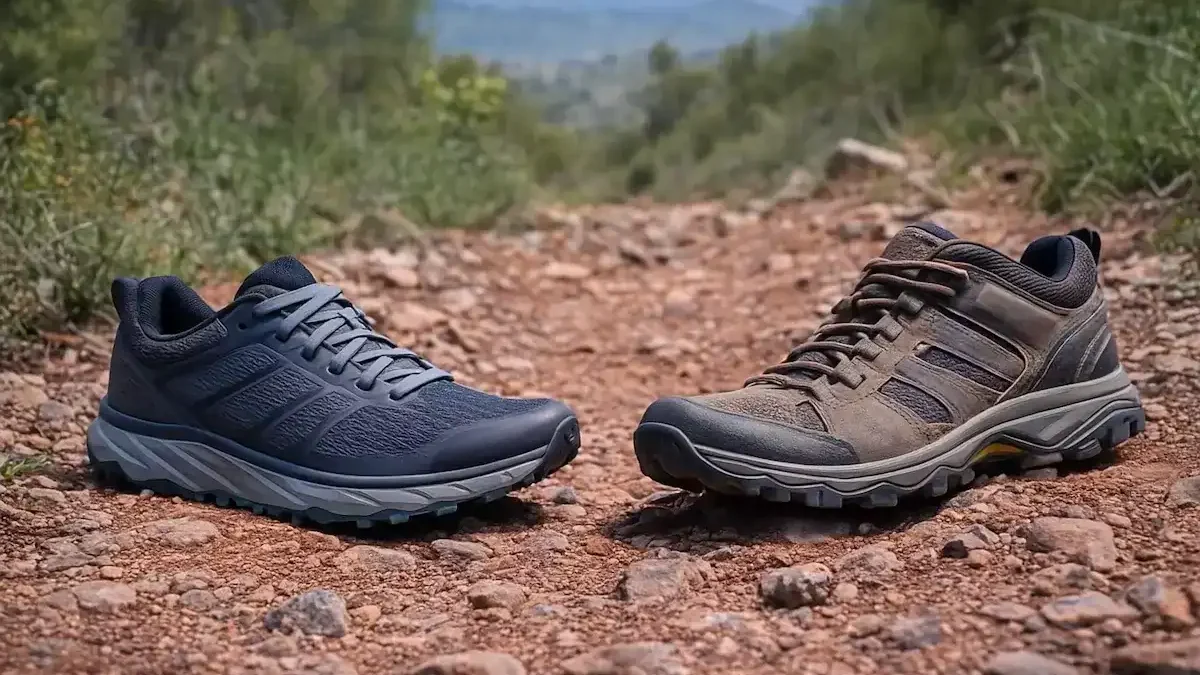
Trail running shoes put more emphasis on low weight, flexibility and easy movement. Hiking shoes generally put more emphasis on protection, structure and durability. But those categories increasingly overlap.
The Brooks Cascadia 20, for example, is a trail running shoe that Brooks also recommends for hiking. The Altra Lone Peak 9+ is designed for trail running, hiking and thru-hiking. At the same time, newer hiking shoes such as the Merrell Moab Speed 2 borrow cushioning and design ideas from athletic footwear.
So the question is no longer simply whether hiking shoes or trail runners are better. The better question is: Which type of shoe makes sense for the terrain you actually use?
Trail Running Shoes vs. Hiking Shoes at a Glance
Before comparing them, it helps to separate hiking shoes from hiking boots.
Hiking shoes are usually low-cut around the ankle. Hiking boots extend higher and generally provide more coverage and structure. A low-cut hiking shoe can actually have more in common with a rugged trail runner than with a traditional hiking boot.
Feature | Trail running shoes | Hiking shoes | Hiking boots |
|---|---|---|---|
Weight | Usually lightest | Moderate | Usually heaviest |
Flexibility | Usually highest | Moderate | Usually lowest |
Cushioning feel | Often athletic and responsive | Usually more structured | Usually firmer and more structured |
Upper protection | Moderate | Moderate to high | High |
Underfoot protection | Varies by model | Usually high | Usually high |
Trail traction | Mild to very aggressive | Moderate to aggressive | Moderate to aggressive |
Waterproof options | Available | Common | Very common |
Ankle coverage | Low | Low | Mid or high |
Fast hiking | Excellent | Good | Less ideal |
Trail running | Best choice | Usually too heavy | Poor choice |
Easy day hiking | Excellent | Excellent | Often unnecessary |
Technical hiking | Rugged models work well | Excellent | Excellent |
Heavy backpack | Depends on shoe and hiker | Usually better suited | Often preferred |
Hot weather | Usually best ventilation | Varies | Usually warmest |
There is no universal winner. For most people, terrain, weather and load matter more than whether the shoe is labeled “trail running” or “hiking.”
Which Should You Choose?
Here is the simplest way to decide.
Choose trail running shoes if most of the following describe you:
- You want lightweight footwear.
- You move quickly or mix hiking with running.
- You mainly hike maintained trails.
- You carry a light day pack.
- You prefer the feel of running shoes.
- You hike in warm or dry weather.
- You want one shoe for trail running and hiking.
See our recommended trail running shoes or find trail running shoes on Amazon.
Choose hiking shoes if:
- You regularly walk over rocks, roots and rough ground.
- You want more protection around the foot.
- You prefer a firmer and more structured platform.
- You regularly encounter mud or wet conditions.
- You carry more gear.
- Durability matters more than low weight.
Find trail running shoes on Amazon.
Choose hiking boots if:
- You hike in snow, deep mud or very rough terrain.
- You want additional coverage above the ankle.
- You regularly carry a heavy backpack.
- You prefer a stiffer and more substantial shoe.
Those are guidelines, not rules. An aggressive trail running shoe can handle terrain that some lightweight hiking shoes cannot.
Can You Hike in Trail Running Shoes?
Yes. Modern trail running shoes can be excellent hiking shoes. This is particularly true for day hikes, fast hiking, warm-weather hiking and trips where you are carrying a light pack.
Some manufacturers explicitly design their shoes for this crossover. Brooks lists hiking among the intended uses for the Cascadia 19, while Altra markets the Lone Peak 9+ for trail running, hiking and thru-hiking.
That means the useful question is not: “Can I hike in trail running shoes?”
It is: “Does this trail running shoe provide enough grip, protection and stability for this hike?”
A lightweight road-to-trail shoe may be perfect for packed dirt and gravel but less appropriate for a steep route covered with sharp rocks.
A more technical trail runner such as the Hoka Speedgoat 7 or Brooks Cascadia 19 provides considerably more trail capability.
Can You Run in Hiking Shoes?
You can run short distances in hiking shoes, but they are usually not the best choice for regular trail running.
Hiking shoes tend to weigh more and flex less than trail running shoes. Their construction is designed around walking rather than the faster and more repetitive movement of running.
If your outings regularly combine hiking and running, a trail running shoe is usually the better compromise.
This is also why trail runners have become popular for fast hiking. You get trail-specific traction without carrying the additional weight of more traditional hiking footwear.
What About Walking on Trails?
Trail walking sits directly between hiking and trail running. If you walk on park paths, gravel trails, packed dirt or relatively smooth woodland trails, you probably do not need a traditional hiking shoe.
A road-to-trail shoe such as the Hoka Challenger 8 gives you running-shoe cushioning with a trail outsole. Its 4 mm multidirectional lugs provide more traction than a road shoe without making it feel excessively aggressive on harder surfaces.
Move toward a hiking shoe when the terrain becomes steeper, wetter or rockier. The Salomon X Ultra 5 Gore-Tex, for example, is specifically designed for full-day hiking on mixed and technical terrain. It adds waterproofing and a more structured platform.
The pace is not what determines which shoe you need. The trail does.
Current Trail Running and Hiking Shoes to Consider
These shoes illustrate the spectrum from light road-to-trail footwear to more traditional hiking shoes.
As an Amazon Associate, we earn from qualifying purchases.
Shoe | Type | Best for | Drop | Why consider it | Launch/list price |
|---|---|---|---|---|---|
Road-to-trail running shoe | Easy trails, gravel and trail walking | 8 mm | Cushioned ride with moderate 4 mm trail lugs | $155 | Check latest price | |
Technical trail running shoe | Rocky trails and long trail outings | 5 mm | Vibram Megagrip, 5 mm lugs and substantial cushioning | $165 | Check latest price | |
Trail running / hiking | Mixed and technical trails | 6 mm | Trail Adapt System includes a flexible rock plate and DNA Loft v3 cushioning | $150 | Check latest price | |
Altra Lone Peak 9+ | Trail running / hiking | Hiking, thru-hiking and roomy fit | 0 mm | Original FootShape fit and Vibram Megagrip outsole | $160 | Check latest price |
Salomon X Ultra 5 Gore-Tex | Hiking shoe | Wet, rocky and technical hiking | 11 mm | Gore-Tex waterproofing, Advanced Chassis and Contagrip outsole | $175 | Check latest price |
Merrell Moab Speed 2 Gore-Tex | Athletic hiking shoe | Lightweight waterproof hiking | 10 mm | Full-length rock plate, FloatPro cushioning and Vibram TC5+ outsole | $175 | Check latest price |
Keen Targhee IV Waterproof | Hiking shoe | Rugged trails and roomy fit | 12 mm | Tough construction, roomy forefoot and waterproof design | $180 | Check latest price |
Not sure which shoe type fits your needs? Use our free shoe finder for a personalized recommendation.
How Terrain Changes Your Choice
Terrain should be one of the biggest factors in your decision.
Gravel and Packed Dirt
Trail running shoes usually make more sense. A shoe such as the Hoka Challenger 8 provides enough outsole traction for gravel and packed dirt without the extra structure of a hiking shoe. That also makes this style useful if your route moves between pavement and trail.
Woodland Trails
Either category can work. For relatively smooth trails with occasional roots and rocks, a trail running shoe is often enough.
If the route becomes rougher, a hiking shoe may provide more protection. A rugged trail runner such as the Brooks Cascadia 19 sits between those options. Its Trail Adapt System combines cushioning with a flexible rock plate designed to protect the foot while allowing it to adapt to uneven terrain.
Rocky and Technical Trails
This is where footwear choice becomes more important. Look for:
- A secure fit
- Reliable outsole traction
- Toe protection
- Underfoot protection
- A platform that feels controlled on uneven ground
The Hoka Speedgoat 7 represents the trail-running approach to this terrain. It uses Vibram Megagrip and 5 mm lugs.
The Salomon X Ultra 5 Gore-Tex represents the hiking-shoe approach. It is heavier and more structured, with greater emphasis on protection and stability.
Check current price for the Salomon X Ultra 5 Gore-Tex.
Mud
Do not choose purely by shoe category. Look at the outsole. Deeper and more widely spaced lugs can grip soft ground and shed mud more effectively than shallow tread. Some technical trail running shoes provide considerably more aggressive traction than general-purpose hiking shoes.
Wet Trails
Waterproof footwear can help when you regularly encounter wet grass, shallow puddles, mud and rain. Hiking shoes frequently offer waterproof membranes, but waterproof trail running shoes are also available.
For more options, see our guide to the best waterproof trail running shoes.
Snow and Cold Weather
This is where hiking shoes and boots gain an advantage.
A more substantial upper can provide additional protection from snow, moisture and cold air. For deeper snow, winter conditions or extended exposure, a hiking boot or winter-specific shoe is usually more appropriate than a lightweight trail runner.
See best winter boots.
Do Hiking Shoes Provide Better Ankle Support?
This question needs an important distinction.
Low-cut hiking shoes do not extend around the ankle much more than most trail running shoes. They may feel more stable underfoot because of their structure, but that is different from supporting the ankle with a higher collar.
Hiking boots can extend higher around the ankle.
Research suggests higher shoe collars can reduce the amount and speed of ankle inversion in controlled laboratory situations. However, evidence that simply wearing high-top footwear prevents ankle sprains in real-world use remains mixed.
That means you should not choose hiking boots solely because you assume a higher collar guarantees protection from ankle injuries.
If you have repeated ankle sprains or ongoing instability, footwear alone is not a substitute for professional assessment.
Which Is More Durable?
Hiking shoes are generally built with tougher materials.
Trail running shoes often use lightweight mesh and thinner overlays to reduce weight. Hiking shoes may use thicker synthetic materials, leather, reinforced toe protection and heavier outsole construction.
That gives hiking shoes an advantage when you frequently scrape against rocks or travel through rough terrain.
But avoid mileage claims such as “trail runners last 500 miles while hiking shoes last 1,000 miles.”
There is no reliable universal lifespan.
Durability depends on:
- Terrain
- Body weight
- Walking or running style
- Outsole compound
- Upper construction
- How frequently you use the shoe
- How much pavement you cover
Check outsole wear, compressed cushioning, damaged uppers and changes in how the shoe feels rather than replacing footwear based only on an arbitrary mileage number.
Trail Running Shoes vs. Hiking Shoes for Waterproofing
Neither category is automatically waterproof.
Many hiking shoes are sold in waterproof versions because hikers often encounter wet ground and changing weather.
Trail running shoes frequently prioritize ventilation instead. That can be useful in hot conditions because breathable shoes release heat and moisture more easily.
There is another consideration.
If water enters over the collar of a waterproof low-cut shoe, it can take longer to escape. In warm weather, some hikers prefer a breathable shoe that gets wet but dries quickly.
Choose waterproofing because your conditions require it, not simply because waterproof shoes sound more protective.
See the best waterproof trail running shoes.
Which Is Better With a Heavy Backpack?
As the amount of gear you carry increases, a structured hiking shoe becomes more attractive.
A light trail runner works very well for a short hike with a small day pack. Experienced ultralight hikers also use trail runners for long-distance trips.
But heavier loads can make a firmer platform and more protective upper desirable, particularly on rocky terrain. There is no universal pack-weight cutoff where everyone should switch from trail runners to hiking shoes. Your experience, strength, terrain, foot shape and shoe design all matter.
Fit Matters More Than the Category
A great trail running shoe that does not fit your foot is still the wrong shoe.
The same is true of a hiking shoe.
Your heel should remain secure, particularly when climbing. Your foot should not slide sideways when the ground tilts.
At the front, leave enough space so your toes do not repeatedly hit the end of the shoe during descents.
Foot shape matters too. The Altra Lone Peak 9+ (check price)
has the brand’s roomy Original FootShape design. The Salomon X Ultra 5 Gore-Tex is available in a wide version. Keen is also known for providing generous room through the forefoot in models such as the Targhee IV.
If you need more room, choose an actual wide size when possible instead of simply buying a longer shoe.
What About Heel-to-Toe Drop?
Heel-to-toe drop is the difference between the height of the heel and the height of the forefoot. (Learn more about this in our shoe drop explainer.)
The shoes in this guide cover a large range.
The Altra Lone Peak 9+ has a 0 mm drop. The Speedgoat 7 has a 5 mm drop. The Cascadia 19 uses 6 mm. The Challenger 8 uses 8 mm. The Salomon X Ultra 5 Gore-Tex uses 11 mm.
That does not mean one is automatically better for hiking.
It mainly changes how the shoe positions the foot and distributes work through the lower leg.
If you normally wear conventional shoes, there is no need to switch suddenly to zero drop simply because you are hiking.
Make substantial changes in footwear gradually.
Read our guide to what heel-to-toe drop means for more detail.
More Trail Shoe Resources
If you are shopping specifically for trail footwear, these guides can help narrow the choices:
- Best Trail Running Shoes
- Best Trail Running Shoes for Women
- Best Men’s Trail Running Shoes
- Best Waterproof Trail Running Shoes
- Best Hiking Shoes for Flat Feet
- Best Salomon Shoes
- What Is a Vibram Outsole?
- Free Shoe Finder
Frequently Asked Questions
Yes. Trail running shoes can work very well for day hiking, fast hiking and even long-distance hiking. They are usually lighter and more flexible than traditional hiking footwear. Rugged trail runners can also provide substantial grip and rock protection. Hiking shoes may make more sense when you want a tougher upper, waterproofing or additional structure for rough terrain and heavier loads.
Trail running shoes prioritize low weight and easy movement. Hiking shoes generally prioritize protection, durability and underfoot structure. Both categories can have aggressive outsoles, rock protection and waterproof versions, which is why there is now considerable overlap between them.
Trail running shoes are often better for walking on easy trails because they feel lighter and more flexible. Hiking shoes become more useful as terrain gets rocky, wet or technically difficult. For everyday trail walking, choose based on terrain rather than assuming a hiking shoe is automatically better.
A higher collar can restrict some ankle movement, and laboratory research suggests high-top footwear can reduce inversion under certain conditions. However, evidence that high-top shoes or boots reliably prevent ankle sprains in real-world use is not conclusive. Fit, traction, strength, fatigue, terrain and previous ankle injuries also matter.
Hiking shoes often use tougher materials and may last longer under abrasive conditions, but there is no fixed mileage advantage. Shoe life depends on terrain, body weight, gait, outsole material, construction and frequency of use. Inspect the outsole, upper and cushioning rather than relying on a universal mileage number.