Retail work puts different demands on your feet than a run. One shift may mean hours at a checkout; another may involve walking a large sales floor, climbing short stockroom steps and turning in tight spaces. The right shoe depends on which part of the shift tires you out, how your feet fit as the day goes on and what your employer allows.
Best shoes for retail workers: quick comparison
| Shoe (jump to review) | Best for | Feel | Price & availability |
|---|---|---|---|
| Brooks Ghost 18 | Mixed retail shifts | Balanced and versatile | $150 | Check latest price |
| Hoka Bondi 9 | Standing-heavy cashier shifts | Maximum cushioning | $175 | Check latest price |
| New Balance Fresh Foam X More v6 | Plush cushioning and width choices | Soft, broad platform | Check latest price |
| Asics Gel-Kayano 33 | Support-focused retail shifts | Guided stability | Check latest price |
| Skechers Work Arch Fit 2.0 | Work-specific traction | Slip-resistant work option | Check latest price |
| Crocs On The Clock Work Slip-On | Easy-clean service counters | Work slip-on | $49.99 | Check latest price |
| Dansko Professional | Stationary retail shifts | Firm rocker clog | Check latest price |
| Hoka Clifton 11 | Walking-heavy sales floors | Lighter cushioning | $155 | Check latest price |
What shoes should cashiers and sales associates look for?
Start with your actual job. A cashier who stands on tile for eight hours usually needs steady cushioning, a stable base and space for toes to move late in the day. Someone walking continuously between stockroom and aisles may put more weight on the shoe’s rolling transition and secure heel fit. More cushioning is not automatically better if it makes you feel wobbly.
Next, check the workplace guidelines before shopping. Some retailers allow plain dark running shoes. Others require all-black uppers, closed toes and heels, slip-resistant outsoles or safety-toe protection. These are different requirements. An ordinary running shoe should not be assumed slip-resistant merely because its rubber outsole looks grippy.
Width deserves as much attention as cushioning. Feet can swell during a long shift, while a shoe that is too long can cause heel slip. Try the actual width offered for your foot, leave comfortable toe room and test with the insoles or orthotics you normally wear. Replace shoes when the midsole feels compressed, the heel tilts, or tread is worn.
Should you choose running shoes or work shoes for retail?
For dry sales floors where athletic footwear is permitted, neutral running shoes can be comfortable because they provide breathable uppers, cushioning and different width choices. A worker covering a very large store might compare the Brook Ghost and Hoka Clifton. For standing-heavy positions, a more substantial shoe such as the Hoka Bondi may feel better, but a stable fit matters more than how thick the foam looks.
Where your employer specifies slip resistance, footwear built and labeled for that environment comes first. (See also slip resistant work shoes.) An anti-slip rating is not interchangeable with oil resistance, protective-toe certification or electrically rated footwear.
Check the manufacturer information for the exact model and the safety requirements in your store’s policy. Workers handling food, cleaning spills or entering warehouses may have different rules even within the same retail chain.
If your feet hurt consistently despite correctly fitted shoes, consider other causes such as plantar fascia irritation, pressure under the forefoot or unsuitable work mats. Shoes may help, but persistent, worsening or one-sided pain deserves medical assessment rather than another blind purchase. See also best shoes for plantar fasciitis.
Brooks Ghost 18: Best overall for mixed retail shifts

Brooks Ghost 18 (Image: Amazon)
Best for: Best overall for mixed retail shifts
For associates who move between the register, fitting rooms and sales floor, the Ghost 18 strikes a useful middle ground. Its balanced cushioning feels less bulky than a maximal shoe, while the breathable upper suits warm indoor stores. It is a neutral trainer, not a certified occupational shoe.
For a fair comparison, wear the shoes indoors at the end of the day with your normal work socks. Spend time standing still, walk several lengths of a room, and turn as you would behind a register. Do not assume a premium price guarantees the best personal fit.
Who should skip it: Skip it if you need a workplace-approved slip-resistant outsole, a protective toe or more structured stability. Fit the heel snugly, leaving space for swelling late in a shift.
Specifications: 10 mm drop; nitrogen-infused DNA LOFT v3 midsole; breathable two-colour air-mesh upper; padded flat-knit tongue; men’s reference weight 10.2 oz (289 g). Neutral running shoe, not certified work footwear.
Hoka Bondi 9: Best max cushioning for cashier stations

Hoka Bondi 9 (Image: Amazon)
Best for: Best max cushioning for cashier stations
For cashiers who stand in one area for long stretches, the Bondi 9 offers a substantial platform and a rolling transition through each step. The thicker feel can be welcome on dry tile or concrete, provided the shoe remains stable on your foot. A floor mat and short movement breaks still matter.
For a fair comparison, wear the shoes indoors at the end of the day with your normal work socks. Spend time standing still, walk several lengths of a room, and turn as you would behind a register. Do not assume a premium price guarantees the best personal fit.
Who should skip it: Avoid it for workplaces that demand verified slip resistance or waterproof, wipe-clean footwear. Its high-volume silhouette may not meet a strict black dress-shoe policy.
Specifications: 5 mm drop; supercritically foamed EVA cushioning; breathable upper; 3D-moulded collar; MetaRocker; rearfoot Active Foot Frame; Durabrasion rubber on high-wear areas. Men’s reference weight 297 g.
New Balance Fresh Foam X More v6: Best plush option with forefoot room

New Balance Fresh Foam X More v6 (Image: Amazon)
Best for: Best plush option with forefoot room
The More v6 is for workers who like a softer, broad-based cushioned feel during long hours on hard floors. It is worth trying alongside the Bondi when underfoot comfort matters more than a nimble, low-profile appearance. Don’t assume extra foam means better comfort for everyone; side-to-side stability and toe fit are essential.
For a fair comparison, wear the shoes indoors at the end of the day with your normal work socks. Spend time standing still, walk several lengths of a room, and turn as you would behind a register. Do not assume a premium price guarantees the best personal fit.
Who should skip it: Skip if a very soft platform feels unstable when turning quickly or pulling stock. Width options vary by version, and some colourways may not meet a store’s dress code.
Specifications: Fresh Foam X cushioning; approximately 4 mm drop; gusseted tongue; lace closure; synthetic upper and reflective details. Men’s reference weight 10.8 oz (306 g), women’s 8.5 oz (241 g); width options vary by version.
Asics Gel-Kayano 33: Best support-focused retail trainer

Asics Gel-Kayano 33 (Image: Amazon)
Best for: Best support-focused retail trainer
The Gel-Kayano 33 is worth considering when you prefer a guided, supportive feel instead of the softer sensation of an unrestricted neutral shoe. Its design aims to maintain a stable ride through repeated walking and directional changes. This does not mean that everyone with flat feet automatically needs it: individual fit and comfort are more important than labels.
For a fair comparison, wear the shoes indoors at the end of the day with your normal work socks. Spend time standing still, walk several lengths of a room, and turn as you would behind a register. Do not assume a premium price guarantees the best personal fit.
Who should skip it: Avoid if its structure feels intrusive or you prefer a simpler, lighter neutral design. Like other road shoes here, it does not substitute for a certified slip-resistant work shoe.
Specifications: FLUIDSUPPORT guidance system; FF BLAST PLUS and FF BLAST MAX cushioning; lightweight engineered-mesh upper. Support-focused running-shoe construction, not certified occupational slip-resistant footwear.
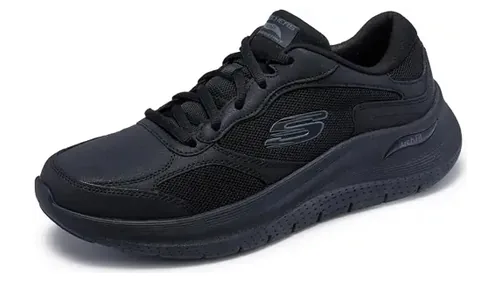
Skechers Work Arch Fit 2.0: Best retail work option when traction matters
Best for: Best retail work option when traction matters
Some stores, especially those with polished floors, food counters or occasional spills, require slip-resistant footwear. The Work Arch Fit 2.0 line is a more relevant starting point than a standard road-running shoe. Look at the exact Work model, outsole designation and your employer’s policy before buying; not every shoe bearing the broader Arch Fit name has the same traction properties.
For a fair comparison, wear the shoes indoors at the end of the day with your normal work socks. Spend time standing still, walk several lengths of a room, and turn as you would behind a register. Do not assume a premium price guarantees the best personal fit.
Who should skip it: Skip any model that lacks the specific safety features your employer requires. Make sure the arch contour feels natural rather than pushing into your foot during a long trial.
Specifications: Model-specific Skechers Work Arch Fit 2.0 slip-resistant construction; removable Arch Fit insole; shock-absorbing cushioned midsole; lace-up upper. Manufacturer listings for specific Work versions document SRO-rated traction on wet, dry and oily surfaces and ASTM F2892 electrical-hazard testing. Note: Safety ratings vary by exact Work Arch Fit 2.0 style; they do not apply to every Arch Fit shoe.
Crocs On The Clock Work Slip-On: Best easy-clean slip-on for service counters

Best for: Best easy-clean slip-on for service counters
For retail workers in pharmacy counters, deli-adjacent shops or stores where quick cleaning matters, an enclosed work slip-on may be more practical than a knit sneaker. The On The Clock provides an enclosed toe and heel, easy-clean construction and a slip-resistant outsole. Check whether your location permits clogs or slip-on styles, and try moving briskly in them before committing.
For a fair comparison, wear the shoes indoors at the end of the day with your normal work socks. Spend time standing still, walk several lengths of a room, and turn as you would behind a register. Do not assume a premium price guarantees the best personal fit.
Who should skip it: Skip if your job involves substantial brisk walking and you cannot achieve secure heel hold, or if your employer requires a different safety standard.
Specifications: Crocs On The Clock Work Slip-On, style 205073; enclosed toe and heel; relaxed forefoot with a tapered heel; enhanced arch support; Dual Crocs Comfort footbed; Crocs Lock slip-resistant tread. Crocs states ASTM F2913-24 testing and ASTM F3445-24 certification for this model. Note: This shoe does not have a protective toe.
Dansko Professional: Best firm rocker clog for stationary shifts

Dansko Professional (Image: Amazon)
Best for: Best firm rocker clog for stationary shifts
The Dansko Professional is a more structured choice for workers who stay in one place and prefer a firm, supportive clog over a soft running shoe. Its rocker-style shape and substantial upper can suit retail roles where clogs are permitted. It requires a careful fit check: the heel movement feels different from that of a laced sneaker, and the firmer platform is not universally comfortable.
For a fair comparison, wear the shoes indoors at the end of the day with your normal work socks. Spend time standing still, walk several lengths of a room, and turn as you would behind a register. Do not assume a premium price guarantees the best personal fit.
Who should skip it: Skip if you need to run stock across a large store, climb ladders frequently, or must wear lace-up protective footwear. Check the specific outsole and workplace slip-resistance requirements.
Specifications: Reinforced roomy toe box; contoured supportive footbed; padded instep collar; protective heel counter allowing controlled heel movement; rocker-bottom sole; leather upper with finish-specific cleaning needs. Firm rather than plush underfoot.
Hoka Clifton 11: Best lighter cushioned option for big stores

Hoka Clifton 11 (Image: Amazon)
Best for: Best lighter cushioned option for big stores
For sales-floor staff covering many aisles, the Clifton 11 provides a lighter-feeling alternative to the Bondi’s substantial platform. Its rolling ride can make it worth comparing with the Ghost 18 for repeated walks from register to stockroom. Do not choose by weight alone: a secure heel, sufficient toe room and the correct outsole for your workplace matter more.
For a fair comparison, wear the shoes indoors at the end of the day with your normal work socks. Spend time standing still, walk several lengths of a room, and turn as you would behind a register. Do not assume a premium price guarantees the best personal fit.
Who should skip it: Skip if your store requires tested slip resistance, a protective toe or a black leather-style upper. Some colourways may not meet an employer’s dress code.
Specifications: 8 mm drop; engineered knit upper; MetaRocker rolling geometry; cushioned midsole and lace-up closure. Intended as a road-running shoe, not a certified slip-resistant occupational model.
Retail-worker shoe FAQs
Start with stable cushioning and heel fit. The Brooks Ghost 18 and Hoka Bondi 9 are reasonable comparisons on dry floors where standard sneakers are allowed. If your store requires slip-resistant shoes, look at a work-rated model instead.
Often, yes, if your employer permits them and the store does not require specific safety footwear. Ordinary running-shoe rubber should not be treated as verified slip-resistant workplace traction.
The Bondi 9 may suit standing-heavy roles, while the Clifton 11 may appeal to workers who walk farther. Fit, dress code and workplace traction requirements decide whether either is appropriate.
Try the exact shoe in a manufacturer-offered wide fitting where possible. Toe shape, heel hold and swelling during the shift matter more than ordering a longer shoe.
It depends on workplace policies and exposure to slick or wet surfaces. Check the policy and the exact model’s stated safety features before buying.
Look for stable cushioning rather than the softest foam available. Excessively soft or poorly fitting shoes can feel unsteady while standing and turning.
Replace them when cushioning feels flat, the sole wears unevenly, grip declines, or the heel becomes unstable. The interval depends on hours worn, surfaces, walking distance and shoe construction.
For broader recommendations across professions, visit our best shoes for standing all day hub. If concrete floors are your main challenge, compare our shoes for walking on concrete. For role-specific safety rules, start with the work shoes hub.