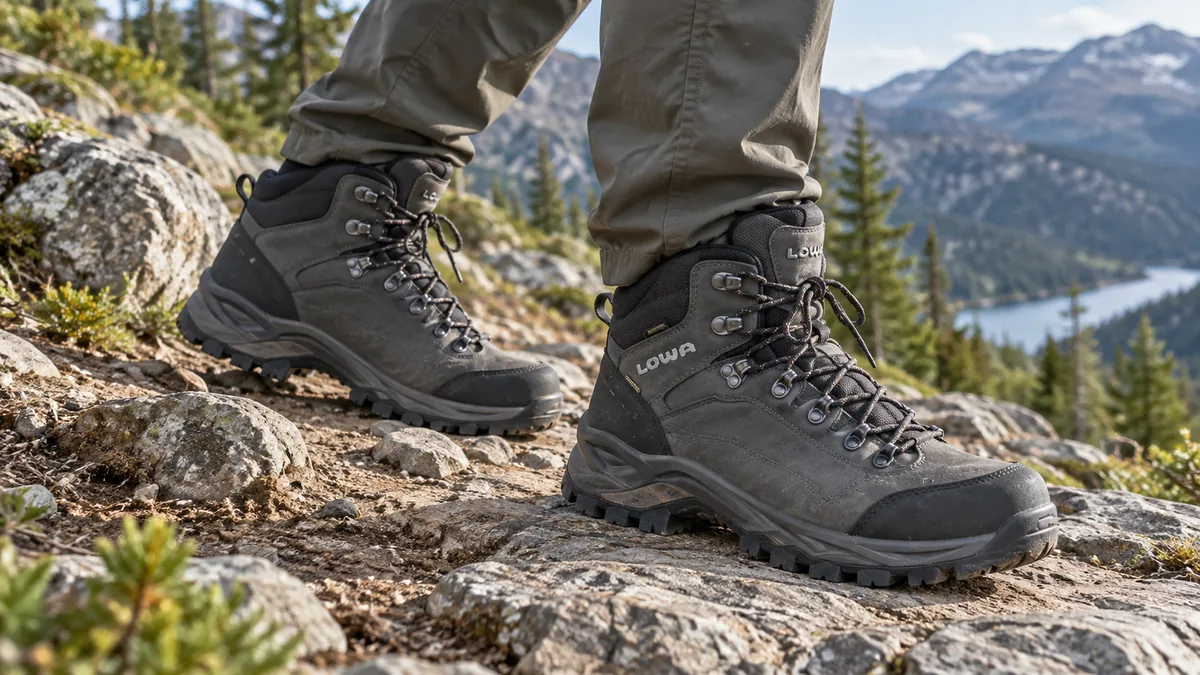
Quick Answer: Lowa Renegade Evo GTX Mid Review: The Lowa Renegade Evo GTX Mid is a midweight leather hiking boot for day hikes and backpacking trips on rough or wet ground. Its nubuck upper breaks in to a custom fit, its Gore-Tex lining keeps feet dry and its supportive frame and Vibram sole make it one of the most stable boots in its class. It comes in narrow, regular and wide, which few rivals match. The polyurethane midsole is firm rather than plush, and the boot feels heavy and a little clunky on easy trails.
Classic leather stability in three widths, with a firm ride and a heavy feel
The Lowa Renegade Evo GTX Mid is the current version of the Renegade, the German brand’s leather boot that has been a fixture on American trails for a quarter of a century. The Evo is Lowa’s update to that boot rather than a new model, and it keeps the recipe that made the original a bestseller: a full nubuck leather upper, a Gore-Tex lining, a stiff supportive frame and a Vibram outsole, in a mid-height cut that covers the ankle without climbing the calf. Lowa lists it at $280, and it has replaced the old Renegade GTX Mid at major U.S. retailers.
Within Lowa’s range it is the all-rounder, sitting above the brand’s light synthetic hikers and below its heavy backpacking and mountaineering boots. It is aimed at the hiker who wants one boot for most things: day hikes with a full pack, weekend trips, muddy fall trails and light winter walking. It is also one of the few premium hiking boots sold in a genuine choice of widths, which matters more to more people than any midsole technology.
If you are comparing this boot with other all-weather options, see our best boots for walking, outdoor work and wet or cold conditions. For lighter footwear, our best walking shoes guide is the better starting point.
Specs
Here are the specifications for the Lowa Renegade Evo GTX Mid:
| Type | Mid-height waterproof leather hiking and backpacking boot |
| Best for | Day hikes with a pack, backpacking, wet and rough trails, hard-to-fit feet |
| Upper | Heinen Terracare nubuck leather |
| Waterproofing | Gore-Tex membrane; PFC-free water repellent since January 2025, per Lowa |
| Midsole | Double-injection DuraPU and DynaPU polyurethane |
| Support | Lowa Monowrap frame |
| Outsole | Vibram Rene Trac rubber |
| Weight | 2 pounds 9.6 ounces per men’s pair, per the manufacturer’s listing; about 3.07 pounds in a size 14, independently measured |
| Widths | Narrow, regular and wide |
| Sizes | Men’s 7.5 to 15; women’s version also sold |
| Flood height | About 5.6 inches, independently measured |
| Price | $280 list as of 2026, with some retailers listing $265; Lowa does not publish a month-level launch date for the Evo update. Check latest price |
Pros
These are the strengths that have kept the Renegade in production for 25 years:
- Outstanding lateral support and ankle stability, which is exactly what you want under a heavy pack on uneven ground.
- A leather upper that stretches and molds to your foot over the first dozen hikes, so the fit improves with age.
- Three widths, a rarity in premium hiking boots, so wide and narrow feet can be fitted properly.
- Gore-Tex waterproofing behind full leather, with a tall enough cuff to wade shallow streams.
- Vibram Rene Trac outsole that bites into dirt and duff and wears slowly.
Cons
These are the compromises that come with a traditional build:
- The polyurethane midsole is firm and the boot could use more cushioning for long days on hard trail.
- It is heavy and stiff enough to feel clunky on easy trails and when stepping over deadfall.
- The upper is stitched from several leather panels, and those seams can catch and fray over years of hard use.
- It fits slightly short, so half-size decisions matter.
- Like every full-height Gore-Tex leather boot, it runs warm in summer.
What is new compared with the Lowa Renegade GTX Mid

The Evo is an evolution, and Lowa has kept the changes deliberately modest. The most meaningful is the midsole: the Evo uses a double-injection polyurethane construction, pairing a firmer DuraPU layer with a softer DynaPU layer, which Lowa says improves cushioning and shock absorption over the single-density sole of the old boot. Polyurethane is denser and longer-lasting than the EVA foam in most modern hikers, and it does not pack down over time, which is why the Renegade has always felt firm. The dual-density version takes a little of the edge off without changing that character.
The upper has been reworked with fewer seams, according to Lowa, to reduce pressure points and improve durability, though it is still assembled from multiple leather panels rather than a single hide. The leather itself is now Heinen Terracare nubuck, a tannery process marketed for its environmental standards, and Lowa dropped PFC chemistry from its water repellent at the start of 2025. Weight, width options, the Monowrap frame and the Vibram Rene Trac outsole all carry over. If you loved the old Renegade, the Evo will feel like the same boot with a slightly kinder midsole.
Who should buy the Lowa Renegade Evo GTX Mid
Buy the Renegade Evo if you want a boot that will still be on your feet in five years. It is the choice for hikers who carry weight, who hike in wet or cold conditions, who want side-to-side support on rocky and rooted trails and who prefer the feel of a leather boot that has shaped itself to them over the feel of a foam sneaker with a collar. Weekend backpackers, hunters, trail crews and people who hike the same muddy loop all winter are its natural owners.
It is also the boot to try if other premium hikers do not fit. The narrow, regular and wide fittings and the leather’s ability to stretch mean it accommodates feet that a single-width synthetic boot cannot. And for the hiker who values a proven design over the latest thing, the Renegade’s 25-year record is itself a reason to buy.
Who should probably skip it
Skip the Renegade Evo if you hike mostly on groomed trails with a light pack, in hot weather or at a fast pace. Its weight and stiffness are a burden when the terrain does not demand them, and its firm sole gives none of the plush, easy feel that a modern cushioned hiker offers over long miles. Skip it too if you like to scramble: the stiff leather and hefty sole are not nimble on boulders and slabs. And if you want a boot that needs no break-in at all, a synthetic boot will be comfortable sooner.
Here are three shoes and boots that suit those hikers better:
- Hoka Anacapa 2 Low GTX: thick, soft Hoka cushioning under a waterproof leather upper with a Vibram Megagrip sole, for hikers who want an easy, plush ride on long trail days (check price | read review)
- Merrell Moab Speed 2: a light, trail-runner-style hiking shoe with serious grip and no break-in, for fast day hikers who do not need an ankle collar (check price | read review)
- Salomon X Ultra 5 Mid Gore-Tex: a much lighter, more agile waterproof mid boot that still offers real stability, for hikers who want boot security without boot weight (check price | read review)
How does the Lowa Renegade Evo GTX Mid fit?
The Renegade Evo fits like a traditional leather boot: snug and structured at first, then increasingly personal as the leather gives. It runs a touch short, and with three widths on offer the sizing decision is worth taking slowly.
Fit and sizing
Lowa sells the Evo in narrow, regular and wide, in men’s sizes from 7.5 to 15, with a women’s version built on a women’s last, the foot-shaped form a boot is made around. The boot fits slightly short, so if you are between sizes, or if you like room for thick socks and downhill toe clearance, go up half a size. Width is the bigger decision. Regular suits most feet; wide is a genuine wide rather than a token one and is the reason many broad-footed hikers end up in a Renegade in the first place; narrow is rare enough in hiking boots that low-volume feet should not overlook it. The lacing runs through fabric loops low down and hooks at the ankle, and it is easy to pull snug. Heel hold is good once the leather has shaped to you.
Upper and step-in comfort

Step-in comfort is average on day one and excellent by hike ten, which is the leather-boot bargain. The nubuck is thick and firm out of the box, the padded collar and tongue are supportive rather than soft and the first few outings should be short. Then the leather begins to stretch and settle, the pressure points fade and the boot starts to feel like it was made for your foot. Synthetic boots do not do this; they feel the same on the last day as the first. Inside, the Gore-Tex lining is smooth, and the tall padded cuff holds the ankle without biting. Ventilation is what you would expect of full leather over a waterproof membrane, which is to say poor in summer heat.
How does the Lowa Renegade Evo GTX Mid perform?
The Renegade Evo performs like the workhorse it is: dependable on rough ground, dry through water, steady under load and unbothered by years of use. It is not fast, soft or light, and it does not pretend to be. The sections below cover each part of the boot in turn.
Cushioning and ride
Polyurethane is the key to understanding this boot’s ride. It is a denser, tougher material than the EVA foam in most hiking shoes, which means it lasts far longer and never goes flat, but it also means the boot feels firm underfoot from the first step to the last. The Evo’s dual-density construction softens the landing a little compared with the old Renegade, and the thick footbed helps, but nobody would call it cushioned. The upside is consistency: the boot feels the same at mile 12 as at mile one, and the same in year three as in year one. If you want a plush ride, this is not your boot. If you want one that never surprises you, it is.
Ride and trail performance
On steep, rooted and rocky trails with a pack on, the Renegade is at its best. The stiff sole and leather upper let you edge into slopes and pick your way across uneven ground with confidence, and the ankle flexes forward freely enough for climbing while resisting sideways roll. On easy, flat trail the same stiffness works against it; the boot feels heavy and slow to flex, and lifting it repeatedly over fallen trees or boulders gets tiring. It is a boot for terrain that needs a boot, and it rewards the hiker who uses it that way.
Stability and support
We would classify the Renegade Evo as a high-support boot, and support is its defining quality. Lowa’s Monowrap construction molds a large portion of the boot’s interior structure as one unit, so the midsole, the frame and the upper work together rather than as glued layers, which both supports the arch and keeps the sole from separating over time. The stiff leather sides and tall cuff give strong lateral hold, and the whole platform resists twisting. None of this changes how your foot rolls; it limits how far a misstep can go. Under a 30- or 40-pound pack on off-camber trail the difference between this boot and a soft hiking shoe is obvious, and it is the reason the Renegade remains a backpacking standard.
Outsole, grip and durability

The Vibram Rene Trac outsole uses an open lug pattern that bites well into loose dirt, gravel and forest floor and clears mud reasonably. It is a harder, longer-wearing compound than Vibram’s stickiest rubbers, so it is less sure-footed on wet rock and smooth granite slabs, which is the one situation where a softer-soled boot will beat it. Waterproofing is excellent. The Gore-Tex membrane sits behind full leather and the cuff floods at well over five inches, so the boot simply does not leak. Durability is the Renegade’s reputation and the Evo upholds it, with two caveats. The multi-panel leather upper has seams that sticks can catch and slowly fray, and the firm sole means the footbed is usually the first thing to wear out, which is cheap to replace. A well-cared-for pair should give several seasons of regular use.
Is the Lowa Renegade Evo GTX Mid good for walking?
For rough-weather and rough-ground walking, yes. As a winter dog-walking boot, a muddy-field boot or a trail-walking boot in a wet climate the Renegade Evo is superb: waterproof, warm, stable on slick ground and long-lived. Walkers who want ankle support on uneven country paths will appreciate it, and the three widths mean it fits people that other boots do not. It is not a shoe for pavement, for standing all day indoors or for summer strolls. It is heavy, the sole is firm and the leather-over-membrane build runs hot, so an hour on hard sidewalks in July will feel like work. Treat it as the boot you reach for when the ground is wet, cold or rough, and keep a lighter walking shoe for everything else.
Lowa Renegade Evo GTX Mid vs. Lowa Renegade GTX Mid
Here is how the Evo compares with the boot it replaces:
| Feature | Renegade Evo GTX Mid | Renegade GTX Mid |
|---|---|---|
| Midsole | Dual-density DuraPU and DynaPU polyurethane | Single-density polyurethane |
| Upper | Heinen Terracare nubuck, fewer seams per Lowa | Nubuck leather |
| Water repellent | PFC-free | Older chemistry |
| Outsole | Vibram Rene Trac | Vibram Rene Trac |
| Listed weight (men’s pair) | 2 pounds 9.6 ounces | 2 pounds 9.6 ounces |
| Widths | Narrow, regular, wide | Narrow, regular, wide |
| List price | $280 (some retailers $265) | About $255 before it was discontinued; not confirmed |
Buy the Evo, which is now the only Renegade in the range, when you want the slightly softer midsole and the current, cleaner chemistry. Buy the older Renegade GTX Mid only if you find a leftover pair in your size at a deep discount, because the two boots fit and perform almost identically and the old one has the longer proven record.
Lowa Renegade Evo GTX Mid Alternatives
The Salomon Quest 5 GTX is the modern rival. It offers similar support from a plastic chassis instead of a leather frame, weighs a little less and has a roomier toe box, and it is the pick if you want the stability without the break-in. It comes in one width, though, which is where the Renegade wins (check price).
If the Renegade’s firmness is the sticking point, the Hoka Kaha 3 GTX keeps the leather upper and the waterproofing but puts thick Hoka cushioning underneath. It is heavier and less traditional, and its comfort on a long day is in a different league (check price).
The Merrell Moab 3 Mid is the value option. It is softer, roomier and far cheaper, and it comes in wide, at the cost of the Renegade’s support, durability and full-leather protection. For casual hikers on moderate trails it is often the smarter buy (check price | read review).
Finally, hikers who like the Renegade’s leather classicism but want fewer seams and a lighter, more nimble feel should look at the Danner Mountain 600 Leaf GTX, a boot built from larger leather panels with a less aggressive tread (check price).
Price and value
Lowa lists the Renegade Evo GTX Mid at $280 as of 2026, with some retailers showing $265, and it does not publish a month-level launch date for the Evo update. That is at the upper end of the midweight boot market, above the Salomon Quest 5 and well above the Merrell Moab 3. What you are paying for is European manufacturing, premium leather, a polyurethane sole that will not pack out and a design that has proved itself for 25 years. Spread over the five or more seasons a well-kept pair should last, the cost per hike is low. Judged on first-day comfort per dollar, it loses to cushioned synthetics.
Final verdict
Best for: Backpackers, hunters and wet- or cold-weather hikers who want top-tier support and a leather boot that molds to their foot, especially those who need a narrow or wide fitting.
Avoid if: You hike fast and light on groomed trails, you want soft cushioning, you scramble a lot or you cannot stand a break-in period.
Fit: Narrow, regular and wide; runs slightly short, so go up half a size if you are between sizes or wear thick socks, and expect the leather to loosen and shape itself over the first dozen outings.
Verdict: The Lowa Renegade Evo GTX Mid is the classic midweight leather hiking boot, gently updated rather than reinvented. It is firm, heavy and slow to break in, and in return it is stable, waterproof, long-lived and available in widths that almost nothing else in its class offers. For the hiker it suits, it may be the last boot they need to think about for years.
Frequently Asked Questions for Lowa Renegade Evo GTX Mid
The Evo is an update rather than a new boot. It adds a dual-density polyurethane midsole for slightly better cushioning, a reworked nubuck upper that Lowa says has fewer seams and a PFC-free water repellent. Weight, widths, the Vibram Rene Trac outsole and the overall fit are essentially unchanged, and the Evo has replaced the original at U.S. retailers.
It runs slightly short. Most hikers should take their usual size, but anyone between sizes, or who wears thick socks and wants toe room on descents, should go up half a size. The boot is offered in narrow, regular and wide, so choose the width to match the ball of your foot rather than sizing up for width.
Plan on several short hikes, roughly a dozen outings, before the nubuck leather has stretched and settled to your foot. The boot is wearable from day one but feels firm and structured at first, and most owners find it noticeably more comfortable after those first hikes.
Yes. Lowa makes the Renegade Evo in a genuine wide fitting alongside regular and narrow, and the leather upper stretches a little with wear. That combination makes it one of the better premium hiking boots for broad feet.
Yes. It has a Gore-Tex membrane behind a full nubuck leather upper, and the cuff sits well over five inches above the ground, so the boot stays dry through wet grass, mud and shallow stream crossings. Water can still enter over the top of the cuff in deeper water.
Brush off dry mud after each hike, clean with water and a soft brush when needed and let the boots dry away from direct heat. Reapply a nubuck-safe waterproofing treatment when water stops beading on the leather. Well-kept nubuck will last many seasons; leather left caked in mud or dried by a heater will crack and wear early.
Yes. Its firm platform, Monowrap support frame, leather upper and mid-height cuff make it well suited to backpacking and day hikes with a loaded pack. Hikers who prioritize low weight or very soft cushioning may prefer a lighter boot.