Last Updated on October 5, 2026
Quick Answer: The Brooks Adrenaline GTS 25 is our best walking shoe for overpronation in 2026 because it balances cushioning, a stable platform and GuideRails support without feeling overly corrective. Choose the Asics Gel-Kayano 33 for more cushioning, Hoka Arahi 9 for streamlined stability, New Balance Fresh Foam X 860v15 for width options, or Saucony Guide 19 for gentler guidance. Not everyone who pronates needs a stability shoe, so comfort and fit still matter. Compare all five picks.
Overpronation occurs when the foot rolls inward excessively as you walk or run. Some pronation is a normal and necessary part of the gait cycle, but excessive inward movement can contribute to foot fatigue and may be associated with discomfort in the feet, ankles, knees or lower legs.
The right shoe will not permanently change the structure of your foot, and not everyone who pronates needs a stability shoe. However, people who experience symptomatic overpronation may find that a stable platform, secure heel and appropriate arch support make walking more comfortable.
Modern stability footwear has also changed significantly. Many of the best shoes no longer rely on the firm medial posts that were common in older motion-control shoes. Instead, manufacturers increasingly use wider platforms, shaped midsoles, sidewalls and guidance systems that manage movement without making the shoe feel rigid.
Here are our current walking picks for 2026. If you want a broader list that also includes running-focused and maximum-support models, see our best shoes for overpronation. For the gait mechanics and common causes, use our overpronation guide.
How to choose shoes for flat feet and overpronation
Flat feet describe arch shape, while overpronation describes how the foot moves during a step. Flat feet and overpronation are not the same: low arches do not automatically mean you need a stability shoe, and people with higher-looking arches can still overpronate. Start with your symptoms, gait and comfort rather than arch height alone.
Use these five checks before choosing a pair:
- Start with symptoms. If you have no pain, unusual fatigue or sense of instability, you may not need extra correction. Persistent pain or repeated problems deserve professional assessment.
- Match stability to your gait. A neutral shoe can work if your foot feels controlled; choose more guidance when inward rolling is connected with discomfort or instability.
- Check heel and midfoot security. Your heel should stay in place and the midfoot should feel supported without pinching, rubbing or aggressive pressure under the arch.
- Match width and toe room. Support does not compensate for a shoe that is too narrow. Your forefoot and toes need enough room to sit naturally.
- Test the shoe for the activity you actually do. Walk at your normal pace and consider the surface, whether that is pavement, a treadmill or hard floors. The best choice should still feel stable and comfortable after more than a few minutes.
If you need more background on gait mechanics, see our overpronation guide. If arch shape is your main concern, use the flat-feet hub to choose the guide that matches your activity.
Best Walking Shoes for Overpronation Compared
Shoe (review is linked) | Best for | Guidance level | Walking situation | Check Price on Amazon |
|---|---|---|---|---|
Best overall | Moderate | Daily walking, travel, treadmill | ||
More cushioning and support | Moderate to strong | Long walks, pavement, high-mileage days | ||
Less bulky stability | Moderate | Daily walking, brisk walks | ||
Wide feet | Moderate | Long walks when fit and width are priorities | ||
Gentler guidance | Mild to moderate | Everyday walking, walkers who dislike rigid support |
Brooks Adrenaline GTS 25
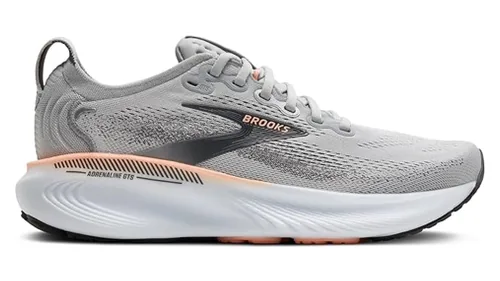
Best for: Overall support
The Brooks Adrenaline GTS 25 is our best overall walking shoe for overpronation because it strikes a particularly good balance between support, cushioning and everyday usability.
Brooks specifically lists walking among the intended uses for the Adrenaline GTS 25, rather than positioning it exclusively as a running shoe. That matters for walkers who want a supportive athletic shoe without buying something designed primarily around faster running.
The Adrenaline uses Brooks’ GuideRails technology to help keep excess movement under control. Instead of a hard medial post under the inside edge of the foot, GuideRails work around the foot to encourage a more controlled path while still allowing natural movement.
Brooks also added more nitrogen-infused cushioning beneath the heel and forefoot for this generation. The resulting ride is cushioned without being excessively soft, which is useful for overpronators who may feel unstable in shoes with highly compressible foam.
The men’s version has a 10 mm heel-to-toe drop, and Brooks offers several width choices.
Some of the most useful features for walkers include:
- GuideRails structured support
- Balanced nitrogen-infused cushioning
- Secure heel and midfoot fit
- Breathable mesh upper
- Multiple width options
The Adrenaline GTS 25 is a particularly good choice for daily walking, treadmill use, travel and long periods spent on your feet. It can also serve as a running shoe if you use the same pair for both activities.
Its main limitation is that walkers who prefer an extremely plush shoe may find the cushioning more controlled than luxurious. For considerably more softness underfoot, look at the GEL-KAYANO 33 (below).
Asics Gel-Kayano 33
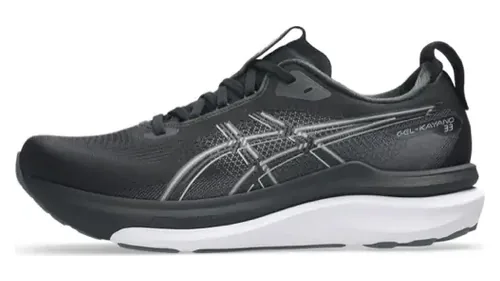
Best for: Maximum cushioning
The Asics Gel-Kayano 33 is one of the biggest stability-shoe updates of 2026 and our choice for walkers who want maximum cushioning combined with substantial support.
The major change is Asics’ FLUIDSUPPORT technology. The system is designed to respond to changing support needs during different stages of a stride rather than simply placing a firm piece of foam beneath the inner side of the foot.
Asics combines FF Blast Plus and FF Blast Max foams in the midsole. That gives the shoe a softer, highly cushioned feel while retaining the broad platform and support expected from the Kayano series.
The Gel-Kayano 33 has an 8 mm heel-to-toe drop and is classified by Asics as both a neutral and stability shoe, reflecting the industry’s move toward less intrusive guidance systems.
For walkers, the combination is particularly appealing if pavement or long distances leave your feet feeling beaten up.
Useful Gel-Kayano 33 features include:
- FLUIDSUPPORT adaptive guidance
- FF Blast Max cushioning
- FF Blast Plus foam
- 8 mm heel-to-toe drop
- Multiple width options
The downside is size and feel. The Kayano is a substantial shoe, and people who prefer to feel closer to the ground may find it excessive.
For long-distance walking, however, the combination of cushioning and support makes it one of the strongest options available.
You can also see our comparison of Asics Gel-Kayanoi generations if you are upgrading from an older version.
Hoka Arahi 9
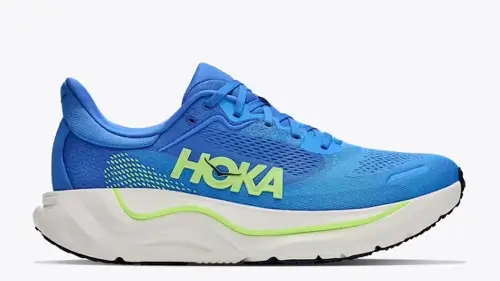
Best for: Cushioned stability without excessive bulk
The Arahi 9 is Hoka’s current streamlined stability shoe and one of the most interesting choices for overpronators in 2026.
Hoka specifically identifies walking as one of its intended uses. The Arahi 9 also uses an enhanced version of Hoka’s H-Frame technology, a stability system designed to manage overpronation while allowing the foot to enter and move through the gait cycle smoothly.
This is important because the Arahi has changed considerably over recent generations. Older versions used Hoka’s J-Frame technology. The current Arahi 9 should not be described as a J-Frame shoe.
The enhanced H-Frame works with a dual-density compression-molded EVA midsole. Hoka also uses an engineered mesh upper with tighter construction along the medial side of the shoe to provide additional support.
Its 8 mm heel-to-toe drop is also higher than some older Arahi generations.
Key features include:
- Enhanced H-Frame stability technology
- Dual-density EVA cushioning
- 8 mm heel-to-toe drop
- Supportive engineered mesh upper
- Durable high-abrasion rubber outsole
The Arahi 9 feels different from traditional heavy motion-control footwear. It is designed to provide support while retaining the cushioned, rolling sensation associated with Hoka. That makes it a strong option for walkers who have previously disliked stiff stability shoes.
People who want even more structure and a larger platform should also consider the Hoka Gaviota, but the Arahi 9 is the better choice when you want support without as much shoe around your foot.
New Balance Fresh Foam X 860v15

Best for: Width options
The New Balance Fresh Foam X 860v15 replaces the 990v6 in our updated list because the 860 is purpose-built as a stability shoe and is a much more logical recommendation for someone specifically searching for footwear to manage overpronation.
New Balance combines Fresh Foam X cushioning with its Stability Plane technology. The Stability Plane is designed to support the foot without eliminating the comfortable cushioning that makes Fresh Foam appealing.
The shoe also uses a rocker profile. This means the sole curves to encourage the foot to move forward through the stride rather than requiring as much flex through the forefoot.
For walking, one of the 860v15’s biggest advantages has little to do with flashy technology: New Balance makes it in an unusually useful selection of widths.
Depending on the men’s or women’s version, options extend from narrow through extra wide. That is important because a supportive shoe can only work properly if your foot actually fits on the platform.
Key characteristics include:
- Stability Plane support
- Fresh Foam X cushioning
- Rocker-shaped sole
- Secure traditional lace-up upper
- Extensive width availability
The 860v15 feels substantial underfoot, so it is not our first choice for someone looking for a particularly light walking shoe. It is much more compelling for walkers who value a stable foundation, cushioning and the ability to select a width that actually matches their foot.
People with wide or narrow feet should put this model high on their list.
Saucony Guide 19
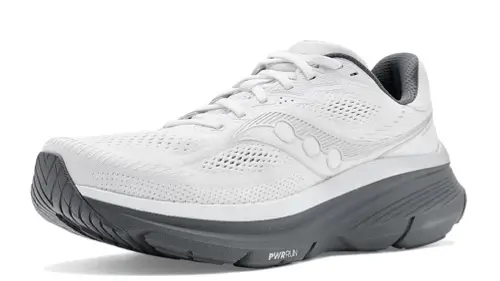
Best for: Natural-feeling guidance
The Saucony Guide 19 takes another modern approach to controlling excessive movement.
Instead of an old-fashioned medial post, Saucony uses CenterPath technology. The system combines a broad platform, elevated sidewalls and shoe geometry to guide the foot while keeping the ride relatively natural.
That can be particularly attractive to walkers who know they need more support but dislike feeling a hard or intrusive structure beneath the inside of their arch.
Saucony also updated the PWRRUN cushioning for the Guide 19, giving the shoe a softer feel than earlier generations. The shoe provides a substantial amount of cushioning while retaining the stable geometry that defines the Guide line.
It has a 6 mm heel-to-toe drop, with a manufacturer-listed stack of 35 mm at the heel and 29 mm at the forefoot.
Useful features include:
- CenterPath guidance technology
- Softer PWRRUN cushioning
- Broad, stable platform
- 6 mm heel-to-toe drop
- Regular, wide and extra-wide versions
The Guide 19 occupies an interesting middle ground. It provides more guidance than a conventional neutral shoe without feeling like a traditional motion-control model.
If you want to understand what PWRRUN is and how it differs from other materials used in modern walking and running shoes, see our complete running shoe foam guide.
Can You Wear Running Shoes for Walking?
Yes. In fact, all five of our top selections come from product families that are primarily marketed as running shoes. Good running shoes can make excellent walking shoes because they typically offer lightweight construction, cushioning, durable outsoles and sophisticated stability systems.
Brooks and Hoka explicitly list walking as an intended use for the Adrenaline GTS 25 and Arahi 9. The main consideration is how the shoe feels at walking speed. You do not need a racing shoe, carbon plate or highly aggressive rocker simply to walk comfortably For overpronation, stability and fit matter more than whether the box says “running” or “walking.”
Should You Use Insoles or Orthotics?
Some people who experience symptomatic overpronation benefit from an insert or orthotic.
If you already use an orthotic, look for a shoe with sufficient internal space and preferably a removable factory insole. An orthotic can take up additional room, especially around the heel and midfoot.
Be careful about assuming that combining the most aggressive stability shoe with the most corrective insert will produce better results. Too much intervention may feel uncomfortable or change how your foot moves.
If your orthotics were prescribed, ask the professional who prescribed them about appropriate footwear.
See our guide to insoles and inserts for foot health for additional options.
Try Walking Shoes Later in the Day
Feet can become larger after hours of standing and walking, so the fit you experience first thing in the morning may not represent how a shoe feels after several miles.
Whenever possible, try shoes later in the day and wear the socks you normally use for walking.
Walk around for several minutes. Pay attention to heel slipping, pressure against the arch, toe room and whether your foot feels stable as you move through each step.
A supportive walking shoe should generally feel comfortable when you try it on. Do not buy a painful shoe on the assumption that it will eventually break in.
If you are ordering online, make sure you understand the retailer’s return policy before wearing the shoes outdoors.
When to Get a Professional Gait Assessment
You do not necessarily need a professional gait analysis simply because your feet pronate. If you have persistent pain, recurring injuries, a noticeable change in your gait or difficulty finding comfortable footwear, however, an assessment may be useful.
A podiatrist or other qualified health professional can evaluate your feet and gait in a clinical setting. Specialty running stores may also offer gait observation, treadmills or pressure-mapping systems, although a retail assessment should not be confused with a medical diagnosis.
Persistent foot, ankle, knee or lower-leg pain should be evaluated rather than treated indefinitely by experimenting with different shoes.
Frequently Asked Questions About Walking Shoes for Overpronation
Our best overall choice is the Brooks Adrenaline GTS 25. It provides structured GuideRails support, balanced cushioning, multiple width options and a design Brooks specifically recommends for walking as well as running.
The Hoka Arahi 9 is the current Arahi generation in 2026. It uses enhanced H-Frame technology designed to help manage overpronation while maintaining a cushioned and relatively streamlined ride.
Yes. Hoka specifically lists walking among the intended uses for the Arahi 9. Its enhanced H-Frame stability system and cushioned platform make it particularly relevant for walkers seeking additional support.
The Asics Gel-Kayano 33 is our choice for maximum cushioning. It combines FF Blast Max and FF Blast Plus foam with Asics’ FLUIDSUPPORT guidance system.
The New Balance Fresh Foam X 860v15 is one of the strongest choices because New Balance offers it in several widths. Saucony also offers the Guide 19 in regular, wide and extra-wide versions.
No. Flat feet describe the shape or height of the arches, while overpronation describes how the foot moves during the gait cycle. The two frequently occur together, but having flat feet does not automatically mean you need stability footwear.
Stability shoes are designed to guide or limit excessive movement while you are wearing them. They do not permanently correct the structure of your foot. More about stability shoes.
Not necessarily. Motion-control shoes generally provide stronger intervention and may be useful for some people, but many walkers are more comfortable in modern stability shoes that provide guidance without feeling excessively rigid.
Yes, provided the shoe has enough room and the combination is comfortable. Shoes with removable insoles are generally easier to use with orthotics. If you have prescription orthotics, follow the footwear advice provided by your health professional. More about orthotics.
Consider professional assessment if you experience persistent foot, ankle or leg pain, recurring injuries, significant difficulty walking comfortably or a noticeable change in your feet or gait. Shoes can provide support, but persistent symptoms should not simply be treated by repeatedly changing footwear.