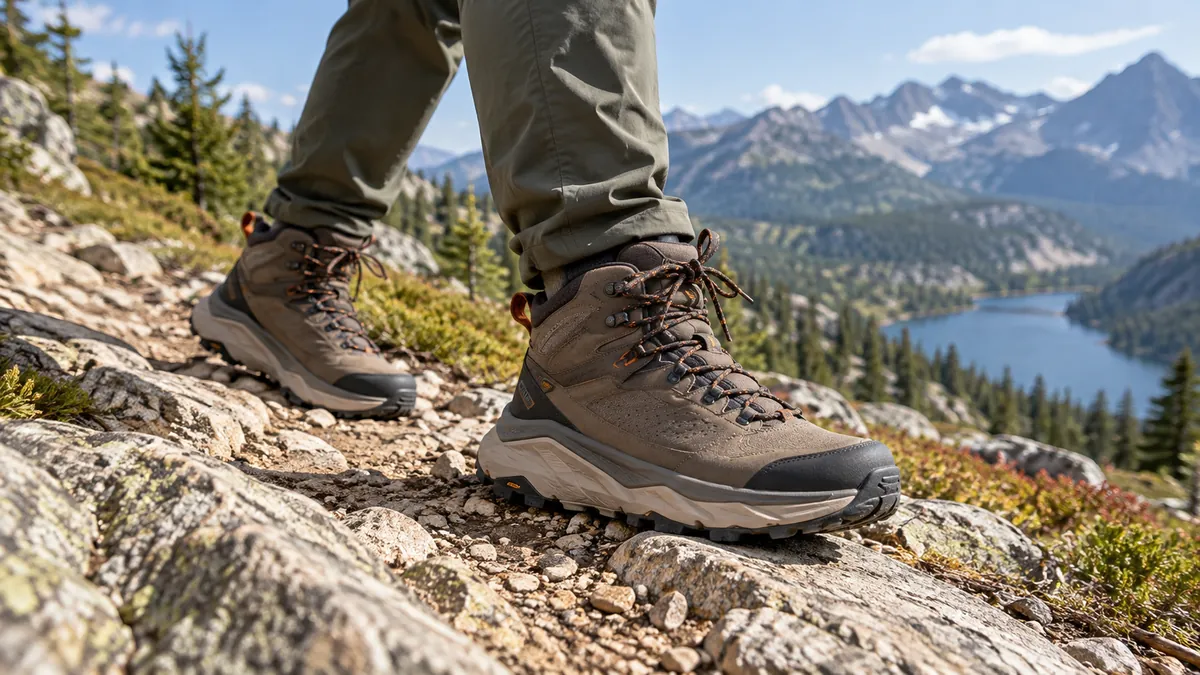
Quick Answer: Hoka Kaha 3 GTX Review: The Hoka Kaha 3 GTX is a waterproof, mid-height hiking boot for people who want running-shoe comfort on long days on the trail. Its thick, two-layer foam midsole gives it a soft, forgiving feel that is rare in a leather boot, a Gore-Tex lining keeps your feet dry and a Vibram Megagrip sole holds on wet rock and loose dirt. The trade-offs are weight, warmth on hot days and a snug fit: Hoka itself suggests going up a half size, and there is no wide option. Check latest price.
The Kaha 3 GTX is the top hiking boot in Hoka’s lineup. Hoka calls it a long-haul adventure hiker for day hikes and multiday trips, and it takes the brand’s big idea from running shoes, lots of soft foam under your foot, and puts it inside a waterproof nubuck leather boot. There is also a Kaha 3 Low GTX, a shoe-height version, but this review covers the mid-cut boot that wraps above your ankle bone.
If you have ever finished a long hike with sore, beaten-up feet in a stiff traditional boot, the Kaha is aimed squarely at you. It is built for weekend hikers, backpackers and long-distance trail walkers who care more about how their feet feel at mile 10 than about saving every ounce.

Hoka Kaha 3 GTX men’s hiking boot in Gravel and Cement. Image: Amazon
Specs
Here are the specifications for the Hoka Kaha 3 GTX:
| Type | Waterproof mid-cut hiking boot with max cushioning |
| Best for | Long day hikes, multiday trips, wet trails and hikers who want a soft ride |
| Upper | Waterproof nubuck leather with recycled polyester mesh, rubber toe cap and molded heel counter |
| Waterproofing | Gore-Tex Invisible Fit, a membrane bonded to the upper rather than a loose inner sock |
| Midsole | Dual-density foam with 30% sugarcane-based EVA, plus a rockered sole with flex grooves |
| Outsole | One-piece Vibram Megagrip with 4 mm lugs |
| Heel-to-toe drop | 7 mm (men’s, per Hoka) |
| Weight | About 20 oz per boot (men’s, per Hoka) |
| Width | Standard width only |
| Fit advice | Hoka recommends going up a half size |
| Price | $240 at launch in early 2025. Check latest price |
Pros
- Far softer underfoot than a traditional leather boot, so your feet should feel fresher late in a long hike.
- The two-layer midsole pairs a soft top with a firmer base, which keeps the boot steady when you carry a pack.
- Vibram Megagrip rubber is one of the more trusted trail compounds for wet rock and slick roots.
- Gore-Tex keeps rain, puddles and wet grass out, and the bonded design avoids the baggy feel of a loose inner bootie.
- A rocker sole and an extended heel make long descents feel smoother.
Cons
- At about 20 oz per boot, it is heavy next to a hiking shoe or trail runner.
- It runs snug: Hoka recommends going up a half size, and there is no wide version.
- Like any waterproof boot, it gets warm in summer heat and dries slowly once water comes in over the top.
- The tall, soft platform gives you less ground feel on rocky scrambles than a lower, firmer boot.
What Hoka changed from the Kaha 2
Hoka describes the Kaha 3 as cushier and more durable than before, and the changes line up with that. The biggest one is the waterproofing. The Kaha 3 GTX is Hoka’s first mid-cut hiker with Gore-Tex Invisible Fit, where the waterproof layer is bonded directly to the upper instead of sitting inside the boot as a separate sock-like liner. For you, that should mean a closer, less bulky fit and fewer spots where a loose liner can wrinkle and rub.
Underfoot, Hoka switched to a dual-density midsole made with 30% sugarcane-based EVA, the light foam used in most sneakers, and says it has a bit more bounce than the Kaha 2. The outsole is now one piece of Vibram Megagrip, and Hoka added a molded heel counter and toe cap for durability. Small styling changes, such as beveled edges, slim the look down.
Kaha 3 GTX | Kaha 2 GTX | |
Waterproofing | Gore-Tex Invisible Fit, bonded to the upper | Gore-Tex membrane |
Midsole | Dual-density foam with sugarcane-based EVA, bouncier per Hoka | Earlier cushioned foam |
Outsole | One-piece Vibram Megagrip | Vibram Megagrip |
Toe and heel protection | Molded toe cap and heel counter | Earlier construction |
Buy the new model when you want the closer-fitting waterproofing, the bouncier foam and the tougher build, and when you are happy to try it on with a half size up. Buy the previous model when you find a Kaha 2 GTX in your size, already know it fits your foot and want to save some money; it is still a cushioned, waterproof boot with a Vibram sole.
Who the Kaha 3 GTX is a smart buy for
The Kaha 3 GTX makes the most sense if you hike long days or carry a pack, because that is when cushioning earns its keep. A loaded pack adds force to every step, and on hard-packed trail or rocky descents a stiff boot passes much of that jolt straight to your feet and knees. The Kaha’s soft top layer takes the edge off each landing, and the firmer base layer keeps that softness from turning wobbly under weight.
It also suits hikers in wet places. If your trails run through the Pacific Northwest, the Appalachians or anywhere with muddy spring and fall seasons, the combination of Gore-Tex and Megagrip rubber is exactly what you want. And if you already run or walk in Hoka shoes and love that cushioned, rolling feel, this is the most familiar-feeling hiking boot you can buy, just with leather, ankle coverage and real trail grip added.
Who should probably skip it
Skip the Kaha 3 GTX if you have wide feet. It comes in one standard width, and Hoka’s own advice to size up a half size tells you it runs snug. Going up in length can help, but it will not add much room across the ball of your foot. It is also more boot than you need for short, dry hikes on easy paths, where its weight and waterproof lining mostly make your feet hot. And if you only hike a few times a year, the launch price is a lot to pay for comfort you will rarely use.
If that sounds like you, start with one of these instead:
- Keen Targhee IV: a waterproof hiker known for a roomy, foot-shaped toe box, a better place to start if standard-width boots pinch (check price)
- Merrell Moab Speed 2: a light hiking shoe with trail-runner comfort and serious grip, a cooler and lighter choice for warm-weather day hikes (check price | read review)
- Columbia Newton Ridge Plus II Waterproof: a waterproof leather boot with ankle support at a fraction of the price, a sensible pick for occasional hikers (check price | read review)
Still not sure which kind of hiking footwear fits your feet and your trails? Our Free Shoe Finder asks a few quick questions and suggests shoes and boots that match.
Plan on a half size up: how the Kaha 3 GTX fits
Fit is the part of this boot to get right before anything else. On its US product page, Hoka recommends going up a half size from your usual size, which is unusual advice and worth taking seriously. A hiking boot needs a little extra room anyway, because feet swell over a long day and your toes slide forward on steep descents. If your toes touch the front of the boot when you stand, they will be jammed into it on the way downhill.
The Kaha 3 GTX comes in one standard width for men and women. The bonded Gore-Tex layer helps the upper hug your foot rather than feel baggy, which is good news for narrow and average feet. It also means there is less give across the forefoot, so if standard-width shoes usually feel tight across the ball of your foot, sizing up will mostly add length, not width. The nubuck leather will soften with wear, but do not count on it stretching into a wide fit. Our Hoka shoe sizing guide covers how the brand’s sizing compares across models.
Around the ankle, Hoka uses what it calls an Achilles-friendly collar, which is shaped to ease pressure on the back of your heel. Quick-lace metal hooks at the top make it easy to snug the boot around your ankle, and the cushy sockliner, the insole layer that sits on top of the midsole, adds a soft layer under your foot. Try the boots on in the afternoon with the socks you actually hike in, and walk down a ramp or a few stairs if you can.

Hoka Kaha 3 GTX hiking boot alternate angle. Image: Amazon
Soft underfoot, steady with a pack and grippy when it is wet
Hoka places the Kaha 3 GTX at the plush end of its cushioning scale, and that is the whole point of the boot. The midsole uses two densities of foam: a softer layer for comfort and a firmer one underneath for support. In practice, that combination should give you a cushioned, forgiving landing without the squishy, unstable feeling you get from a single soft foam once you add a heavy pack. Your heel sits about 7 mm higher than your toes, a moderate drop that feels natural to most walkers.
The sole is also shaped to help you move. Hoka uses a rocker, meaning the sole curves up at the toe and heel so your foot rolls forward instead of slapping down flat, and adds flex grooves so the boot still bends where your foot does. The heel has an extended, beveled shape Hoka calls the Hubble heel, designed to smooth out landings. That matters most on long downhills, which are usually where tired legs and stiff boots hurt the most.
Stability comes from the boot’s wide base and Hoka’s Active Foot Frame, which lets your foot sit down inside the midsole rather than perched on top of it. Think of it like sitting in a bucket seat rather than on a stool. That gives you a secure, planted feel on uneven ground, but it is a stable neutral boot, not a corrective one, and no boot can fix how your foot moves. If you have ongoing foot, ankle or knee pain, a podiatrist or physical therapist is the right first stop.
For grip, the Kaha uses a one-piece Vibram Megagrip outsole with 4 mm lugs, the rubber teeth on the bottom of the boot. Megagrip is a sticky compound designed to hold on wet rock, and 4 mm lugs are deep enough to bite into mud and loose dirt without feeling clunky on hard-packed trail or pavement. In very deep mud or snow, deeper lugs grip better, but for most three-season hiking this is a confident setup.
The waterproofing does its job against rain, puddles and wet grass, with one catch shared by every waterproof boot: the same membrane that keeps water out also slows down how quickly sweat escapes, so your feet will run warm on hot days. If water ever pours in over the collar during a stream crossing, it will take a long time to dry. On durability, the one-piece outsole, rubber toe cap and molded heel counter are all there to help the boot hold up to rocks and scuffs, and Hoka’s leather comes from a Leather Working Group gold-rated tannery.

Hoka Kaha 3 GTX women’s hiking boot in Barley Flour. Image: Amazon
Is the Hoka Kaha 3 GTX good for walking?
Yes, if your walking happens on trails. For long walks on dirt paths, forest roads, gravel and rocky hiking trails, the Kaha 3 GTX is one of the most comfortable boots you can choose, thanks to the soft midsole, the rolling rocker sole and grip that holds when the ground is wet. It is a strong pick for travel days that include muddy country walks or long hikes, and for anyone who wants to keep their feet dry through a rainy fall season.
For everyday walking on sidewalks, it is more boot than you need. The weight, the warm waterproof lining and the ankle collar all work against you on flat pavement, and a cushioned walking shoe will feel lighter and cooler. Our guide to the best walking shoes is a better place to look for daily walks, and our best trail walking shoes guide covers lighter options for easy trails. You can also browse more boots and shoes in our hiking shoes hub and the rest of the lineup in our Hoka shoes guide.
Hoka Kaha 3 GTX Alternatives
If you like the idea of the Kaha but want a different trade-off, these are worth comparing.
The Hoka Kaha 3 Low GTX uses the same waterproof build, cushioning and Vibram sole in a shoe-height version that Hoka lists at about 17 oz. Pick it if you hike maintained trails without a heavy pack and would rather have a lighter, cooler shoe than ankle coverage (check price).
For a lighter Hoka hiker that still keeps your feet dry, the Hoka Anacapa 2 Low GTX pairs Gore-Tex and Vibram Megagrip with Hoka cushioning in a low-cut shoe. It suits faster day hikes where the Kaha’s weight would slow you down (check price | read review).
Heavier loads call for more structure. The Salomon Quest 5 GTX is a waterproof backpacking boot with a firm, supportive ride, a better fit for multiday trips on rough ground where you want more support than softness (check price | read review).
Those who prefer a traditional leather boot that molds to the foot over time should look at the Lowa Renegade Evo GTX Mid. It is firmer underfoot than the Kaha, but it shines under a loaded pack and suits hikers with hard-to-fit feet (check price | read review).
Price and value
Hoka launched the Kaha 3 GTX at $240 in early 2025, which puts it at the premium end of hiking boots. What that money buys is a genuinely high-end parts list: Gore-Tex in its closer-fitting Invisible Fit form, a full Vibram Megagrip outsole, gold-rated nubuck leather and a two-layer midsole that is far softer than most boots in its class.
It is worth it if you hike often, cover long distances or carry a pack, because comfort over many hours is exactly what this boot does better than cheaper options. If you hike a handful of times a year on short, dry trails, a less expensive boot or hiking shoe will cover you just fine. Check latest price.
Final verdict
Best for: long day hikes, multiday trips and wet trails, especially if you carry a pack and want a soft, cushioned ride.
Avoid if: you have wide feet, hike mostly in hot, dry weather or only need a boot a few times a year.
Fit: snug, standard width only; Hoka recommends going up a half size.
Verdict: The Hoka Kaha 3 GTX is the boot to choose when comfort over a long day matters more than weight. It brings Hoka’s cushioned, rolling feel to a waterproof leather boot with excellent grip, and the updates make it fit closer and feel bouncier than before. Get the size right, ideally by trying a half size up, and it is an easy boot to live with on the trail. Check the latest price.
Frequently Asked Questions for Hoka Kaha 3 GTX
No. Hoka sells the Kaha 3 GTX in one standard width. If standard-width boots usually feel tight across the ball of your foot, look at a boot or hiking shoe that is offered in a wide size.
No. It is waterproof but not insulated, so it works for cool, wet hikes rather than deep cold. For snowy winter hikes, look at Hoka’s winter-ready Kaha 2 Frost GTX or a dedicated winter boot.
Its cushioned, sneaker-like build should need less breaking in than a stiff traditional leather boot. Still, wear it around the house and on a few short walks before a long hike so you can spot any rubbing early.
They share the same waterproof build, cushioning and Vibram outsole. The Kaha 3 GTX is a mid-cut boot that covers your ankle, while the Low is a shoe-height version that is lighter and cooler but offers less protection from water, mud and debris.
Yes, for most hikers. The firmer lower layer of the midsole helps it stay steady under a pack, and the cushioning helps on long days. If you carry very heavy loads over rough ground, a stiffer, more structured backpacking boot may feel more supportive.
Brush off dried mud, wipe the nubuck with cool water and let the boots air dry away from direct heat. Reapplying a nubuck-safe water repellent now and then helps the leather shed water so the Gore-Tex layer can breathe.